
AI vs Manual Construction Takeoffs: Which Is More Accurate in 2026?
Manual takeoff wins on judgment. AI takeoff wins on consistency and speed. Neither wins outright, and the answer changes depending on plan quality, project type, and how many hours your estimator has already logged that week. Let’s assess it better with the help of a reality-based example.
Somewhere in the country right now, an estimator is squinting at sheet A-204 at eleven at night, trying to remember whether that mechanical room has already been counted. A few feet away, on the same desk, a laptop finished reading the same 120-page plan set eighteen minutes ago and is now just sitting there, waiting to be reviewed. That gap is the real shape of the AI vs manual construction takeoffs argument in 2026.
This guide walks through the accuracy data for both methods, section by section, so the decision stops being a gut call.
What Counts as a Construction Takeoff, and Why Does Accuracy Even Matter?
A construction takeoff is the process of measuring drawings to produce every quantity a project needs. It includes square footage of drywall, linear feet of conduit, cubic yards of concrete, counts of fixtures and doors.
Estimators call this “taking off” the plans, one item at a time. The output feeds directly into the bid, so a wrong quantity becomes a wrong price, and a wrong price becomes either a lost job or a losing one.
Accuracy is not a side detail here but the entire point of the exercise. Industry-wide, the numbers are blunt: 85% of construction projects globally run over budget, and 70% of U.S. projects specifically exceed their initial budget, per Budget Overrun Statistics 2026. A KPMG study covering the past three years found only 31% of projects landed within 10% of budget, and Autodesk pegs the average overrun across all project types at 27%.
How Does Manual Construction Takeoff Actually Work?
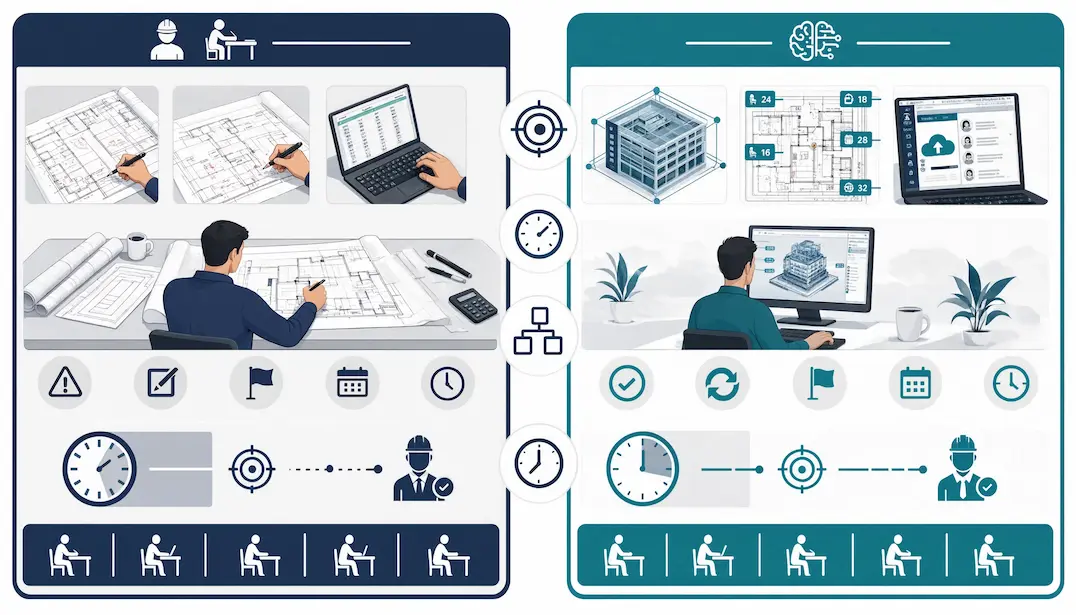
Manual takeoff hasn’t changed structurally in decades, even where the tools have moved from paper to a digitizer screen. An estimator opens the plan set, confirms scale, and works sheet by sheet, measuring and marking as they go. It’s methodical. It’s also entirely dependent on human bandwidth.
The Six-Step Manual Process
- Verify the scale on every sheet. A misread scale invalidates everything measured after it.
- Measure each area and linear run, and count using a scale ruler or an on-screen click-to-measure tool.
- Mark up the plans as items are counted, so nothing gets measured twice or skipped.
- Transcribe every measurement into a spreadsheet or estimate. It is a manual step with real transposition risk.
- Apply waste factors per material and re-check the math before pricing.
- Re-measure affected sheets from scratch whenever a revised plan set arrives.
Each step can turn out to be a common quantity takeoff mistake where fatigue, time pressure, or a missed addendum can quietly introduce error. None of the six steps is hard on its own. Doing all six, across sixty sheets, under a bid deadline, is where things slip.
Where Manual Takeoff Still Earns Its Keep
Manual work isn’t obsolete, and treating it that way misreads the data. It remains the stronger option for custom residential remodels, hand-sketched details, owner-supplied fixtures, and any scope small enough (commonly cited around the $150,000 mark) that software overhead outweighs the time saved.
An experienced estimator also catches things no current model catches: a spec note on page 47 that quietly changes the entire framing scope, or an architect’s dimension that doesn’t add up against the rest of the set. That kind of interpretive judgment is still a human specialty in 2026.
How Does AI Construction Takeoff Software Actually Work?
AI takeoff software does not read a plan the way a person does. It runs a trained object-detection model over the drawing, matching shapes, symbols, and schedule text to a library of known construction elements (walls, doors, ductwork, fixtures, MEP symbols), then converts what it finds into quantities.
Vendors including STACK, Autodesk Takeoff, Monaro, Beam AI, BuildVision AI, and Civils.ai all apply a version of this same underlying approach, trained on different slices of plan data and tuned to different trades.
What the AI Actually Reads Well
On a clean, vector-based PDF with standard symbology (the kind an architect issues for a straightforward commercial build), a good AI takeoff tool commonly extracts 80% to 90% of quantities without human intervention and does it fast.
| Experts’ Insight On Making Takeoffs Even Faster |
| Mechanical and HVAC-specific tools push this further on terminal equipment. Distributor-facing platforms report production-ready accuracy on diffusers, grilles, fans, and fixture counts once a schedule and floor plan are both present. Some vendors advertise accuracy figures as high as 99% on that narrow slice of scope. |
Where AI Quantity Takeoff Still Breaks Down
Scanned drawings, hand-marked revisions, and non-standard symbols are the model’s weak spots. The software either misses the item or flags it for review, which is exactly the correct failure mode, but it still means a human has to step in. Scope interpretation is the harder limit.
A spec calling for painted CMU in a food-service kitchen probably means epoxy coating, not standard latex, and an experienced estimator prices that correctly on instinct. An AI model has no such instinct unless the distinction is written explicitly into the drawing set it was given.
AI vs Manual Takeoff: The Accuracy Numbers, Side by Side
Here is where the debate gets specific instead of philosophical. On clean commercial plan sets, AI-generated quantities typically land within 3% to 7% of a final, human-verified quantity. It is a range broadly comparable to that of an experienced estimator working the same set without time pressure. The gap opens up once plan quality drops.
Under AACE International’s 18R-97 cost estimate classification, the accuracy of any estimate is governed primarily by the maturity of the underlying project definition, not by which tool produced the number: a Class 5 estimate at 0-2% design definition can run −50% to +100%, while a fully defined Class 1 estimate tightens to roughly −3% to +20%. Neither AI nor manual takeoff escapes that structural reality.
| Error Source | Manual Takeoff | AI Takeoff |
| Root cause | Fatigue, scale misreads and missed addenda | Non-standard symbols, scan quality, scope ambiguity |
| Error pattern | Random, worsens with hours worked | Systematic, repeatable and easier to audit |
| Typical variance (clean plans) | 3% to 10% depending on estimator experience | 3% to 7% against the final verified quantity |
| Typical variance (poor plans/scans) | Widens significantly; judgment can partly offset | Widens sharply; detection confidence drops |
| Catchable before bid submission? | Only through a second reviewer or fresh eyes | Yes. Flagged low-confidence items surface directly |
Hours Per Bid vs Minutes Per Plan Set
Speed is where the two methods separate most dramatically, and the gap has only widened since 2024. A mid-size commercial takeoff (a 20,000 to 60,000 square foot office or retail build) commonly takes a manual estimator 8 to 20 hours, depending on trade count and plan complexity. On the mechanical side specifically, a mid-size HVAC or plumbing takeoff typically runs 4 to 8 hours by hand, longer on larger sets.
Get AI-Assisted Construction Takeoffs Reviewed by Expert Estimators
| Method | Typical Time (Mid-Size Commercial) | Typical Time (HVAC/MEP Scope) |
| Paper takeoff (scale ruler) | 12 to 20 hours | 6 to 8 hours |
| Digitizer / on-screen takeoff | 8 to 14 hours | 4 to 6 hours |
| AI-assisted takeoff, human reviewed | 2 to 5 hours | 20 minutes to 2 hours |
| AI takeoff with outsourced QA layer | Same-day to 36-hour turnaround | 24 to 36 hours (QA-verified delivery) |
That’s not an incremental gain. On the contrary, it’s a 60% to 90% reduction in hours per bid, which is the real lever behind why AI-adopting firms report chasing more work without adding estimating headcount.
One commercial HVAC contractor reported cutting bid turnaround from five days to two after adopting an AI takeoff workflow, alongside doubled revenue over the same period. Numbers like that explain the adoption curve better than any marketing page does.
What Each Method Actually Costs Per Bid
Manual takeoff from a professional quantity surveyor has no software line item, which makes it look free until you price the hours. At a fully loaded estimator rate of $55 to $75 per hour, a 15-hour manual takeoff runs $825 to $1,125 in labor, per bid. Freelance estimators charge roughly $1,000 for a single 30-page manual takeoff, a useful market signal for the labor a GC would otherwise absorb in-house.
AI takeoff shifts the cost from hours to a subscription. General commercial AI takeoff platforms run roughly $200 to $800 per month, depending on feature depth and seat count. Trade-specific HVAC and mechanical takeoff tools tend to run lower per seat, commonly $85 to $150 per user per month, reflecting a narrower scope of detection. The ROI crossover for most mid-size GCs lands around three to four bids per month: below that volume, the math is close; above it, the subscription cost is typically recovered inside the first one or two bids through labor savings alone.
| Cost Component | Manual Takeoff | AI Takeoff |
| Per-bid labor cost (mid-size commercial) | $825 – $1,125 | $150 – $350 (review time only) |
| Monthly software cost | $0 (time-intensive instead) | $85 – $800 depending on trade scope |
| Freelance outsourcing benchmark | ~$1,000 per 30-page set | N/A — in-house, same-day |
| Break-even bid volume | N/A | ~3–4 bids/month for most mid-size GCs |
Does the Accuracy Gap Change by Trade? AI vs Manual for HVAC and MEP Takeoffs
General commercial takeoff and mechanical takeoff are not the same problem, and lumping them together understates how well AI performs on MEP work specifically. HVAC and plumbing takeoffs hinge on two tasks: reading an equipment schedule and counting symbols on a floor plan, since schedules almost never state final quantities themselves. That second task (repetitive symbol counting across dozens of sheets) is exactly the pattern-matching problem AI models handle best.
Terminal equipment counts (diffusers, grilles, fixtures, fans) are reported as production-ready for AI extraction by multiple mechanical-focused platforms; manual mechanical takeoffs, by contrast, can consume 50% to 80% of total bid-cycle time on complex jobs. Central plant equipment (chillers, AHUs, boilers) appears explicitly in schedules, so both methods extract it reliably. Ductwork routing sits in the middle: AI handles standard runs well but still benefits from a human pass on unusual routing.
- Terminal equipment (diffusers, grilles, fixtures): High AI reliability once the schedule and floor plan are both legible.
- Central plant equipment (chillers, AHUs, boilers): Reliable for both methods, since schedules list it explicitly.
- Ductwork and piping runs: Strong AI performance on standard layouts; human review still recommended on complex or field-revised routing.
- Addenda and revision tracking: A clear AI advantage with automated variance detection replaces a full manual re-measure.
AI Takeoff Software Compared: How the Leading Tools Differ in 2026
No single platform wins across every trade and project size. The right choice depends on plan volume, trade mix, and whether takeoff needs to plug into a broader estimating or bid-management workflow.
| Category | Best Suited For | Core Strength | Typical Limitation |
| General commercial AI takeoff | Multi-trade GCs, office/retail builds | Broad symbol libraries, PDF-native detection | Weaker on hand-sketched or scanned sets |
| Mechanical/HVAC-focused AI takeoff | Distributors, mechanical subcontractors | High accuracy on terminal equipment counts | Narrower scope; doesn’t cover architectural trades |
| Digitizer-style tools (e.g., PlanSwift) | Estimators wanting manual control, digitized | Full measurement control, low learning curve | Minimal automation; time scales with sheet count |
| BIM-integrated takeoff (e.g., Autodesk Takeoff) | Large GCs already on that ecosystem | Deep 2D/3D and model integration | Higher cost, steeper onboarding |
| QA-reviewed AI takeoff services | Firms wanting hands-off, verified output | Human-checked accuracy, fast turnaround | 24–36-hour delivery instead of instant |
The category distinction matters more than any single product name. A digitizer tool measured on-screen is faster than paper but still fundamentally manual. Genuine AI takeoff is a different category. That’s because detection happens automatically, and the estimator’s role shifts from measuring to reviewing.
Why Most Firms Run Both Methods in 2026
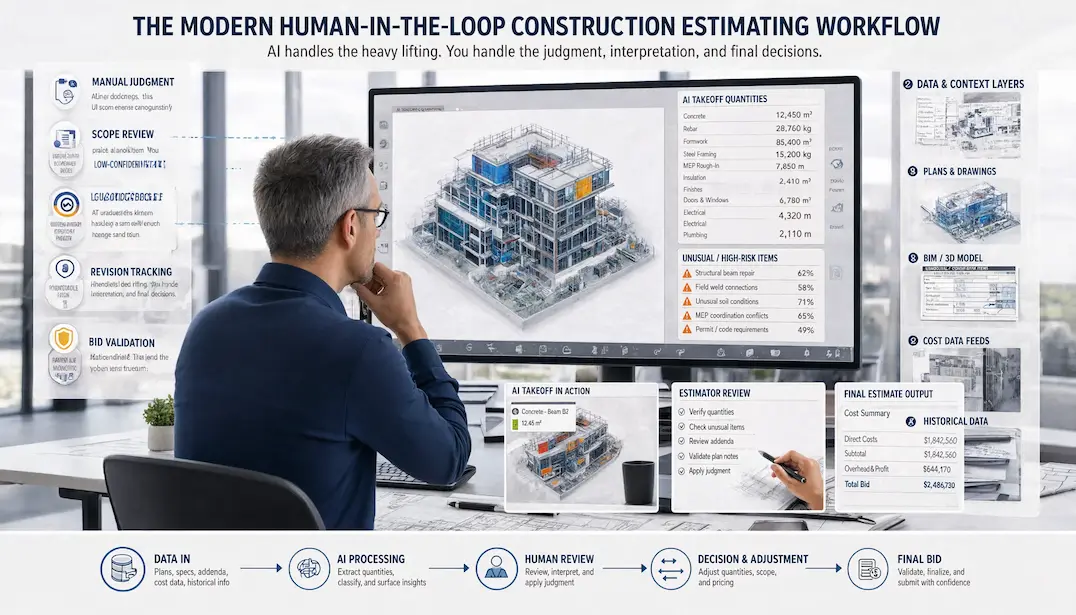
The honest answer to AI vs manual construction takeoffs isn’t either-or. It’s sequencing. AI handles volume and repetition; the estimator handles judgment, risk, and anything the drawings don’t spell out. Firms that have figured out that handoffs are bidding more work without burning out their estimating staff.
A Representative Example
A GC bidding on a 35,000-square-foot medical office project runs a 120-sheet PDF set through an AI takeoff tool. In roughly 90 minutes, it returns quantities across concrete, framing, drywall, ceilings, flooring, and rough MEP counts.
The estimator checks that output against the spec book, catches two line items where a non-standard wall assembly was undercounted, adjusts them manually, and builds subcontractor scope sheets from the corrected numbers. Total estimator time: about four hours, down from a 16-hour manual pass.
A Decision Framework: Trust the AI, or Override It?
Trust the AI Output When
The plan set is a clean, architect-issued PDF with standard symbology, the project type matches what the tool was trained on (commercial office, retail, multifamily, standard MEP), and the quantities cover straightforward assemblies like slab area, partition length, or fixture counts.
Override And Verify Manually When
Plans include hand-drawn details or unusual symbols, the project involves specialty systems such as clean rooms or data centers, site conditions aren’t reflected in the drawings, or the AI output varies by more than 10% from historical cost-per-square-foot benchmarks. A number that looks wrong against experience is a legitimate data point worth acting on, not something to talk yourself out of.
Frequently Asked Questions
Is AI takeoff more accurate than manual takeoff?
On clean, well-drawn plan sets, AI takeoff accuracy is comparable to that of an experienced manual estimator, typically within 3% to 7% of the final verified quantity. Accuracy drops for both methods as plan quality drops, but manual accuracy additionally degrades with estimator fatigue and time pressure in ways AI output does not. The strongest results in 2026 come from using AI as the first pass, then having an estimator review it before the number goes into a bid.
How long does a manual construction takeoff take compared to AI?
A manual takeoff on a mid-size commercial project runs 8 to 20 hours; the same scope through an AI takeoff tool with human review typically finishes in 2 to 5 hours. Mechanical and HVAC-specific takeoffs shrink further, from 4 to 8 hours manually down to as little as 20 minutes with dedicated AI tools.
Can AI takeoff software read scanned or hand-drawn plans?
Not reliably. AI detection models perform best on vector-based, digitally created PDFs. Scanned drawings and hand-sketched details reduce accuracy because the model works from lower-quality image data rather than clean vector geometry.
Is AI takeoff software worth the cost for a small contracting firm?
It depends on bid volume. Firms bidding fewer than two or three projects a month see a tighter ROI case, though time savings still matter if the estimator also wears a project manager’s hat. At four or more bids a month on projects over roughly $500,000, most firms recover the monthly subscription cost within the first one or two bids through labor savings alone.
Does AI takeoff software replace human estimators?
No. AI automates quantity extraction. It does not replace scope judgment, risk assessment, or the field experience that determines whether a number is actually buildable. The shift is in how estimator time gets spent: less time measuring, more time thinking through the bid, checking subcontractor scope, and pricing risk.
What is the biggest accuracy risk with each method?
For manual takeoff, it’s a fatigue-driven error on long sets. The kind that doesn’t surface until construction is underway. For AI takeoff, it’s silent scope gaps: the model extracts exactly what’s drawn, so any intent not explicitly on the page gets missed unless review catches it.
The Bottom Line
Neither method wins outright, and anyone selling a single-answer verdict is selling something. The practical 2026 answer is sequencing, not selection: let AI handle volume and repetition, let your estimator handle risk and interpretation, and treat any AI output that swings more than 10% from historical benchmarks as a flag, not a footnote. That handoff is what actually moves the accuracy needle. Sheet A-204 still needs a human eye. It just doesn’t need sixteen hours of one anymore.
If you want someone who actually knows when to use AI for material takeoffs and puts in the required amount of manual effort at the same time, call our construction estimating company. Our specialized quantity surveyors are your best bet to get accurate quantity takeoffs that reduce cost overruns and increase profit margins.