

Average Cost to Install Vinyl Plank Flooring (Per Sq Ft) | Budget + Pro Tips
Nothing throws a wrench in a home renovation like underestimating flooring costs. You may walk into the project thinking, “I’ll just lay some vinyl plank and call it a day,” only to be blindsided when the per-square-foot price creeps into double digits once labor, prep, and materials are all added up. According to Forbes Home, professional installation of vinyl plank flooring costs between $2.50 and $13 per square foot, with total project costs ranging from $250 to $4,600 per room and averaging around $2,400 per room.
This guide breaks every one of those variables down individually, with sourced, 2026-current pricing for materials, labor, subfloor prep, and room-specific projects, plus a side-by-side comparison of what the major cost-estimating sites are currently quoting, so you can sanity-check any contractor bid against real market data.
What “Per Square Foot” Actually Includes
A price “per square foot” sounds simple, but it hides a pile of different charges. Most people think it’s just the planks. It’s not. That number usually mixes several pieces together, and if you don’t know what they are, the final bill can jump fast.
Materials come first. The vinyl planks, yes, but also things you don’t notice in photos. These include underlayment, vapor barriers, trims, and those odd transition strips that bridge one room to the next.
Labor is the hands-on part. Cutting boards around vents, door frames, and odd corners. Clicking or gluing planks. Fixing tiny gaps. A few hours or a full day, installers fold that into the per-sq-ft rate.
According to Angi’s 2026 cost data, the average vinyl flooring installation project costs $2,561, with most homeowners spending between $1,009 and $4,115, and per-square-foot pricing ranging from $2 to $22 depending on the vinyl type, room size, and local labor rates.
Underlayment might be included or might not. Some products have it attached, others don’t. If the subfloor needs a moisture barrier or a sound layer, that cost sneaks into the number. And yes, taxes and small fees end up there, too.
Regional Differences and Complexity
Complexity matters just as much. Hard costs vs Soft costs are not the same. A flat room with clean edges? Easy. Fast. Cheap. A room with dips in the subfloor, weird angles, tight hallways, or stairs? That changes everything. Patterns like diagonal layouts or herringbone push waste higher, sometimes 10–15% more material. Subfloor repairs can add dollars per square foot on their own.
Complexity matters just as much. A flat room with clean edges? Easy. Fast. Cheap. A room with dips in the subfloor, weird angles, tight hallways, or stairs? That changes everything. Patterns like diagonal layouts or herringbone push waste higher, sometimes 10–15% more material. Subfloor repairs can add dollars per square foot on their own.
In short, that “simple” per-sq-ft number is really a summary of a lot of small decisions and conditions that stack together.
| Cost Component | Typical Range | Source |
| Material only (standard vinyl plank) | $2 – $7 / sq ft | Angi / This Old House, 2026 |
| Material only (luxury vinyl plank/LVP) | $3 – $10 / sq ft | Angi / This Old House, 2026 |
| Labor only (installation) | $1.50 – $4 / sq ft (floating); up to $10 / sq ft in high-cost markets | HomeAdvisor 2026; NEDES Estimating LVP Guide |
| Fully installed, budget tier | $3 – $5 / sq ft | Fixr.com; D&G Flooring, 2026 |
| Fully installed, mid-range | $5 – $8 / sq ft | Carpet Exchange, 2026 |
| Fully installed, premium/rigid-core | $8 – $13+ / sq ft | Forbes Home; HomeGuide, 2026 |
| 1,000 sq ft whole-home project | $3,500 – $17,000 | Today’s Homeowner; This Old House, 2026 |

Cost Breakdown Of Materials
Material pricing for vinyl plank isn’t one neat ladder. It feels more like three loose piles, and you pick whichever pile hurts your wallet the least.
The lowest-priced stuff (entry-level vinyl plank) usually runs $1.50 to $3.00 per sq ft. a range confirmed by Carpet Exchange’s and D&G Flooring’s 2026 pricing guides. It’s thin. It bends easily. It works fine in a guest room or a rental you don’t want to overspend on, but it won’t win any battles against dogs, sand, or rolling chairs.
The next batch is where most people land. Mid-range LVP, roughly $3.00 to $5.00 per sq ft, per Carpet Exchange’s 2026 flooring cost guide. Boards feel sturdier. The locking edges don’t crumble if you sneeze near them. It’s the category that doesn’t feel cheap but also doesn’t make you stare at your bank account afterward.
Then you move into the pricier bin. Rigid-core boards (SPC/WPC) or anything with a thick wear layer, often land from $6.00 to $12.00+ per sq ft, with Today’s Homeowner’s 2026 data confirming top-tier vinyl plank material can run as high as $15 per square foot. These planks don’t flex much. They hide a subfloor’s minor sins. Some people buy them for durability; others just like how solid they feel underfoot. Either reason is fine.
LVP vs LVT vs Sheet Vinyl
LVP (Luxury Vinyl Plank)
Pros: Looks like wood, easy to live with, handles moisture better than laminate.
Cons: Cheap versions show gaps when the room shifts in temperature.
LVT (Luxury Vinyl Tile)
Pros: Mimics stone or ceramic without the cold-foot problem.
Cons: More cuts, more edges, more chances to mess up if you’re installing it yourself.
Sheet Vinyl
Pros: One big roll, hardly any seams, fast.
Cons: You tear it once, that’s it. No small patch to fix it.
Wear Layer Thickness & What It Means
Wear layers look tiny on the spec sheet, but they’re basically the floor’s armor. Thin armor wears out. Thick armor sticks around.
| Wear Layer | Where It Fits | Effect on Price |
| 6–8 mil | Low-traffic rooms | Cheapest |
| 12 mil | Normal homes | Middle range |
| 20 mil | High-traffic homes, pets, rentals | Higher range |
| 22–30+ mil | Commercial or “I never want to redo this again” projects | Highest |
Cost Breakdown Of Labor & Installation Types
Labor is where prices start drifting. Two installers can quote totally different numbers for the same room, and it often comes down to the installation method and how fussy the job is.
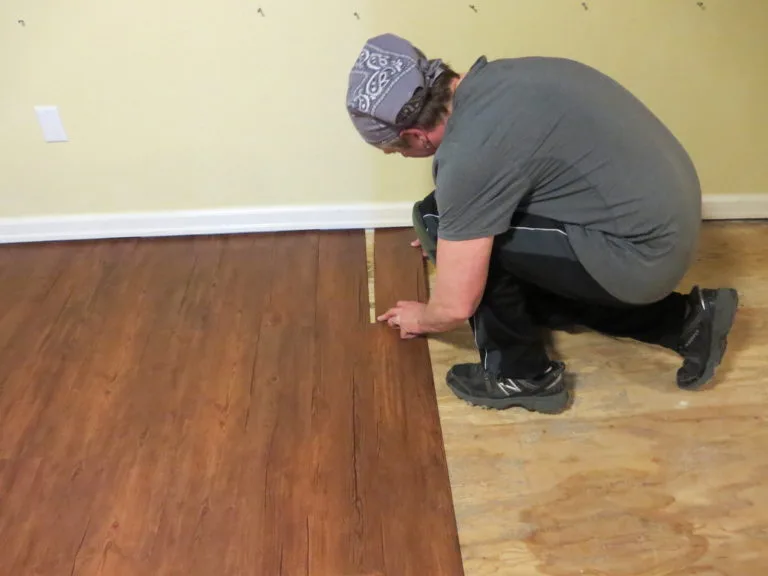
Click-lock floating floors sit on the low end of labor costs. They snap together, float over the subfloor, and don’t need glue. A lot of homeowners tackle these on their own. It’s mostly measuring, cutting, and keeping seams straight. Installers usually charge less for this method because it’s fast and predictable.
Glue-down floors are slower. They need adhesive, curing time, and a much cleaner subfloor. More scraping. More checking for high and low spots. Labor is higher here, plain and simple. Glue isn’t free either, and that cost gets folded into the job.
There’s also loose-lay vinyl and full-spread glue, but you’ll see those more in commercial buildings or big open spaces. They behave differently. Loose-lay just sits there with friction and weight, while full-spread glue is almost permanent once it’s down.
Rigid-core boards (SPC/WPC) behave differently from flexible LVP, too. The rigid ones cut slower and need more precise fits around door frames. Flexible planks bend into place more easily, which saves a tiny bit of time but not enough to shift the entire budget.
Most installers fall into similar labor ranges: $1.50 to $4.00 per sq ft for basic rooms. Add stairs, and the price per square foot climbs fast because stairs take forever. Patterns like herringbone or even a simple diagonal layout can double the cutting time. Thresholds, small closets, hallway turns, all the annoying spots push labor upward.
Get A Precise Cost Estimation From Our Team
Most installers fall into similar labor ranges: $1.50 to $4.00 per sq ft for basic rooms, consistent with 2026 labor-cost data from HomeAdvisor and NEDES Estimating’s own LVP cost guide. Add stairs, and the price per square foot climbs fast because stairs take forever. Patterns like herringbone or even a simple diagonal layout can double the cutting time. Thresholds, small closets, hallway turns, all the annoying spots push labor upward.
| Installation Method | Labor Cost / Sq Ft | Notes |
| Floating (click-lock) | $1.50 – $4.00 | Fastest and least expensive; no adhesive needed |
| Glue-down | +$0.50 – $1.00 more than floating | More stable but slower to install and to fix |
| Full-spread adhesive | Highest of the three | Common in commercial spaces and over radiant heat |
How Much Stuff’s 2026 calculator adds one more layer most estimates skip: underlayment and supplies, which run $0.30 to $0.60 per square foot for moisture barrier, transition strips, and adhesive, on top of a national average labor rate of $1.50 to $2.40 per square foot.
Rough Time Estimates by Room Size
Here’s how long installers typically spend on straightforward, click-lock projects:
| Tier | Wear Layer / Core | Price per Sq Ft (material) | Example Products |
| Budget | 6–12 mil, WPC core | $1.50 – $2.50 | TrafficMaster, Home Decorators Collection |
| Mid-range | 12–20 mil, SPC/WPC core | $2.50 – $4.50 | LifeProof, Shaw Floorte, COREtec basics |
| Premium | 20+ mil, rigid SPC core | $4.50 – $7.00 | COREtec Plus, Mohawk SolidTech, Armstrong Luxe Plank |
These times stretch if the subfloor needs patching or leveling or if the layout has too many tight corners.
Hidden / Overlooked Cost Drivers
The sticker price on the flooring box isn’t the whole story. A lot of the final cost hides in the stuff you don’t think about until someone points at your subfloor and frowns.
Subfloor prep is the big one. If the floor isn’t level, installers have to patch, skim, or pour leveling compounds. Moisture problems bring even more steps. These fixes can add $1 to $4+ per sq ft, sometimes more if the floor dips like a ski slope, in line with Today’s Homeowner’s reported $1.00–$6.00 per sq ft range for subfloor repairs and HomeAdvisor’s $3–$10 per sq ft for full subfloor replacement. People rarely budget for this part, but it’s unavoidable when the surface isn’t flat enough for vinyl.
Just like concrete setting, there’s the removal and disposal of the old floor. Carpets are easy. The tile is slow. Laminate sits somewhere in the middle. Hauling the debris costs money, too. Some installers charge per room, others calculate it by square foot. Either way, it’s rarely free.
Transitions, trims, and baseboards don’t cost much individually, but they add up. Baseboards run $5.50 to $11.00 per piece, and transition strips add a few more dollars per linear foot, according to HomeGuide’s 2026 cost breakdown.
If your home has radiant heat, that’s another layer of checks and materials. Not every vinyl plank works over heated floors. The ones that do sometimes need special underlayment or specific installation methods, which bumps up labor time.
And finally, the layout. Patterns like herringbone or diagonal installs create more waste and longer install times. Small rooms, oddly enough, slow things down because every edge demands another cut. Straight, open rooms are cheap. Anything fussy is not.
Cost by Room & Project Size
Costs shift from room to room. A floor that’s cheap in a big square living room can turn into a headache once you shove it into a tight bathroom.
Bathrooms tend to run higher. Lots of corners, pipes, weird cuts. Moisture checks. You’re usually looking at something in the $3 to $8+ per sq ft range when everything is added up, a range corroborated by HomeGuide’s and Angi’s 2026 per-square-foot vinyl cost data.
Kitchens aren’t much easier. Appliances in the way, cabinet legs, vents slow down the installer, and the price slides toward $3 to $7+ per sq ft — NEDES Estimating’s own 2026 LVP cost guide puts kitchen installs specifically at $4.50 to $8.50 per sq ft installed.
Basements are a wild card. Moisture decides the number more than anything else. A slab that sweats will need barriers or panels, and the job can land around $3.50 to $8 per sq ft, sometimes higher if leveling is required, consistent with 2026 industry averages reported by HomeGuide and Angi.
Open-plan rooms, on the other hand, usually cost less per square foot. Big spaces, fewer cuts. Installers move fast. Somewhere around $2.50 to $6 is common, per Fixr.com’s and HomeGuide’s 2026 installed-cost ranges.
And then there are stairs. These are basically their own category. Every step is its own tiny project. Expect $40 to $100+ per step, depending on trim and nosing — FlooringClarity’s cost data puts professional stair installation at a comparable $60 to $100 per step.
Waste Factor & Plank Size
No one gets away with buying the exact square footage. There’s always waste in the form of offcuts, miscuts, odd angles. A normal, straight layout usually needs 5–10% extra. Turn the planks diagonally or run a herringbone pattern and that jumps to 10–15%. D&G Flooring’s 2026 installation guide recommends budgeting 10% extra for straight-lay jobs and 15% for diagonal or herringbone layouts specifically.
Plank size affects this too. Big planks look great in open rooms but create awkward scraps in small bathrooms. Shorter planks fit tight spaces better but make large rooms look busier. There isn’t a perfect choice. Just tradeoffs.
Quick Example Budgets
Here are rough ballpark totals (materials plus average labor) for projects people ask about all the time:
150 sq ft bathroom: Somewhere around $600 to $1,400+. Tight spaces and moisture checks push the higher end (a range consistent with Angi’s and HomeGuide’s 2026 bathroom flooring cost data).
300 sq ft kitchen: Roughly $900 to $2,100+. Cabinets add a lot of small, annoying cuts (in line with 2026 per-square-foot kitchen data from NEDES Estimating and HomeGuide).
1,000 sq ft home (mostly open areas, normal layout): Usually $3,500 to $11,000+, according to Today’s Homeowner’s 2026 cost data. Glue-down and rigid-core installs sit on the higher half; floating installs on the lower, with premium products and full subfloor rebuilds pushing the priciest projects toward the $17,000 mark reported by Angi and This Old House.
These aren’t perfect numbers. Floors with dips or moisture issues can break any estimate. But they’re close enough to help you plan without guessing.
Best Vinyl Plank Types for Budgets & Use Cases
If you’re trying to match flooring to a budget or a specific room, the choices narrow pretty fast.
For tight budgets, the simplest option is basic LVP. It is the lightweight stuff you see stacked at big-box stores. LifeProof-style collections, for example, often float around $2 to $3.50 per sq ft, depending on color and stock. NEDES Estimating’s own LVP guide identifies LifeProof’s value-tier SPC line as one of the best-value rigid-core options at retail. These planks aren’t fancy, but they work. They’re easy to cut, easy to snap together, and good enough for spare rooms or rentals where the goal is “looks clean” rather than “built like a tank.”
When you want flooring that can take a beating, skip the flimsy board. Look for 20+ mil wear layers and a rigid SPC core. It also holds up to pets, kids, heavy traffic, and whatever else people drop on it. Price usually falls somewhere between $4 and $8+ per sq ft (D&G Flooring’s 2026 data prices this premium 20+ mil tier at $4.50 to $7.00 per sq ft for material alone, before labor), but the lifespan is longer, and it doesn’t get torn up easily.
Wet rooms need something different. 100% waterproof LVP is the go-to, but not everything labeled “waterproof” behaves the same. You want to look at the spec sheet for things like:
- Whether the edges are sealed or just click-locked.
- The temperature range it can handle without warping.
- Whether the manufacturer actually lists bathroom or basement use (some don’t, even though the planks resist water).
Good waterproof lines usually run around $3 to $6+ per sq ft, depending on thickness and core type, in line with HowMuchStuff’s 2026 SPC pricing data ($2–$6 per sq ft material plus $1.25–$2.00 per sq ft labor).
In short: cheap LVP for simple spaces, rigid-core for tough rooms, and the fully waterproof lines for anything that might get splashed or flooded.
Pro Tips to Save Money Without Losing Quality
- Watch for store sales. They pop up without much of a pattern. Sometimes a flooring line gets discounted because the store needs shelf space, not because anything is wrong with it.
- Check the contractor pallets in the back aisles. They’re usually plain boxes, not the glossy ones up front. Prices tend to be lower, and many are the same product families you see advertised.
- Always collect multiple installer quotes. The difference between the first and third estimate can be ridiculous. Patterns show up once you compare them side by side.
- Combine rooms into one job if possible. Installers often cut their per-sq-ft rate when they know they’re already there with all their gear.
- Don’t pick the thinnest wear layer just to save a couple dollars. A tiny upgrade in thickness keeps the floor from wearing out early.
- Let your planks sit in the room for a bit before installation. It keeps weird expansion issues from showing up later.
- Test the floor for moisture. Even a cheap test kit is enough to warn you when something isn’t right.
- Use the underlayment the manufacturer actually calls for instead of guessing. The wrong one can make the floor sound hollow or shift over time.
- Leave real expansion gaps. It feels strange but skipping this step causes buckling, especially in warm months.
- Stagger your seams. No patterns needed. Just avoid lining boards up like a repeating grid.
- When talking to installers, ask whether they offer a material allowance. Some do, but they don’t announce it.
- Bring up other quotes calmly. Just showing that you’ve compared prices sometimes nudges the installer to adjust their number.
DIY vs Hiring a Pro
Vinyl plank is one of the few flooring types where a careful DIYer can get a genuinely professional-looking result. According to Floorzi’s 2026 installation guide, professional labor alone runs $1.50 to $4.00 per square foot, meaning a 1,000 square foot project keeps $1,500 to $4,000 in your pocket by installing it yourself. D&G Flooring puts the savings on a 500 square foot room at $750 to $2,000.
ally.
Quick Comparison Table
| Situation | Cost Expectation | Notes |
| DIY (click-lock) | Only materials: about $2–$6+ per sq ft | Good for small rooms, minimal risk if you’re patient. |
| Pro install (click-lock) | Materials + labor: roughly $4–$9+ per sq ft | Cleaner fit; saves time; fewer headaches. |
| DIY (glue-down) | Often a bad idea | Hard to fix mistakes; adhesive waste can get expensive. |
| Pro install (glue-down) | Around $5–$12+ per sq ft | Needed for big spaces or any layout that must stay perfectly aligned. |
These per-square-foot figures align with 2026 installed-cost data from Fixr.com ($3–$11/sq ft), Forbes Home ($2.50–$13/sq ft), and HomeGuide ($2–$12/sq ft), which collectively show most residential installs falling within this band depending on quality tier and installation method.
Does Vinyl Plank Flooring Pay You Back at Resale?
According to NEDES Estimating’s LVP cost guide, which cites a Journal of Housing Economics (2021) study, durable, low-maintenance flooring installed in kitchens and bathrooms returns roughly 70 to 80 cents per dollar invested in resale value. D&G Flooring’s 2026 guide adds useful context: mid-range LVP typically recoups 50% to 70% of its installed cost at resale, compared to 70% to 80% for hardwood. So vinyl plank is a strong value play, but not a full substitute for hardwood if resale ROI is the primary goal.
The category is also growing fast: the global LVP market was valued at $51.7 billion in 2023 and is projected to reach $101.1 billion by 2032, according to Allied Market Research.
Frequently Asked Questions
Is vinyl plank waterproof?
Most modern LVP is waterproof, but the room still matters. Water can slip underneath if edges aren’t sealed well, so the install quality decides how reliable it feels long-term.
Can I install vinyl plank over tile?
Yes, if the tile isn’t wobbling and the grout lines aren’t deep. A thin leveling layer helps prevent the plank from sinking into those gaps.
How much extra flooring should I buy?
Add roughly 5–10% for straight layouts. Angled or patterned installs need more because the off-cuts waste faster, usually closer to 10–15%.
Will vinyl planks increase home value?
It can help, mainly by making the space look cleaner and newer. Buyers react to condition, not just flooring type, so installation quality matters.
How much does it cost to install 500 square feet of vinyl plank flooring?
Based on 2026 pricing from HowMuchStuff and Today’s Homeowner, a 500 square foot project typically runs $1,500 to $6,000 installed, depending on plank tier and subfloor condition.
Is vinyl plank flooring cheaper than laminate?
They’re comparable. Omni Calculator’s flooring cost data lists laminate at roughly $2 to $6 per square foot in materials, close to standard vinyl plank’s $2 to $7 range. It is the deciding factor is usually water resistance, since vinyl plank wins in wet areas.
What wear-layer thickness should I buy?
Today’s Homeowner recommends at least a 12-mil wear layer for high-traffic areas, moving up to 20+ mil for homes with pets, kids, or heavy foot traffic.
Does vinyl plank flooring need underlayment?
It depends on the product. Many LVP lines ship with attached cork or IXPE underlayment; if not, budget an extra $0.30–$0.60 per square foot, per HowMuchStuff’s 2026 calculator.
Can vinyl planks go on stairs?
It can, but it’s not an easy project. You’ll be trimming pieces constantly, and stair noses need exact cuts or the edges look sloppy.
How long does vinyl plank flooring last?
Entry-level planks may last around a decade. Better lines can push past 20 years if you don’t flood them, drag heavy furniture, or skip maintenance.
Do I need to remove baseboards first?
Not always, but removing them gives cleaner edges. Leaving them on works with quarter round, though it adds one more visual line along the wall.
Can heavy furniture damage vinyl planks?
Yes, pressure dents happen. Felt pads help, and spacing out weight keeps the floor from slowly sinking under big couches or full dressers.
The Bottom Line
So that’s the whole picture. It is messy in a few places, but at least you know what’s actually hiding inside those “per-square-foot” numbers.
Most projects land somewhere between $3 and $12 per sq ft once materials, labor, and the usual surprises get stacked together, a range that lines up closely with 2026 data from Forbes Home ($2.50–$13/sq ft) and Fixr.com ($3–$11/sq ft). Smaller rooms skew high because you still pay for trims and setup time. Bigger rooms even out a bit. Nothing mysterious, just math mixed with a few headaches.
Before you buy anything, get three quotes. Not two. Three. Ask for line-item details so you can see which installer padded where, and which one actually looked at your subfloor instead of guessing. It’s the easiest way to dodge the weird, inflated pricing that shows up when you only talk to one company.
If you want someone to run the numbers for your exact space (no fluff, no pressure) contact us for an ideal cost estimation. It only takes a moment, and it saves you from the endless guessing


