Best Drywall Access Panels for Commercial Construction: Types, Uses & Cost Impact
Commercial construction is a tough nut to crack from the beginning. Its maintenance, compliance with industry standards, and permit fees collectively make it a strenuous task. In fact, recent studies highlight that businesses spend $1.60 to $2.80 per square foot every year to maintain their commercial structures according to industrial codes. One of the best practices to reduce the maintainence is choosing the right elements for your infrastructure. If you are a contractor, developer, or architect on the hunt for the best drywall access panels, this blog is your best bet.
We will guide you through types, cost, uses, and their impact on your construction project in this write-up. But before all of that, let’s assess why drywall access panels matter in the real-world commercial construction.
What Are Drywall Access Panels?
Get behind the walls and ceilings of any business structure, and you will find this secretive universe of pipes, duct systems, wiring, and fire safety systems. An access panel for drywall is basically an opening cut into this kind of drywall surface.
The purpose of this is to allow easy access to these surfaces by way of maintenance, inspection, and upgrades of the systems without necessarily destroying the surrounding walls and ceilings. In simple terms, it is the connection between a well-planned building system and its users.
Common commercial uses of access panels for drywall include:
- Plumbing: pipe cleanouts, valves and water supply systems.
- Fire safety equipment: Fire dampers, sprinklers and alarm systems.
- General checking and maintenance: This allows the facility managers to do the checks without the costly demolition.
- Fire safety equipment: Fire dampers, sprinklers and alarm systems.
- Routine inspections and maintenance: This gives the facility managers permission to conduct checks without the expensive demolition.
Where to Use Drywall Access Panels
Drywall panels are not just an option. They are a strategic must-have. You will find them in every corner of a busy building. They keep things running. They make inspections easy. Most of all, they stop small leaks from becoming huge bills. Without their assessment, every construction estimating service would be just one broken pipe away from a total mess.
Common Uses in Commercial Jobs:
- Offices: Hide your data cables and HVAC parts behind a door. Good access can cut your inspection labor by 20%.
- Hospitals: Speed saves lives. Panels let crews reach gas lines and wires fast. Hospitals spend big on upkeep, don’t let poor access make that bill even higher.
- Retail Shops: Keep the lights on. Panels let you fix vents and sprinklers without closing your doors to customers. You can cut emergency repair costs by 30%.
- Hotels: No guest wants to hear a sledgehammer. Use panels in back halls to fix pipes quietly. This saves cash and keeps your guests happy.
- Schools: Kids need to be in class, not in the hall waiting for repairs. Panels in gyms and labs mean faster fixes and less downtime.
The bottom line is straightforward! If you hide a system behind a wall, put a door in front of it. You will thank yourself later.

Types of Drywall Access Panels Used in Commercial Construction
Not all drywall access panels are created equal as far as commercial building construction is concerned. The selection of the ideal type will impact the functionality and accessibility of the building systems as well as the costs, compliance, and long-term maintenance. Between offices and data rooms, different types of panels serve specific purposes. Therefore, it is essential to know which panel to order and to estimate the project accurately and efficiently.
1. Standard Drywall Access Panels
It is the most widespread and the least expensive one. Usually, standard drywall access panels are fitted in those non-rated walls and ceilings that do not need any fire resistance. They are simple to access in case of minor electrical or plumbing systems and general maintenance.
Key points:
- Low initial price is usually between $10 and $50 a panel.
- Ideal for offices and low-traffic areas
- Easy to install and replace
Additional benefit: It is a part of the aesthetics: Hidden drywall access panels may be incorporated into walls, ceilings, and remain virtually invisible while still providing access points.
Cost & compliance note: Standard panels are cheap but have low code compliance sensitivity, and can only be used in non-fire-rated assemblies. Failure to place in the area of rating may lead to failure in inspecting and add costs to the total construction cost estimation.
2. Fire-Rated Drywall Access Panels
Fire-rated drywall access panels have to be installed where fire protection is most required, such as corridors, mechanical rooms or exit routes. These panels are compliant with the NFPA 80 and the International Building Code and the openings of fire-rated walls or ceilings must not decrease to the required level of fire resistance.
Key points:
- The increase in initial expense is $75-$150 per panel, based on size and rating.
- Minimizes the reworking risk in the event of inspections.
- Usually placed in corridors, stairwells, and critical MEP access points.
Why they matter: Fire-rated panels are not only life-saving but also help avoid code violations, failure of inspections, and the following delays in the project.
3. Insulated & Moisture-Resistant Panels
These are panels that are meant to be in wet or high moisture areas like the bathrooms, kitchens, and the mechanical rooms. Insulated panels are also effective in minimizing the transfer of noise. Hence are best suited in multi-use or sensitive areas.
Key points:
- Moderate cost: $50–$120 per panel
- Protects against moisture damage and mold
- Supports HVAC and plumbing maintenance in wet areas
Use case: The benefits of installing these panels at the early stage include longevity, preventing damage to the building by water, and enhance performance of the building itself.
4. Security / Lockable Access Panels
The business environment that involves sensitive equipment and systems such as electrical closets, server rooms or data centers would require security or lockable access panels.
Key points:
- Medium cost: $75–$200 per panel
- Controls access to critical building systems
- Prevents tampering while maintaining inspection access
Benefit: They are secure and yet accessible, and they minimize liabilities, but they still comply with building codes.
Panel Types, Uses, Costs, and Compliance
| Panel Type | Typical Use | Cost Impact | Code Sensitivity |
| Standard | Offices | Low | Low |
| Fire-Rated | Corridors | Medium–High | Very High |
| Insulated / Moisture-Resistant | Wet Areas (Restrooms, Kitchens) | Medium | Medium |
| Security / Lockable | Electrical / Data Rooms | Medium | Medium |
Top drywall access panels for commercial use – types, uses & costs.
Material Options & Their Cost Implications
In the case of drywall ceiling access panels, the material selected may be a big difference, not only in appearance, but also in strength, cost of installation, and long-term maintenance efficiency. Choosing the right material ensures access panels meet code requirements. It also guarantees they withstand daily use and provide easy inspection access. This helps avoid costly repairs in the future.
Steel Access Panels
Steel is the strongest and is usually used in busy places, mechanical rooms, and industrial purposes. It is impact resistant, can take heavier loads, and may be fire resistant.
- Cost: $100–$400 per panel for materials, and $200–$600 installed
- Benefits: They are available in life cycle versions and fire-rated versions, and are really easy to inspect and maintain.
- Ideal for: Corridors, utility rooms and areas that are required to be as durable as possible.
Maintenance angle + labor savings: Steel panels reduce the number of replacements thus decreasing the costs of long-term maintenance and the inconvenience of the inspection process.
Aluminum Access Panels
The aluminium product is not as heavy or expensive as steel. It cannot be corroded and is easily handled, which makes it suitable for ceilings and dry environments.
- Cost: $ 75-$250 per panel for materials and $150-$400 installed.
- Benefits: light, non-corrosive, simple to install and may be utilized on a recurrent basis.
- Ideal for: Office ceilings, HVAC rooms and commercial spaces that need to be inspected often.
These help if you are choosing drywall estimating services. Checking through the aluminum paneling can be done in a short period and saves man-hours, which will save up to 20% of the time spent on maintenance during the entire life period of the building.
Gypsum Access Panels
Gypsum boards can be combined with drywall to provide a finish that is virtually invisible. They are mainly aesthetic and may also offer functional access to light-duty systems.
- Cost: $50-$500 per panel for materials and $150-$300 installed.
- Benefits: The finish is concealed, it can be combined with the walls and it is lightweight. It is also easy to cut and install.
- Ideal For: Ideal to use in offices, retail, or where image is paramount.
The use of gypsum panels would be best in places that are concerned with the beauty, and where the repairs would not require frequent repetitive efforts during inspections.
Plastic Access Panels
Plastic panels are not widely used in commercial buildings, although they may be valid in temporary or not very busy areas.
- Cost: $50-$100 per panel for materials and 100-200 installed.
- Benefits: Lightweight, low-cost and not corrosible.
- Ideal for: Utility room, closet in the house or transitory installations.
Plastic panels are cheaper but less durable and are not often suggested in high-traffic and fireproof places.
Materials vs Installation
| Material | Typical Use | Material Cost | Installation Cost | Maintenance / Longevity |
| Steel | High-traffic / Fire-rated | $100–$400 | $200–$600 | Very High |
| Aluminum | Ceilings / Light-medium traffic | $75–$250 | $150–$400 | High |
| Gypsum | Offices / Aesthetic areas | $50–$150 | $150–$300 | Medium |
| Plastic | Storage / Temporary | $50–$100 | $100–$200 | Low |
How Access Panels Change the Bill
In a commercial building, the real price tag is hidden. Small choices, like where to put a drywall door, can shake up your budget and your timeline. Installing the right panel at the start isn’t just a chore. It is a smart business move. It can save a building thousands of dollars over time.
Upfront Cost vs. Hidden Fees
A standard door might cost $50 to $150. Fire-rated steel doors can cost $200 to $400. This looks small on paper. However, most teams forget the high price of “bad access.”
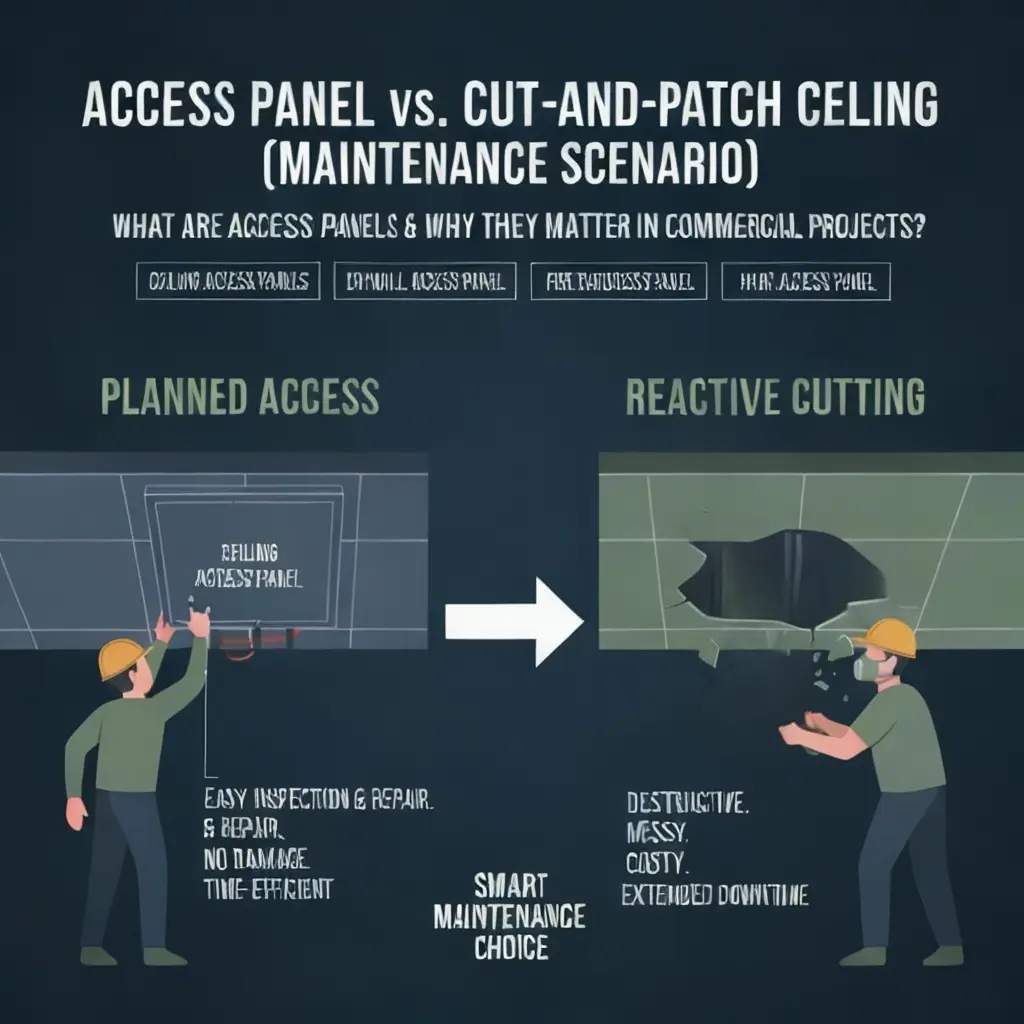
- Without a panel, simple repairs require you to smash, patch, and repaint.
- Every time you break a wall, you lose $200 to $500.
- For a 30-panel system, poor planning can waste $7,000 a year in labor. That means the panels would have paid for themselves in just twelve months.
Labor and Upkeep Savings
This is where panels shine. Regular checks on pipes or wires take less time. They are safer. They don’t annoy your tenants.
- One shopping center saved $7,000 a year with just 30 panels. Their team finished inspections in half the usual time.
- Match the door to the room. Steel lasts forever. Aluminum is light and easy to move. Gypsum looks great. Moisture-proof doors stop water damage. Pick for the long haul, not just today.
Fast Installation
Speed is money on a job site. Access panels help you finish on time.
- These snap in fast and cut your labor bill.
- They make life easier for plumbers and sparkies, which stops delays.

Real-World Cost Scenarios
Knowing the real worth of access panels for drywall is not a mere theory. It can best be learnt through real project situations where proper planning saves time, money, and headaches. Types or materials are often listed by the competitors, but they seldom demonstrate the effects of panels on the lifecycle costs, labor, and inspection efficiency. The following is how proactive estimating will turn small elements into big cost-controlling instruments:
Scenario 1: 5000 sq ft Office Fit-Out
- Panels Installed: 12 standard modified drywall access panels.
- Situation: Corridors that were to have fire-rated panels were not given any consideration when doing initial estimates.
- Impact: Absence of fire rating resulted in re-inspections, patching of the walls, and repainting.
- Cost Insight: Rework contributed between $2500 and $3500 to the project, and this is the way up-front estimating saves hidden costs.
Lesson for estimators: Adding fire-rated panels that comply with the codes in the initial takeoffs saves time and money on making corrections to the work.
Scenario 2: 100,000 sq ft Retail Renovation
- Panels Installed: 30 mixed steel and aluminum ceiling access panels.
- Benefit: HVAC maintenance and routine inspections were done using half of the normal work time.
- Annual Savings: 5,000-7,000 according to industry standards of maintenance
Takeaway: Positioning and the choice of materials provide long-term savings on labor and minimize downtime. Which have a direct positive impact on ROI on commercial construction projects.
Scenario 3: Hospital Corridor Upgrade
- Panels Installed: Fire-resistant and waterproof access panels.
- Challenge: There were regulatory requirements for critical plumbing and electrical inspection.
- Impact: Panels eliminated expensive inspection failures and emergency repairs.
- Cost Avoidance: The estimated cost avoidance was the potential rework and disruption costs of between $4000-$6000.
Why it matters: Panels are not only access points in healthcare and other facilities with high risks, but they are also a means of mitigation. Specified properly, panels save budgets and provide seamless inspection.
Installation & Maintenance Benefits: Why Panels Save Money
- Faster Installation: Pre-framed and modular panels reduce labor hours during MEP rough-ins.
- Efficient Maintenance: Easily accessible electrical, plumbing, and HVAC systems will save money used on demolition of the wall.
- Inspection-Friendly: Fire-resistant and code-certified panels simplify the permitting process and eliminate time-wasting.
- Lifecycle Savings: Over 10-15 years, proper panels can save thousands in maintenance and repair costs.
Common Estimating Mistakes That Kill Your Profits
Even the pros make mistakes. In commercial building, a tiny slip-up can turn into a huge bill. At Nedes Estimating, we see these errors all the time. Learn them now so your budget stays on track and your inspections pass the first time.
1. Forgetting Panels in the Count
If you don’t put access panels in your bid, you are asking for trouble. Future repairs will force you to cut into finished walls.
- Every time you cut and patch, you lose $200 to $500.
- Count your panels early, or pay for them twice later.
2. Picking the Wrong Fire Rating
This is a massive trap. If the code calls for a fire-rated door and you install a cheap one, you will fail your inspection.
- Panels must meet NFPA and IBC rules.
- Swapping them out later causes major delays and heavy fines.
3. Getting the Size Wrong
Size is a goldilocks problem. If the panel is too small, your tools won’t fit. If it’s too big, you waste money on materials.
- Both errors waste time and labor.
- Plan the size around the equipment, not the other way around.
4. Ignoring the Finishing Work
Many estimators forget that a panel needs a finish. You have to paint it. You have to trim it. Sometimes you have to match a ceiling texture.
- If you don’t budget for this labor, it eats your profit.
- Don’t just buy the door, budget for the person who has to make it look good.
Best Practices for Estimating Drywall Access Panels
Precision in estimating the drywall access panel is both a science and an art. The systematic approach can keep the projects within the budget, and the inspections went without problems, as well as the maintenance in the future is not a hassle. Nedes Estimating is an opinion that can be checked this way, and this is a practical checklist that any estimator needs to adhere to:
1. Identify Rated Assemblies
Decide which walls and ceilings are fire-rated or which should be provided with special panels. This will make sure that there will be no rework and inspection failures because of non-compliance with NFPA and local building codes.
2. Coordinate with MEP Drawings
Cross check mechanical, electrical, and plumbing (MEP) layouts to find the best positions of the panels. Proper installation prevents ducts, piping, and wiring interference and minimizes labor in installation.
3. Confirm Inspection Access Requirements
Verify code and facility management requirements of inspection points. Valves, junction boxes, dampers, and other important systems should have sufficient access through panels. This is a move that safeguards schedules and budgets.
4. Include Installation + Finishing Labor
Forget to consider labor in making the panel installation, patching, painting, and trim work. This consideration as a cost estimate will make sure that your commercial construction estimating represents the actual costs of the project.
FAQs
What do drywall access panels cost?
Prices depend on the material. A basic panel costs $50 to $400. Installation adds another $150 to $600. Fire-rated doors cost more, but a good estimate prevents hidden surprises.
Do they really save money over time?
Yes. They stop you from wasting cash on labor and repairs. One retail plant with 30 panels saved $7,000 a year. They did it by cutting down on inspection time and wall damage. It adds up fast.
When do I need a fire-rated panel?
If your wall or ceiling is a fire barrier, you need one. The law (specifically the IBC and NFPA 80) demands it. You will usually find them in halls and machine rooms. If you skip them, you will fail your inspection and pay for the rework.
Should I put them in my first estimate?
Absolutely. If you put them in the budget now, you cover the door, the labor, and the paint. Early planning kills “surprise” costs. It makes life easier for everyone.
What if I forget them?
You pay the price. You’ll have to smash walls, patch holes, and repaint. It turns a tiny mistake into a $1,000 headache. Don’t guess. Plan right the first time.
Conclusion
Drywall access panels are small, but they carry a big punch. They change how you handle costs, risks, and your bottom line. When you plan them well, you save on labor. You stop doing the same work twice. You keep your building systems running for a long time.
For an estimator, panels are a secret weapon. Putting them in your first count keeps your budget real. It keeps your team on schedule. Most of all, it makes future repairs a breeze. Don’t think of these doors as an extra cost. They are a tool to save money. They guard your cash and your time.
If you run construction bids, you must plan for access early. It keeps things clear. It keeps you flexible. Even if material prices go up, you stay safe. Think ahead. Protect your profit. Stay smart, stay compliant, and keep your project moving.