How Much Does a Cinder Block Wall Cost in 2026?
A cinder block wall costs $15 to $35 per square foot installed in 2026, or $10 to $17 per square foot for labor alone once you supply the blocks. A typical 8-foot by 15-foot backyard wall (120 square feet) lands between $1,800 and $4,200 for a full professional build. That’s the number most people search for. But it’s also the number that gets people in trouble, because a retaining wall, a garage wall, and a decorative fence wall all sit inside that same phrase.
This guide breaks the number down by wall type, region, block style, and reinforcement level, using 2026 material data and labor benchmarks from masonry contractors across the U.S.
Cinder Block Wall Cost: The Quick Answer
Nationally, cinder block wall installation costs fall into three clear bands, based on square footage:
| Project Scope | Cost per Sq Ft | Typical Total |
| Materials only (DIY) | $3 – $6 | $360 – $720 (120 sq ft) |
| Fully installed, standard wall | $15 – $30 | $1,800 – $3,600 |
| Reinforced or load-bearing wall | $20 – $40 | $2,400 – $4,800 |
Fence-style and freestanding walls are often quoted by the linear foot instead. Expect $60 to $240 per linear foot, depending on wall height; a 4-foot front-yard wall sits at the low end, an 8-foot privacy wall at the high end.
What Determines the Price Per Square Foot?
Six variables move the number more than anything else:
- Wall height
- Block type
- Reinforcement
- Finish
- Site access
- Local labor rates
A 4-foot garden wall in a rural market and an 8-foot reinforced retaining wall in a coastal city can differ by 400% in total cost, even though both technically qualify as a cinder block wall.
Cinder Block Wall Cost by Project Type
Not all block walls serve the same purpose, and the purpose dictates the engineering, which is the real cost driver. Below is a breakdown by application.
| Wall Type | Cost per Sq Ft | Cost per Linear Ft | Notes |
| Garden or privacy fence | $10 – $30 | $60 – $240 | Non-load-bearing, minimal footing |
| Retaining wall | $20 – $35 | $60 – $200 | Needs drainage, deeper footing and rebar |
| Garage wall | $8 – $40 | — | $25,000 – $60,000 for a 2-car garage |
| Shed wall | $8 – $16 | — | $3,000 – $4,400 total shed build |
| House foundation/basement | $10 – $20 | — | Requires engineered footing |
| Full cinder block house | $190 – $250 | — | Includes framing, roof and finishes |
Retaining Walls Cost More! Here’s Why
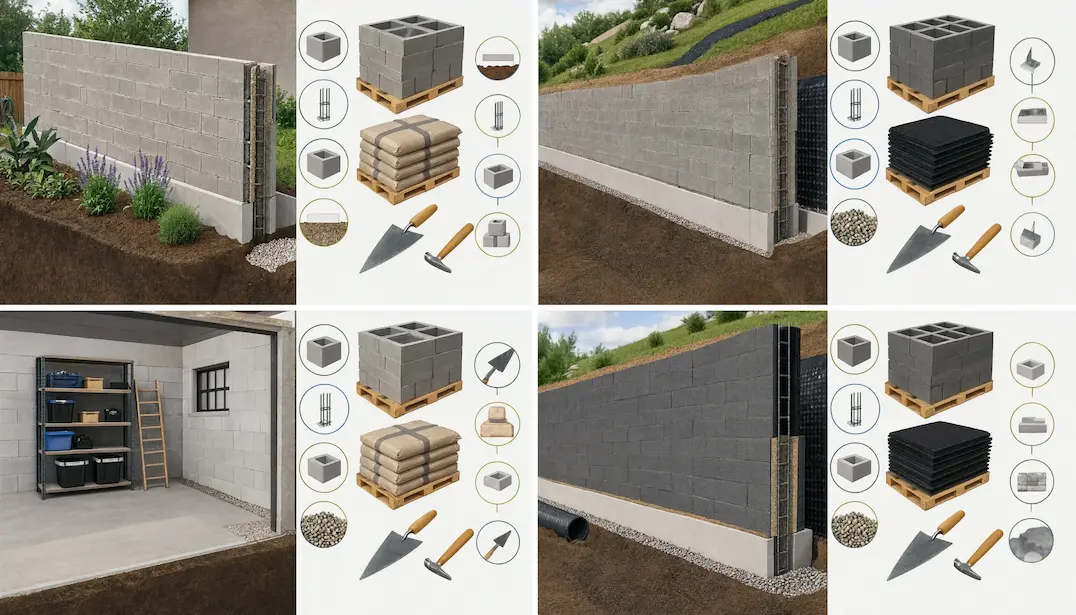
A cinder block retaining wall costs $60 to $200 per linear foot, roughly double a standard garden wall. Retaining walls hold back soil, so they carry lateral pressure that a freestanding fence never faces. That pressure requires a wider footing, vertical rebar in every core, poured concrete fill, and (for walls over 4 feet) a drainage system behind the wall to relieve hydrostatic pressure.
Skip the drainage step, and the wall bows or cracks within a few years. It’s the single most common point of failure homeowners report after a rushed retaining wall build.
Material Costs: Blocks, Mortar, and Reinforcement
How Much Does a Single Cinder Block Cost?
A standard 8-inch by 8-inch by 16-inch concrete block costs $1 to $3 each in 2026. Buying by the pallet is cheaper per unit. A pallet of 70 to 90 blocks runs $115 to $225, which works out to roughly $1.50 to $2.50 per block after the bulk discount.
| Block Type | Price per Block | Best Use |
| Standard 8x8x16 CMU | $1.00 – $3.00 | General walls, foundations |
| Split-face (textured) | $3.00 – $5.00 | Decorative retaining walls, facades |
| Half block (8x8x8) | $2.50 – $4.00 | Corners, coursing adjustments |
| Specialty (header, bond beam, L-corner) | $1.00 – $3.00 | Structural transitions, roof lines |
| Capstone | $0.95 – $2.00 | Wall tops, weatherproofing |
Mortar and Grout
Type S mortar runs $8 to $15 per 80-pound bag, and a typical wall needs roughly 7 bags per 100 blocks laid. Grout (used to fill the hollow cores around rebar) adds a separate cost, typically bundled into the $1 to $5.25 per square foot reinforcement figure below.
Rebar and Reinforcement: $1 to $5.25 per Square Foot
Any load-bearing wall, and most retaining walls, need vertical rebar dropped into the block cores and filled with grout. This step is non-negotiable for structural walls. Building inspectors check for it, and skipping it voids most homeowner insurance claims tied to wall failure. Budget $1 to $5.25 per square foot on top of your base material cost for rebar and grout fill.
Labor Costs: What Masons Actually Charge in 2026
Labor makes up roughly half the total bill on most cinder block wall projects. Expect to pay $10 to $17 per square foot for professional installation, or $34 to $100 per hour, depending on your market.
| Labor Structure | Rate | Best For |
| Per square foot | $10 – $17 | Standard-sized walls, easy quoting |
| Per block laid | $5 – $10 per block | Small or custom jobs |
| Hourly | $34 – $100 per hour | Complex, multi-day, or repair work |
An experienced two-person crew lays 75 to 125 standard blocks per day. A simple 20-foot by 4-foot garden wall (about 90 blocks) typically wraps in a single day. Retaining walls and foundations take considerably longer because of footing excavation, rebar placement, and required inspection holds between pours. Know more about the masonry work cost per hour with our detailed guide.
Why Coastal and Urban Markets Cost More
Labor is the variable most tied to geography. Masons in New York, the Bay Area, or South Florida charge toward the top of the $34 to $100 hourly range, while contractors in the Midwest and rural South often land closer to the bottom. Permit fees follow the same pattern; coastal counties with strict wind-load or seismic codes charge more for plan review and inspection.
Additional Costs Homeowners Often Miss
The base per-square-foot number rarely covers everything on the final invoice. Here’s what regularly gets added after the initial quote:
- Delivery: $50 – $200 to deliver blocks to the site, more for difficult access
- Permits: $50 – $500 depending on wall height and local code requirements
- Excavation: $1 – $5 per sq ft for loose soil, $5 – $12 per linear ft for deeper trenching
- Structural engineer review: $300 – $1,000, typically required for retaining walls over 4 feet
- Old wall demolition: $5 – $20 per linear foot
- Drainage (French drain behind retaining walls): $0.50 – $2 per sq ft
Finishing Costs: Sealing, Painting, and Stucco
Cinder block is porous by nature, and the hollow cores collect rainwater if left untreated. Finishing costs run $1.50 to $10 per square foot, depending on the material chosen.
| Finish Type | Cost per Sq Ft | Primary Benefit |
| Acrylic or epoxy paint | $0.80 – $1.60 | Affordable stain and water resistance |
| Waterproof sealant | $2 – $10 | Prevents water intrusion and cracking |
| Stucco | $3 – $9 | Weather resistance plus texture |
| Stone or masonry veneer | $4 – $22 | Premium appearance |
Build Smarter. Bid With Confidence.
Regional Price Differences Across the U.S.
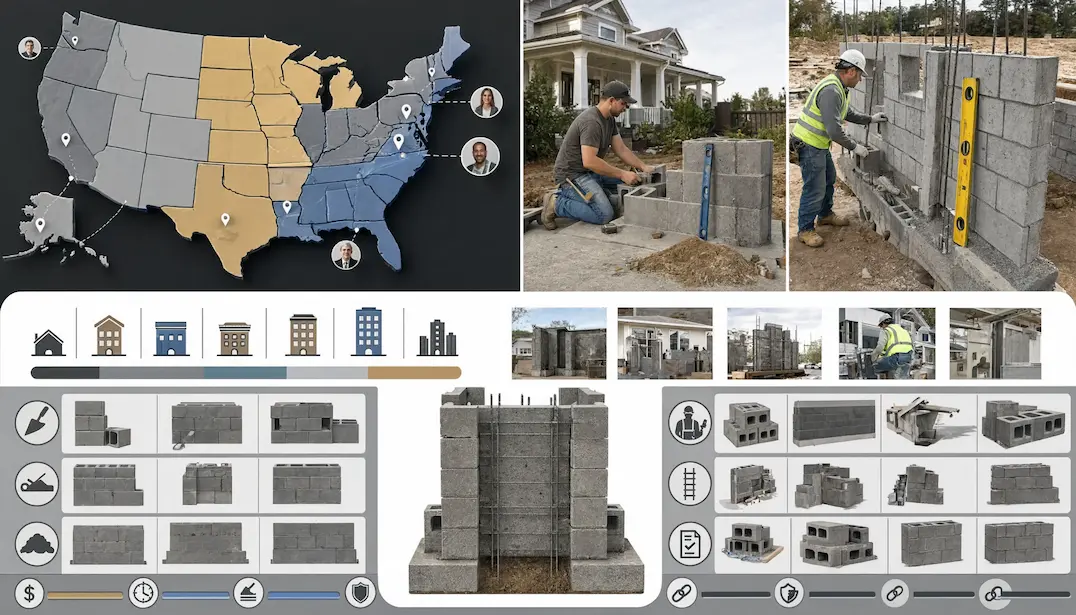
Location shifts the total bill more than almost any other factor besides wall height. Labor rates, permit fees, and even delivery distance from the nearest block plant vary widely by region.
| Region | Installed Cost per Sq Ft | Why It Differs |
| Northeast (NY, MA, NJ) | $22 – $38 | High labor rates, strict permitting |
| West Coast (CA, WA, OR) | $20 – $36 | Seismic code requirements add rebar |
| Southeast (FL, GA, SC) | $15 – $28 | High demand, moderate labor cost |
| Midwest (OH, IN, IL) | $13 – $24 | Lower labor rates, shorter permit timelines |
| Southwest (AZ, TX, NM) | $14 – $26 | Common retaining-wall market, competitive pricing |
Florida and coastal Gulf states also factor hurricane wind-load standards into wall design, which can add rebar spacing requirements even for short fence walls. If you live in a hurricane zone, ask your contractor whether your wall design meets the local wind-load code before signing off on a quote.
Block Sizes and Wall Thickness Options
Wall thickness affects both structural rating and price. Thicker blocks cost more per unit but reduce the number of courses and reinforcement needed for taller walls.
| Block Width | Common Use | Relative Cost Impact |
| 4 inches | Non-structural facing, garden borders | Lowest cost, limited height |
| 6 inches | Light fences, low garden walls | Slightly above 4-inch pricing |
| 8 inches | Standard residential walls, most common | Baseline pricing used in this guide |
| 10-12 inches | Foundations, retaining walls, load-bearing walls | 10 – 20% higher material cost |
The eight-inch block remains the default choice for most residential fences and privacy walls because it balances strength, weight, and cost. Contractors reach for 10- or 12-inch blocks mainly on foundations, basements, and retaining walls over 4 feet, where lateral load calculations demand the extra mass.
Maintenance and Long-Term Cost of Ownership
A cinder block wall’s upfront cost tells only part of the financial story. Compared to wood or vinyl fencing, block walls carry a higher initial price but a lower lifetime cost, since they rarely need full replacement.
- Expected lifespan: 50+ years with proper sealing, versus 15-20 years for wood fencing
- Resealing interval: every 5-10 years, at $2-$10 per square foot
- Crack repair: $100-$500 for minor sections, versus full-panel wood replacement after storm damage
- Repointing old mortar joints: $3-$25 per square foot, typically needed after 20-30 years
Over a 30-year span, a sealed and well-maintained block wall often costs less per year than a wood fence that needs two or three full replacements in the same period. The math favors block heavily in coastal, termite-prone, or high-wind regions where wood degrades faster.
Insulation and Energy Value
Unfinished cinder block naturally moderates interior temperature swings, which matters for garage, shed, and accessory-dwelling walls that share a wall with living space. Thermal mass research from the Portland Cement Association indicates concrete masonry walls delay heat transfer by several hours, shifting peak cooling load into cooler evening hours. Adding rigid foam insulation to the interior face of a block wall costs roughly $1 to $3 per square foot and meaningfully improves this effect for conditioned spaces.
Cinder Block vs. Concrete Block: Does It Change the Price?
Cinder blocks and concrete blocks get used interchangeably in casual conversation, but they’re not identical. Cinder blocks use coal cinders as the lightweight aggregate, while concrete blocks (technically CMUs, or concrete masonry units) use crushed stone or sand. That difference affects strength more than price: concrete blocks carry higher load ratings and cost only marginally more, generally within a few cents per block.
Most contractors today install true CMU concrete block even when customers ask for a ‘cinder block wall,’ since coal-cinder aggregate has become rare in modern manufacturing. The pricing guidance in this article applies to both, since suppliers and masons quote them under the same line item in 2026.
Cinder Block Wall Cost Calculator: Example Projects
Real numbers help more than ranges. Here are three sample projects, built from 2026 material and labor benchmarks.
Example 1: 8-Foot by 15-Foot Backyard Privacy Wall
- Area: 120 square feet
- Materials: $3 – $6/sq ft = $360 – $720
- Labor: $10 – $17/sq ft = $1,200 – $2,040
- Total installed: $1,800 – $3,600
Example 2: 40-Foot Retaining Wall, 4 Feet Tall
- Linear footage: 40 feet
- Cost per linear foot: $60 – $200 (includes footing, rebar, drainage)
- Total installed: $2,400 – $8,000
Example 3: Detached 2-Car Garage Block Walls
- Wall-only cost: $10 – $35/sq ft
- Full garage (foundation, roof, walls): $25,000 – $60,000
- Wall-only portion on a 600 sq ft footprint: roughly $6,000 – $21,000
DIY vs. Hiring a Mason: Is It Worth the Savings?
Building a cinder block wall yourself cuts the cost roughly in half, since labor represents 50% or more of the installed price. A 120-square-foot DIY wall runs $360 to $720 in materials alone, against $1,800 to $3,600 professionally installed.
That said, DIY makes sense mainly for low, non-load-bearing walls under 3 feet. Anything taller, anything retaining soil, or anything tied into a structure typically needs a permit and an inspection, and most municipalities won’t sign off on unreinforced owner-built walls above a certain height. Check local code before committing to a DIY retaining wall; it’s the fastest way to turn a $500 savings into a $3,000 teardown-and-rebuild.
How to Get an Accurate Quote
A written estimate should separate five line items: blocks and mortar, reinforcement, labor, footing and excavation, and finish. If a quote bundles everything into one number, ask the contractor to itemize it. Vague quotes are the most common source of mid-project cost overruns.
- Get at least three quotes from licensed masonry contractors
- Confirm whether the quote includes permits and inspection fees
- Ask whether rebar and grout fill are included or billed separately
- Clarify who handles old wall demolition, if applicable
- Request the finish (paint, stucco, sealant) as a separate line item so you can adjust it independently
Does the Time of Year Affect Cost?
Masonry contractors typically book up fastest in spring and early summer, which pushes quotes 5 to 10% higher during peak season in most markets. Late fall and winter bookings, in regions where the ground doesn’t freeze, often come with better pricing since crews have open calendar slots. Concrete and mortar also cure poorly below 40°F, so cold-climate builds usually pause from December through February regardless of price, which is worth planning around if you’re trying to time a lower quote.
Frequently Asked Questions
How much does a 100-foot cinder block wall cost?
A 100-foot cinder block wall costs $6,000 to $24,000 installed, based on the $60 to $240 per linear foot range for fence-style walls. Height is the biggest swing factor; a 4-foot wall sits near the bottom of that range, while an 8-foot wall pushes toward the top.
Is a cinder block wall cheaper than a wood fence?
Cinder block costs more upfront than a wood fence (wood typically runs $15 to $40 per linear foot installed versus $60 to $240 for block), but block lasts significantly longer. A well-built cinder block wall lasts 50-plus years with minimal maintenance, while wood fencing typically needs replacement every 15 to 20 years.
How much does it cost to build a cinder block wall around a pool?
Pool enclosure walls generally follow standard fence pricing, $15 to $30 per square foot, but many jurisdictions require a specific height (often 4 feet minimum) and self-latching gates for pool safety code. Budget an extra $200 to $500 for compliant gate hardware and inspection.
Does a cinder block wall need a permit?
Most municipalities require a permit for walls over 3 to 4 feet tall, and always for retaining walls or anything load-bearing. Permit costs run $50 to $500. Check with your local building department before starting.
How long does it take to build a cinder block wall?
A standard 100-square-foot wall takes one to two days for an experienced two-person crew. Retaining walls and foundations take longer, often one to two weeks, due to excavation, footing cure time, and inspection holds.
Can you build a cinder block wall on a slope?
Yes, but sloped sites require stepped footings that follow the grade in level increments, rather than one continuous footing. This adds excavation time and typically increases the footing cost by 15 to 30% compared to a flat-site build. Steep slopes may also need retaining-wall-level reinforcement even for what would otherwise be a simple garden wall, since uneven soil pressure on one side changes the engineering.
What’s the cheapest way to build a cinder block wall?
The lowest-cost path is a DIY, non-load-bearing wall under 3 feet tall using standard 8x8x16 block bought by the pallet, with no rebar fill and a basic paint finish. This keeps costs near the $3 to $6 per square foot materials-only range.
Bottom Line
Cinder block wall costs in 2026 range from $15 to $35 per square foot installed for most residential projects, with retaining walls and reinforced structural walls landing at the higher end. Materials are the smaller half of the bill; labor, reinforcement, and site prep drive most of the variation between quotes. Get itemized estimates from at least three local masons, confirm permit and reinforcement requirements up front, and budget an extra 5 to 10% for site surprises like poor soil or old wall removal.
If you do not want to get confused between the complex mathematical calculations of cinder block wall cost, contact NEDES. Our Construction Estimating Company will create a unit-price-based estimation report for your cinder block wall at economical rates.