How Access Panels Impact Commercial Construction Cost Estimates?
Small details cost big money. In commercial construction, access panels are often the silent budget killers. What looks like a simple hole in the wall actually dictates your labor costs, permits, and future maintenance.
Experienced pros know the truth that if you ignore access planning now, you pay for it later. Yet, panels get overlooked constantly during bidding. That is a mistake. Data shows that poor planning spikes maintenance labor by 20-40%. Even worse, it triggers expensive change orders when inspectors demand code-compliant access after the wall is closed up.
The real cost isn’t the price of the panel. It’s the aftermath. If a panel is missing or too small, you face recurring nightmares: cutting drywall, patching, painting, and operational downtime. Those repairs cost $200-$500 every single time. This guide isn’t about selling products. It is about protecting your budget through smarter planning.
What Are Access Panels and Why Do They Matter?
Access panels are more than just doors; they are your building’s internal navigation system. In commercial construction, these pre-fabricated openings allow you to reach the “guts” of a project without tearing it apart. Whether they are hidden in a ceiling or blended into a wall, they turn a major repair into a minor task.
Ceiling Access Panels
Ceiling access panels provide a clear path to hidden HVAC dampers. Besides, they are ideal for valves and electrical junctions. In a busy office building, every minute of downtime costs money. Here’s how these help.
- Pre-planned ceiling access saves 20 to 40 minutes per service call.
- You avoid the mess and disruption of breaking into a finished ceiling system.
- It turns a complicated inspection into a simple “open and close” job.
Drywall Access Panels
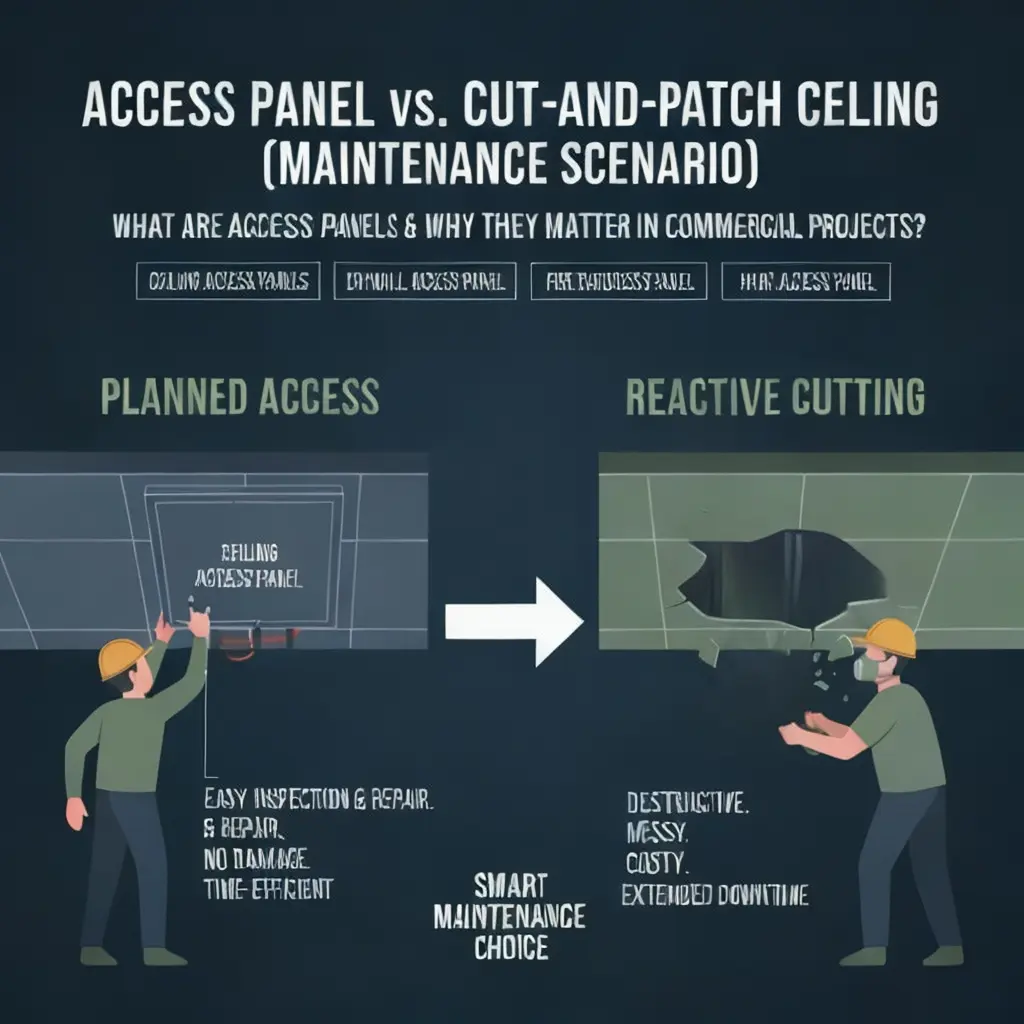
A drywall access panel offers a clean, concealed way to reach plumbing or control components behind finished walls. Without them, contractors are forced to play a game of “search and destroy.” They cut holes, fix the leak, and then leave you with the bill for the repair.
- A single reactive cut-and-patch incident costs between $200 and $500.
- Over the life of a building, these repairs silently inflate your operating budget.
- Installing a panel once is significantly cheaper than patching the same wall five times.
Fire-Rated Access Panels
Fire-rated panels are the heavy hitters of safety. They protect your fire-resistance standards while still allowing access to critical systems. If you fail to meet code during an inspection, your project hits a wall.
- Construction rework can eat up 10-11% of your total project budget.
- Missing the right fire-rated panel leads to failed inspections and major delays.
- Specifying the right panel early is a simple way to keep your budget under control and your building safe.
Where Access Panels Directly Impact Construction Cost Estimates
Access panels barely show up on a blueprint, but they can wreck a budget. Estimators need to look past the drawing and see the layers of cost involved. From material prices to labor efficiency and inspection risks, these small details influence your project’s performance from day one. If you wait until construction starts to think about access, you are already losing money.
Material Costs
The first thing everyone looks at is the hardware price. That part feels straightforward. It isn’t! There’s no safe average number you can drop into a budget and move on. Costs swing hard depending on what the space actually needs, not what looks reasonable on paper.
Basic drywall or ceiling-mounted units are relatively inexpensive. Some sit near the low end, others creep up, but you’re generally talking anywhere from $10 to a few hundred dollars.
Then the requirements start stacking up. It happens in the form of:
- Fire ratings.
- Acoustic insulation.
- Special coatings or custom finishes.
Each one nudges the price higher, sometimes a little and sometimes a lot.
Once you’re dealing with fully certified, fire-rated systems (especially in commercial or regulated environments), the numbers jump fast. At that point, it’s not unusual to see costs land in the $250 to $2,000+ range per installation.
Typical Commercial Access Panel Cost Ranges
| Panel Type | Unit Cost | Installed Cost Range |
| Drywall (standard) | $10–$150 | $150–$400 |
| Ceiling access panel | $50–$300 | $200–$600 |
| Fire-rated access panel | $200–$800 | $500–$2000+ |
Result
For estimators, the error does not lie in the increased cost of the fire-rated panels. It is the omission of them where the code mandates them, which can translate into expensive replacements later.
Labor & Installation Costs
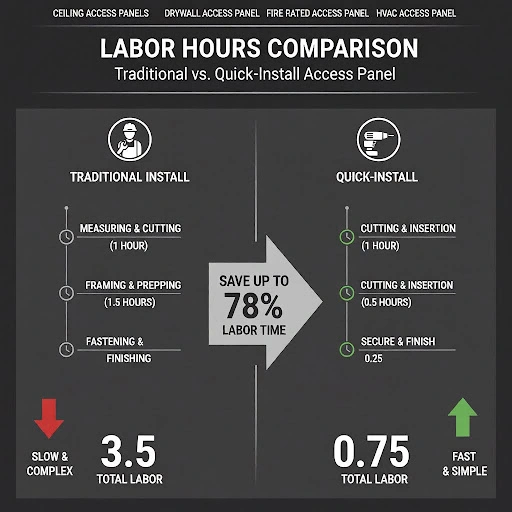
The real value of an access panel isn’t the metal; it’s the time you save. Modern, quick-install designs have revolutionized the process. They eliminate the need for specialized tools and long hours of trade coordination.
- Efficiency Gains: Industry data shows that planned access cuts maintenance time by 20–40%.
- Streamlined Workflow: Better designs mean less trimming, less sealing, and less patching.
- Fewer Callbacks: When a system is easy to install, it is hard to mess up. This saves you from expensive return trips and finishing delays.
Rework, Repairs & Hidden Costs
Rework is a silent killer in construction estimating services. Without intentional access points, technicians are forced to play a game of “cut and hope.” They slice into walls, fix a pipe, and then leave a mess behind.
- The Repair Loop: Every time someone cuts a wall, you have to pay for patching, sanding, and repainting.
- The Price of Mistakes: Each of these “minor” events costs between $200 and $500.
- The Bottom Line: These costs aren’t rare; they are incredibly common in commercial buildings. Planning ahead stops this cycle before it starts.
Mini cost scenario
10 maintenance visits × $350 average repair = $3500 in avoidable costs
This basic mathematics is appealing to estimators since it is realistic. These hidden costs can be much more than the original cost of correctly specifying access panels over a 10-20 year lifecycle of the building.
Inspection Failures and Code Compliance Risk
Inspection risk is one of the most expensive and cost drivers with the most underestimated cost. Missing or incorrectly fire-rated access panels can lead to failed inspections, which will require replacement of the panel, drywall demolition, and a delay in the schedule. Research work in the construction sector always indicates that rework consumes up to 11% of the total construction costs and causes about 22% of the schedule slippage.
This is the point where an experienced estimator will be an advantage: the definition of access panels that are compliant with budgets and schedules. A single inspection failure will result in a chain of labor, material, and time money that is many times the initial panel allowance.
Lifecycle Cost and ROI: Why Access Panels Pay for Themselves
Think of access panels as a high-yield savings account for your building. While they might look like an upfront cost, they are actually a strategic shield for your budget. Most owners focus only on the installation day, but the real magic happens over the next twenty years. A building is a living thing that requires constant attention. If you make that attention easy, you save money. If you make it hard, you pay a “frustration tax” on every single repair.
Reduced Maintenance Labor Across Building Types
Modern facilities like hospitals and offices are packed with hidden HVAC, plumbing, and electrical systems. They need constant care. Without access panels, your maintenance crew becomes a demolition team.
- Speed: Planned panels can slash maintenance time by up to 40%.
- Efficiency: Crews spend their time fixing the problem, not fighting the wall.
- Discretion: You avoid the noise and dust that drive tenants crazy.
Avoiding Rework and Repair Costs
Reactive repairs are a slow leak in your bank account. Every time a technician has to cut into a ceiling, the bill starts climbing. You aren’t just paying for the mechanical fix; you are paying for a painter, a taper, and a cleaner.
- The Price Tag: A single “cut-and-patch” job typically costs between $200 and $500.
- The Solution: Code-compliant panels eliminate this cycle of destruction.
- The Result: You stop paying to fix the same square foot of drywall over and over again.
Minimizing Downtime
In mechanical estimating services, when a pipe leaks in a retail store or a hospital wing, every minute counts. Unplanned access usually means closing doors and losing revenue. You cannot afford to shut down an entire office floor just to check a valve.
Access panels provide instant, non-destructive entry to the “guts” of your building. This keeps your operations running smoothly. You protect your income, keep your tenants happy, and lower your overall operational risk. In the world of commercial real estate, accessibility is profitability.
| Cost Category | Without Panels | With Panels | Notes / Example |
| Maintenance labor | High | Reduced | 20–40% labor time saved per visit |
| Repairs | Recurring | Minimal | $200–$500 per cut avoided |
| Downtime | Frequent | Limited | Reduces operational disruptions in offices, hospitals, and retail |
| Initial Panel Cost | Low | Moderate | Upfront investment offsets long-term costs |
| Inspection Rework | Possible failures | Rare | Fire-rated panels ensure code compliance |
| Long-term cost | Higher | Lower | Savings accumulate over 10–20 years |
| ROI | Negative or neutral | Positive | Proper planning protects the budget and schedule |
How to Plan Your Access Panel Costs
Estimating access panels is more than just a line on a page. It is about looking ahead. Smart pros know that planning for panels early stops budget leaks. It keeps your job on time. It stops you from doing the same work twice. You must plan for panels in your first budget, your final count, and your team meetings.
Put Panels in Your First Budget
Don’t wait. Think about access panels while you are still dreaming up the project. If you guess the price now, you won’t get hit with “surprise” costs later.
- The Danger: If you forget fire doors in the halls, you will fail your inspection.
- The Penalty: Fixing that mistake can cost $500 for every single door.
- The Win: A good early guess stops you from underpricing your bid.
Plan your access panels smartly to save costs, time, and headaches.
Get the Details Right
When you do your final count, don’t just count the doors. Think about the work. How hard is it to put them in? How many hours will it take?
- Good panels can cut repair time by 40%.
- When panels are easy to reach, you spend less on workers over the years.
- You aren’t just buying a door; you are buying future free time.
Talk to Your Team
Team communication is a key factor in ensuring the success of commercial construction. Your plumbers, sparkies, fire teams, and project managers must always be on the same page. That’s because access panels are insanely vulnerable to mistakes. One pipe in the wrong spot and it is game over for the panel! Swift team collaboration means you won’t be tearing down walls later in the project timeline.
Keep These Things In Mind For Accurate Estimating
- Panel type: Drywall, ceiling, fire-rated, or specialty
- Fire rating: Required by code for corridors, egress routes, and mechanical spaces
- Size & location: Ensures accessibility for maintenance without disruptive cutting
- Labor hours: Installation, coordination, and future maintenance effort
- Future maintenance access: Minimizes downtime and repair costs over building life
Adhering to this direction, estimators show real-life experience, do not submit under-priced offers, and can offer their clients reasonable, defendable cost estimates. Sufficiently accounting access panels is not merely a technical procedure, but a business or cost-saving action, not to mention professionalism and credibility.
Common Estimating Mistakes That Kill Your Project Budget
Small construction estimation mistakes can bleed your budget dry. It is easy to overlook a minor access door during the hectic planning phase. However, that error will haunt your bottom line for years. So, identifying common traps before execution is necessary if you want to save thousands over the building’s lifespan.
Omitting Fire-Rated Panels
This is arguably the most expensive mistake an estimator can make. If the code requires a fire-rated panel and you install a standard one, you are in trouble.
- A single inspection failure can force a rework costing $500 to $2,000 per panel.
- Beyond the cash, the schedule slip can derail your entire project.
- Rework accounts for up to 11% of total construction costs. Staying compliant from day one isn’t just a safety rule; it is a financial survival strategy.
Undersizing Your Panels
Size matters. If a panel is too small for a technician to actually work through, it is useless. When a repairman can’t reach a valve, they start cutting into your finished walls or ceilings.
- You end up in a loop of cutting, patching, and painting.
- Each of these “small” repairs costs $200 to $500.
- Multiply that by twenty maintenance events over a decade, and you’ve wasted a fortune. Get the size right the first time to keep your walls intact.
Ignoring Maintenance Frequency
Not all buildings are created equal. A warehouse has different needs than a high-traffic hospital or a busy retail hub. If you don’t consider how often a system needs to be checked, your estimate is incomplete.
- Poor planning leads to labor inefficiencies and massive downtime.
- Strategic access can save 40% on maintenance time.
- Think about the person who has to fix the pipes three years from now. Their speed is your savings.
Chasing the Lowest Initial Price
The cheapest panel on the shelf often carries the highest long-term price tag. While a low-cost option looks great on a spreadsheet today, it usually lacks durability and takes much longer to install.
- Cheap panels often require extra sealing, trimming, and labor.
- You will likely spend more on replacements and repairs than you saved on the initial purchase.
- Focus on the Total ROI. A high-quality panel pays for itself through lower labor costs and better performance. Don’t trade long-term stability for a short-term win.

Real-World Cost Scenarios
The access panels have true value as seen in actual projects. The concealed expenses of missing or inadequately designed panels are commonly miscalculated by estimators, contractors, and building owners, but these actual-life situations demonstrate the extent to which careful planning and design can affect the outcomes.
Example 1: Office Building
Planners did not have to do expensive rework in an office building with 25 access panels and fire-rated panels in corridors, which is in the middle of the building. The project avoided re-cutting of the ceiling followed by patching since it specified the correct panel size, location, and adherence at its inception. The savings on rework avoided have been over $8000, which shows that the original investment in panels is many times more than the life cycle of the building.
Example 2: Hospital
Hospitals face high inspection frequency and a maintenance timetable. Installing access panels in strategic locations that met the code requirements ensured that time was spent minimally when checking the systems and also helped save labor hours up to 40%. Planned access was saving money as well as enhancing operational efficiency, an essential factor in the health care settings where time literally equates to cost.
| Scenario | Without Panels | With Panels | Notes / Impact |
| Initial cost | Lower | Slightly higher | Upfront investment offsets long-term costs |
| Maintenance labor | High | Reduced | 20-40% labor time saved per visit |
| Repairs | Recurring | Minimal | Avoids $200-$500 per cut-and-patch repair |
| Downtime | Frequent | Limited | Critical for hospitals, offices, and retail |
| Inspection Rework | Possible failures | Rare | Fire-rated panels ensure code compliance |
| Long-term cost | Much higher | Lower | Savings accumulate over 10-20 years |
Real-World Cost Scenarios
The access panels have true value as seen in actual projects. The hidden costs of missing or poorly designed panels are often miscalculated by estimators, contractors, and building owners. Real-world cases show how careful planning and design can significantly influence project outcomes.
Example 1: Office Building
Smart planning saved this project over $8,000 before the first lease was even signed. In a recent mid-sized office project, the planners installed 25 strategic access panels. They focused heavily on the central corridors. By specifying the exact size and fire-rating requirements at the very beginning, they bypassed the “rework trap” entirely
Example 2: Hospital
Hospitals face high inspection frequency and a maintenance timetable. Access panels installed in strategic locations that meet code requirements reduce inspection time. They can also cut labor hours by up to 40%. Planned access was saving money as well as enhancing operational efficiency, an essential factor in the health care settings where time literally equates to cost.
| Scenario | Without Panels | With Panels | Notes / Impact |
| Initial cost | Lower | Slightly higher | Upfront investment offsets long-term costs |
| Maintenance labor | High | Reduced | 20-40% labor time saved per visit |
| Repairs | Recurring | Minimal | Avoids $200-$500 per cut-and-patch repair |
| Downtime | Frequent | Limited | Critical for hospitals, offices, and retail |
| Inspection Rework | Possible failures | Rare | Fire-rated panels ensure code compliance |
| Long-term cost | Much higher | Lower | Savings accumulate over 10-20 years |
Conclusion
Small components often create the largest footprint. Access panels dictate your long-term maintenance costs. If you plan them well, you save both your budget and your timeline.
Estimators who ignore these details lose money. Estimators who account for fire ratings and labor hours win bids. You need to be in the second group. Access panels are not just an expense. They serve as a powerful tool for cost control. They ensure the building performs well for decades. You protect the project’s bottom line when you specify these items correctly.
NEDES Estimating is here to help you get it right. We support contractors with precise estimating data. Our methods eliminate underpricing and stop budget overruns. You get a lifecycle efficiency that keeps the building profitable.
FAQs
How much should I budget for access panels?
That depends on the specs. Basic panels are cheap, usually $10 to $400. But once you add fire resistance or complex hinges, the price jumps to $250–$2,000. Don’t use a generic placeholder number. Estimates must account for size and complexity to be accurate.
Will these panels save money on maintenance?
Big time. Well-planned panels let crews reach hidden systems instantly. They don’t have to smash through drywall to fix a pipe. This can save up to 40% on maintenance labor. Over the life of the building, that is a massive reduction in recurring repairs and operational downtime.
Do I need to include them in the very first estimate?
100% yes. Detailed estimates prevent the nightmare of underpricing. If you ignore panel types or labor hours now, you trigger change orders later. Accurate bidding upfront protects your profit margin during construction.
What is the risk of missing a fire-rated panel?
The immediate risk is a failed inspection. The financial risk is worse. Fixing this mistake involves tearing down the work you just finished. You have to demo, patch, and repaint. That costs $500 to $2,000 for every single repair. Protect your timeline: put the compliant panels in the plan from day one.
Do panels really impact inspection approvals?
They make or break them. Inspectors need to see code compliance. Accessible panels prove that fire safety and standards are met. If they aren’t there, you risk project delays and red tags. Doing it right the first time avoids the headache of extra labor and long-term operational costs.