
How Much Do Vinyl Windows Cost in 2026? A Realistic Price Breakdown
A $500 vinyl window and a $1,300 vinyl window might look nearly the same after installation. The real differences are in the details you cannot see in a photo, like the glass, frame quality, hardware, installation, finishing, and the condition of your window opening.
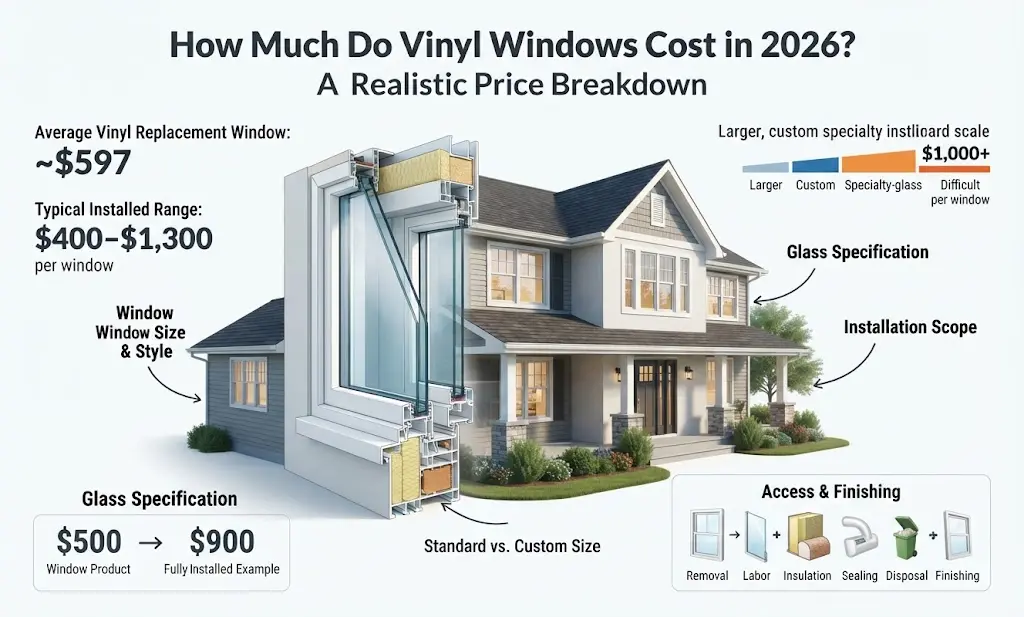
The average cost of a vinyl replacement window is about $597. However, prices can exceed $1,000 per window, especially for larger or operable windows, upgraded energy-efficient glass, custom sizes, or complex installations. So, while an average cost helps with early budgeting, it is not reliable for comparing real quotes.
This guide explains how to estimate window replacement costs and how much to budget for this project in 2026.
What Does a Vinyl Window Cost in 2026?
For a rough calculation, a standard vinyl replacement window usually costs between $400 and $1,300 installed. Larger, custom, or specialty-glass windows, or more complex jobs, can cost even more. Prices vary because ‘vinyl window cost’ might mean just the window plus basic installation, or a full replacement with removal, insulation, trim, and finishing.
The average price range is helpful for starting your budget, but less helpful when comparing real products.
For example, Ecoline experts share that their standard vinyl awning windows cost about $600 to $750 per unit before extras. Professional installation usually adds $100 to $300 per window, and more for large or tricky openings. Custom features can add 25% to 50% to the original quote.
If you are replacing ten standard-size windows, your project will be very different from someone replacing three large casements, a bay window, and several windows with damaged frames. Both are vinyl window replacement projects, but the cost per window can vary widely.
The number on the quote usually reflects some combination of five major cost drivers:
-
Window size and style
Fixed and simpler operating styles generally require less hardware than casement, bay, bow or other multi-unit configurations.
-
Glass specification
Double- or triple-pane construction, Low-E coatings, gas fills, laminated glass, tempered glass and other upgrades can raise the unit price.
-
Standard versus custom sizing
Non-standard dimensions require custom manufacturing and may involve additional work around the opening.
-
Installation scope
A straightforward replacement in a sound existing opening costs less than removing the entire frame, correcting water damage or rebuilding surrounding finishes.
-
Access and finishing
Upper-story windows, difficult exterior access, interior trim replacement, exterior cladding and disposal can all affect labor.
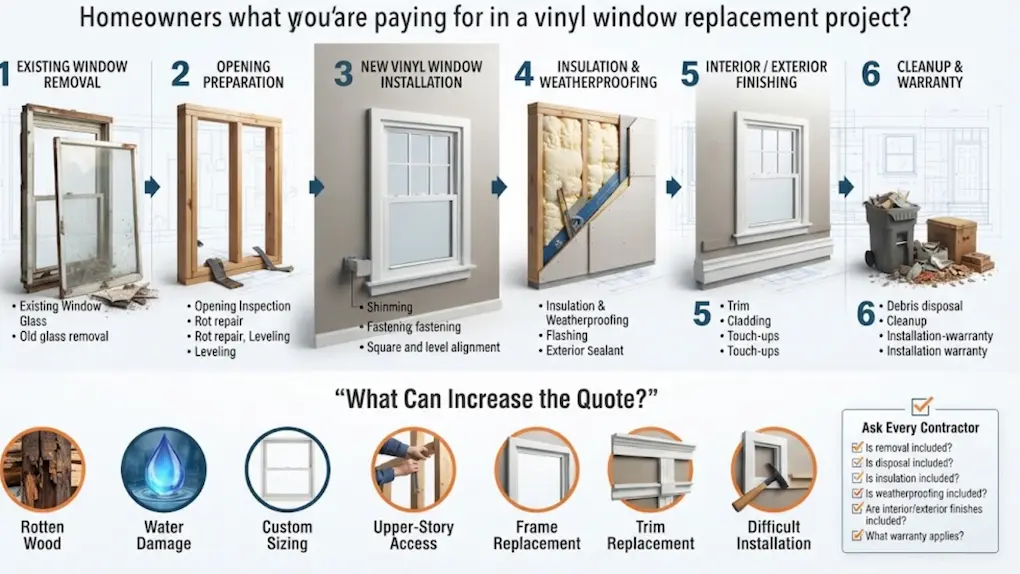
What Are You Actually Paying for in a Window Replacement Quote?
Two contractors might give very different prices for the same number of vinyl windows, and both can be reasonable. The difference is usually in what is included. One price might cover just the new window and basic installation, while another includes removal, disposal, insulation, weatherproofing, trim, and repairs.
This is one of the easiest parts of a quote for homeowners to misunderstand.
A complete replacement price can include:
- The manufactured window unit
- Glazing, hardware and selected upgrades
- Removal of the existing window
- Disposal of the old unit and debris
- Preparation of the opening
- Shimming, fastening and insulation
- Exterior caulking and weatherproofing
- Interior or exterior trim work
- Cleanup
- Labor and installation warranty
Different contractors indicate that removal, opening preparation, and weatherproofing can add hundreds of dollars per window, depending on the job’s condition and complexity. Hard-to-reach windows, resizing, and repairs can make labor costs even higher.
Pay close attention to the condition of your window opening. A simple replacement assumes the frame and wall are in good shape. But after removing the old window, the installer might find rotten wood, water damage, bad insulation, or an uneven opening. These problems need extra work before the new window can be installed correctly.
Finishing work also affects the price. One contractor might install and seal the window but leave the old interior trim in place. Another might include new trim, sill work, exterior finishing, and touch-ups. Trim alone can be a high extra cost, especially if old materials need to be removed or walls repaired.
A $500 Window and a $900 Installed Window Are Not Necessarily the Same Purchase
Here’s a simplified example. A homeowner finds a vinyl double-hung window priced at $500. A contractor later quotes $900 for what appears to be a similar replacement.
The extra $400 could cover several hours of labor, removing the old window, materials, insulation, sealing, disposal, and finishing work. Installing a replacement window is more than just putting the new frame in the wall. The window must be level, square, and securely fastened before the gaps are insulated and sealed against air and water leaks.
This is why the advertised product price alone is not a good way to compare options.
When reviewing estimates, ask each contractor to clarify:
- Is this price for the window only or fully installed?
- Is removal and disposal of the existing window included?
- Are interior and exterior finishes included or reused?
- What happens if rot or damaged framing is discovered?
- Are sealing, insulation, and weatherproofing included in the installation price?
- Which labor and product warranties apply?
A lower estimate might be a better deal, but only if you compare what is included. Next, look at the window itself, since style and how it works can affect the price as much as installation does.
Vinyl Window Cost by Style: Why Size Alone Does Not Set the Price
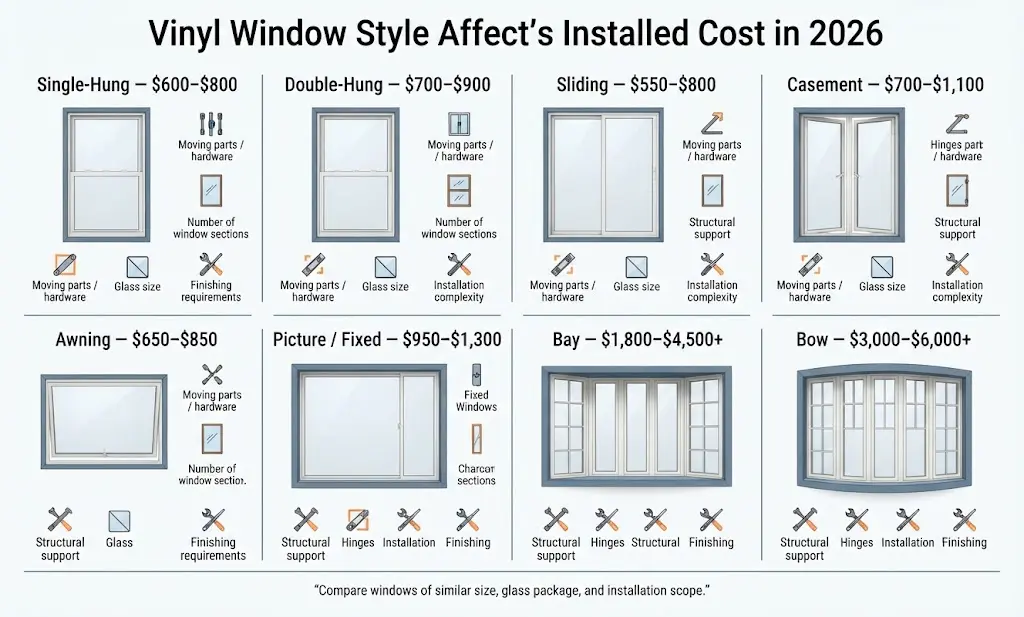
Window size is important, but how the window is built and how it works can affect the price just as much. For example, a large fixed window might cost less than a smaller awning window because it does not need hinges or a crank. But bay and bow windows are usually more expensive because they combine several windows and often need extra support and finishing.
Professional window installation experts usually provide the following broad installed ranges for vinyl windows:
| Vinyl window style | Product + Installation Cost | Factors to affect the quote |
| Single-hung | $600 – $800 | Size, glass package, sash construction |
| Double-hung | $700 – $900 | Two operable sashes, tilt hardware, upgraded glass |
| Sliding | $550 – $800 | Width, number of panels, track and locking system |
| Casement | $700 – $1,100 | Hinges, crank operator, locks, sash size |
| Awning | $650 – $850 | Operating hardware, width, glass specification |
| Picture / fixed | $950 – $1,300 | Mostly glass size and glazing rather than hardware |
| Bay | $1,800 – $4,500+ | Multiple units, projection, support and finishing |
| Bow | $3,000 – $6,000+ | Four or more units, curved assembly, structural and finishing work |
Source: Ecoline Windows
Fixed Windows Can Deliver More Glass for the Budget
Picture windows do not have moving parts like sashes, tracks, hinges, or cranks. This makes them simpler to build and means there are fewer parts that might need fixing or replacing later.
Not every picture window is cheap, though. A large insulated-glass window can cost much more than a small opening window because size, thickness, shipping, and handling all add to the price. Special glass, such as laminated or tempered glass, can also make it more expensive.
It is best to compare windows of similar size. In those cases, a fixed window usually costs less than a casement or double-hung window with the same glass type.
If you are planning a wall with several windows, using one or two that open, along with larger fixed windows, can provide the ventilation you need and help keep hardware costs down.
Casement Windows Usually Cost More for a Reason
A casement window is hinged on one side and normally opens outward via a crank mechanism. The sash also needs hinges, locking hardware and weather seals designed to compress when the window closes.
This extra hardware is why casement windows usually cost more than sliders or basic hung windows. Most installed vinyl casements cost about $700 to $1,100, depending on size and quality.
Casement windows also perform better. Since the sash closes tightly against the frame, they can have very low air leaks if made and installed well. If you are comparing a cheaper slider to a more expensive casement, consider both the price and the performance, not just how they look.
Get an Accurate Vinyl Window Replacement Cost Estimate for Your Project
Double-Hung and Sliding Windows Often Sit in the Middle
Double-hung windows remain common because both sashes can move and many models tilt inward for cleaning. That convenience requires more operating components than a fixed unit but generally less complex hardware than a crank-operated casement.
Sliding windows have sashes that move sideways. Because they are simple to operate, most standard models are priced in the lower or middle range for vinyl windows.
However, you should not assume one style is always cheaper. A large slider with several panels or special glass can cost more than a basic double-hung window.
Bay and Bow Windows Need Their Own Budget
Bay and bow windows should not be treated as oversized versions of a standard window.
A typical bay window has three sections that stick out from the wall. A bow window usually has four or more sections to make a gentle curve. These projects often need extra framing, support cables or brackets, insulation under the seat, interior finishing, and sometimes a small roof or exterior covering.
That is why installed prices for these windows usually start at $1,800 and can go as high as $6,000 + for more complex projects.
For these windows, comparing a simple “price per opening” with the cost of a standard double-hung window is misleading. The homeowner is buying a multi-window assembly and a more complex construction project.
This idea applies to all window styles: compare windows with similar size, glass, and installation details before deciding if one type is expensive. The next thing to consider is the glass, especially if paying more for triple-pane or higher energy ratings is worth it.
Vinyl vs Wood, Aluminum and Fiberglass Windows: Price Comparison
Homeowners often choose vinyl because it is affordable, insulates well, and needs little maintenance. But there are other good frame materials.
Wood looks more traditional, fiberglass is stronger and keeps its shape better, and aluminum is good for narrow frames and strength, though it does not insulate as well.
Current pricing data shows vinyl toward the lower end of the market, although window size, style, glazing and installation scope can outweigh the difference between frame materials.
| Frame material | Product + Installation Cost | Energy efficiency | Maintenance | Why Install |
| Vinyl | $597 – $900 | High with insulated frames and efficient glazing | Low | Affordable, moisture-resistant and widely available |
| Wood | $600 – $1,400 | High | High | Strong insulation and traditional appearance, but requires protection from moisture and periodic refinishing |
| Aluminum | $900 – $1,200 | Low to moderate | Low | Thin, strong frames suit large glass areas, but aluminum conducts heat more readily than vinyl, wood or fiberglass |
| Fiberglass | $1,100 – $1,400 | High | Low | Rigid and dimensionally stable, with less expansion and contraction than vinyl, but usually costs more |
- Vinyl gives the best balance of cost and performance. It does not need painting, will not rot like wood, and its multi-chambered frames can keep heat in well.
- Wood might be better for historic homes or places where the frame is part of the design.
- Fiberglass is a good choice for big windows or projects where extra strength and long-term stability are worth the higher price.
- Aluminum works well for modern designs that need narrow frames and lots of glass. Its downside is that it lets heat through easily, so you should check for thermal breaks and consider the window’s overall U-factor, not just the frame material.
The frame material is important, but the glass and the window’s overall performance ratings usually tell you more about comfort and energy use than just seeing ‘vinyl,’ ‘wood,’ or ‘fiberglass’ on the quote.
Do New Construction and Replacement Windows Cost the Same?
No, new construction and replacement windows can have different product and installation costs. Which is cheaper depends on your project.
Replacement windows fit into an existing opening. An insert or pocket replacement can often be installed without removing the original frame or wall finishes. This saves on demolition and labor, as long as the frame is square, solid, and not rotten.
New construction windows come with a full frame and a nailing flange that attaches to the wall framing. They are usually installed when a house or addition is open to the studs. Installing them in a finished home often means removing siding or trim, exposing the opening, and rebuilding finishes afterward.
Installing a replacement window usually costs about 15%-25% less per window compared to new construction projects. But big renovations can make these comparisons less accurate.
This difference is most important when replacing old windows. If the frame is in good shape, an insert replacement saves labor and mess. If there is rot, water damage, bad flashing, or you need a bigger opening, a full-frame or new-construction installation costs more but lets the contractor fix the real problem.
When budgeting, compare what is included in the installation, not just the window itself. A cheaper replacement window is not a good deal if it leaves damaged framing in place.
How to Save on New Vinyl Windows in 2026
The lowest window price is not always the best deal. A better strategy is to reduce project costs without downgrading installation, glazing, or weatherproofing. Homeowners planning a larger replacement can often save by adjusting timing, project scope and how they compare bids.
1. Check current rebates and incentive programs
Start with your utility provider and state or local energy-efficiency programs. Some still offer rebates for qualifying ENERGY STAR windows or broader home-envelope improvements. Government projects can significantly offset the initial investment.
2. Consider an off-season installation
Spring and early summer tend to be busier for window contractors. Late fall and winter can bring more flexible scheduling and, in some markets, lower labor rates or seasonal promotions.
3. Ask whether the installer works through winter
Cold-weather installation is possible, but the contractor needs appropriate sealing materials and procedures. Some professional sealants are rated for application well below freezing, while other products have stricter temperature limits.
4. Replace several windows together
Larger projects may qualify for volume pricing and reduce repeated setup, travel and disposal costs compared with replacing one or two windows at a time.
5. Keep standard openings where possible
Custom shapes, resizing and structural changes can quickly erase savings gained from choosing an affordable vinyl frame.
Before accepting a discount, compare the same glass package, installation method, scope of finishing, and warranty across all quotes.
Wrapping Up
Vinyl windows remain a practical choice for homeowners seeking lower upfront costs, good energy efficiency, and easy upkeep. But in 2026, the final price depends on much more than just the frame material. Factors like window style, size, glass type, installation method, the condition of the opening, access, and finishing work can all affect your final estimate.
This is why homeowners should use national averages only as a starting point for their budget. When getting quotes, look at the full details: product specs, U-factor and other energy ratings, double- or triple-pane glass, removal, insulation, trim, disposal, and warranty coverage.
It’s also a good idea to check for local rebates, utility incentives, and seasonal pricing before you schedule your project.
FAQ
How much does a vinyl window cost in 2026?
The average price for a typical vinyl replacement window is around $597. Larger, custom, or premium windows may be more expensive. The final price depends on factors like size, style, type of glass, installation method, and the condition of your current window opening.
Are vinyl windows cheaper than wood or fiberglass?
In most cases, yes. Vinyl windows usually cost less up front than wood or fiberglass and need less maintenance. Still, high-end vinyl windows with triple-pane glass, custom colors, or special glass can sometimes cost as much as basic wood or fiberglass options.
Is triple-pane glass worth the extra cost?
Triple-pane windows can offer better insulation, more comfort inside, and less condensation, especially in places with big temperature changes. Instead of just looking at the number of panes, check the window’s U-factor and Energy Rating. Glass coatings, spacers, and frame design also affect how well a window performs.
Is it cheaper to replace all windows at once?
Replacing several windows at once can lower your average cost, since contractors often give discounts for bigger jobs and can combine setup, delivery, labor, and disposal. But you shouldn’t replace windows that are still in good shape just for a discount. Focus on replacing windows with drafts, moisture problems, broken seals, or ones that don’t work well.


