
How Much Does It Cost To Build A Quadplex? 2026 Price Breakdown
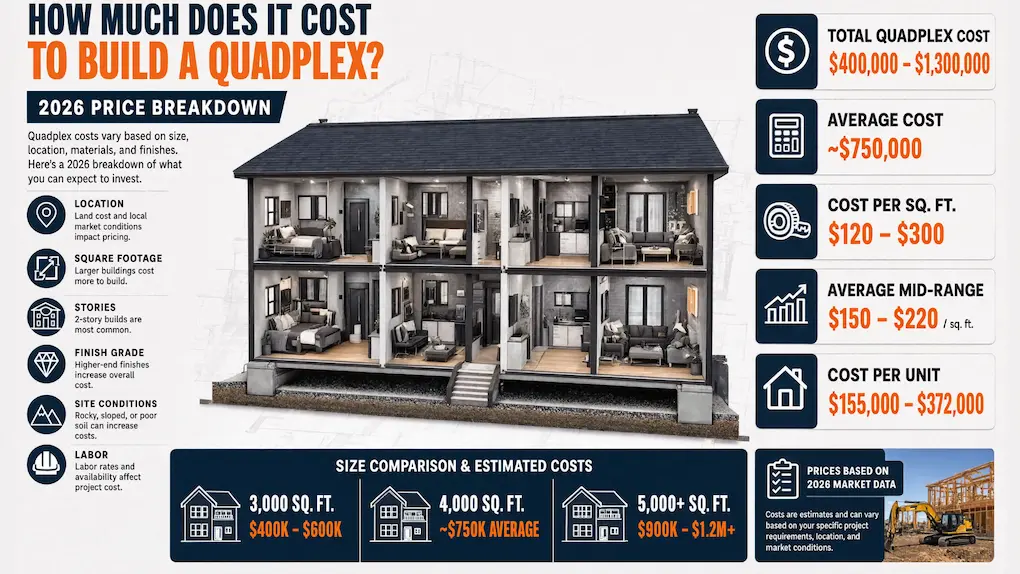
A quadplex costs $400,000 to $1,300,000 to build in 2026, averaging $120 to $300 per square foot. A standard 4,000-square-foot quadplex runs close to $750,000, or roughly $155,000 to $263,500 per unit. NEDES Estimating breaks down every hard cost, soft cost, and regional variable so you can budget your four-unit build with confidence instead of guesswork.
A quadplex (also called a fourplex) is a single residential building split into four separate dwelling units, each with its own kitchen, bathroom, and entrance. Investors like it because it sits at the exact edge of residential financing rules while still producing four rent checks. That edge is also why the cost question gets complicated fast.
What Is The Average Cost To Build A Quadplex In 2026?
The average cost to build a quadplex in 2026 is $750,000, with most projects falling between $400,000 and $1,300,000 depending on size, region, and finish level.
Per square foot, expect $120 to $300, with national data centering around $150 to $220 for a mid-range build. Per unit, budget $155,000 to $372,000, since shared walls, shared roofs, and shared foundations reduce the marginal cost of each additional unit compared to building four detached homes.
| Cost Metric | Low End | Average | High End |
| Total project cost | $400,000 | $750,000 | $1,300,000 |
| Cost per square foot | $120 | $180 | $300 |
| Cost per unit | $155,000 | $220,000 | $372,000 |
| Typical size | 3,000 sq ft | 4,000 sq ft | 5,500+ sq ft |
These figures reflect 2026 material and labor pricing. Construction costs shift year over year, so always confirm current lumber, concrete, and skilled-labor rates before finalizing a budget.
What Determines The Cost To Build A Quadplex?
Six factors determine quadplex construction cost: location, square footage, number of stories, material grade, site conditions, and labor rates.
Location
Location moves the price more than any other single variable. Coastal metros and high-demand urban submarkets push per-square-foot costs toward $250-$300+, while rural and secondary markets can land at $100-$150 per square foot. Local labor rates, union requirements, and permit-office turnaround times all compound this regional gap.
Square Footage And Unit Size
A 3,000-square-foot quadplex (four 750-square-foot units) sits at the low end of the budget, roughly $400,000 to $600,000. A 5,000-square-foot version, with more generous 1,250-square-foot units, typically runs $900,000 to $1,200,000+. Larger footprints mean more framing, more roofing, more HVAC tonnage, and more finish materials.
Number Of Stories
Two-story quadplexes cost $140 to $250 per square foot to build. Single-story quadplexes cost $100 to $200 per square foot. The gap exists because single-story builds skip stairwells, extra framing for a second floor, and additional fire-separation requirements between vertically stacked units. However, they need a larger lot footprint, which raises land cost instead.
Material And Finish Grade
| Finish Tier | Cost Per Sq Ft | What’s Included |
| Budget / Builder-Grade | $100-$150 | Laminate counters, vinyl flooring, standard fixtures |
| Mid-Range | $150-$220 | Quartz counters, LVP flooring, upgraded cabinetry |
| High-End / Luxury | $220-$300+ | Custom millwork, tile, smart-home systems, premium HVAC |
Site Conditions
Sloped lots, poor soil, high water tables, and existing structures that need demolition all add cost before the frame goes up. Excavation and grading alone can run $15,000 to $45,000, and that’s before soil remediation or retaining walls enter the picture.
Labor Market
General contractors typically charge 10% to 20% of total construction cost to manage a quadplex build. In tight labor markets (especially where skilled framers and MEP trades are scarce) that percentage climbs, and project timelines stretch alongside it.
Quadplex Cost Breakdown By Category
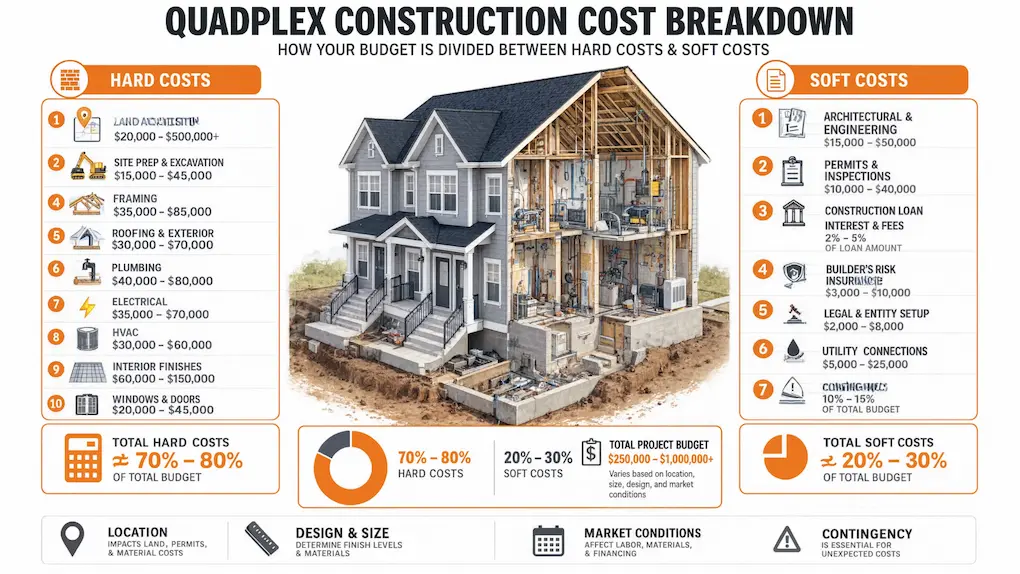
A full quadplex budget splits into hard costs (physical construction) and soft costs (fees, design, financing). Hard costs typically make up 70% to 80% of the total budget; soft costs make up the remaining 20% to 30%.
Hard Costs
| Category | Estimated Cost Range | Notes |
| Land acquisition | $20,000-$500,000+ | Highly market-dependent |
| Site prep & excavation | $15,000-$45,000 | Varies by slope and soil type |
| Foundation | $25,000-$60,000 | Slab standard; basement/pier-and-beam costs more |
| Framing | $35,000-$85,000 | Wood-frame baseline; steel runs 10-20% higher |
| Roofing & exterior | $30,000-$70,000 | Siding, insulation, shingles or metal roofing |
| Plumbing (4 units) | $40,000-$80,000 | Four kitchens, four bathrooms minimum |
| Electrical (4 units) | $35,000-$70,000 | Separate panels/meters typical for rental compliance |
| HVAC (4 units) | $30,000-$60,000 | Four independent systems preferred for tenant billing |
| Interior finishes | $60,000-$150,000 | Flooring, cabinetry, countertops, paint |
| Windows & doors | $20,000-$45,000 | Scales with unit count and floor count |
Soft Costs
| Category | Estimated Cost Range | Notes |
| Architectural & engineering design | $15,000-$50,000 | Higher for custom or multi-story layouts |
| Permits & inspections | $10,000-$40,000 | Varies sharply by jurisdiction |
| Construction loan interest & fees | 2%-5% of loan amount | Accrues over the build timeline |
| Insurance (builder’s risk) | $3,000-$10,000 | Required by most construction lenders |
| Legal & entity setup | $2,000-$8,000 | LLC formation, contracts, title work |
| Utility connection fees | $5,000-$25,000 | Water, sewer, gas, electric tie-ins |
| Contingency reserve | 10%-15% of total budget | Covers unforeseen site or material issues |
Soft costs get overlooked constantly, and that’s exactly where quadplex budgets blow up. Permit fees alone can stretch from $10,000 to $40,000 depending on how long plan review takes and whether local impact fees apply.
How Much Does It Cost To Build A Quadplex Per Unit?
The cost to build a quadplex per unit ranges from $155,000 to $372,000, averaging around $220,000 in 2026.
Per-unit pricing is the most useful benchmark for investors comparing a ground-up build against buying an existing quadplex, because it strips out the noise of total-square-footage differences between projects. A 750-square-foot unit at $200 per square foot costs roughly $150,000 to build; a 1,250-square-foot unit at the same rate costs about $250,000.
Shared systems lower per-unit cost. One roof, one foundation slab, and often one set of exterior walls serve all four units, so building a quadplex almost always costs less per unit than building four detached single-family homes of equal size.
Quadplex Vs. Fourplex: Is There A Cost Difference?
Quadplex and fourplex are the same building type; the terms are interchangeable and carry no cost difference. Both describe a four-unit residential structure, and pricing data for one applies directly to the other. Some regional markets favor “fourplex” (especially the Midwest and South), while “quadplex” appears more often in West Coast and investor-focused listings.
Get an Accurate Quadplex Construction Cost Estimate Before You Build
New Construction Vs. Duplex-To-Quad Conversion: Which Costs Less?
Converting an existing duplex into a quadplex typically costs less than new ground-up construction, since the foundation, roof, and main structural shell already exist.
| Approach | Typical Cost Range | Timeline | Best For |
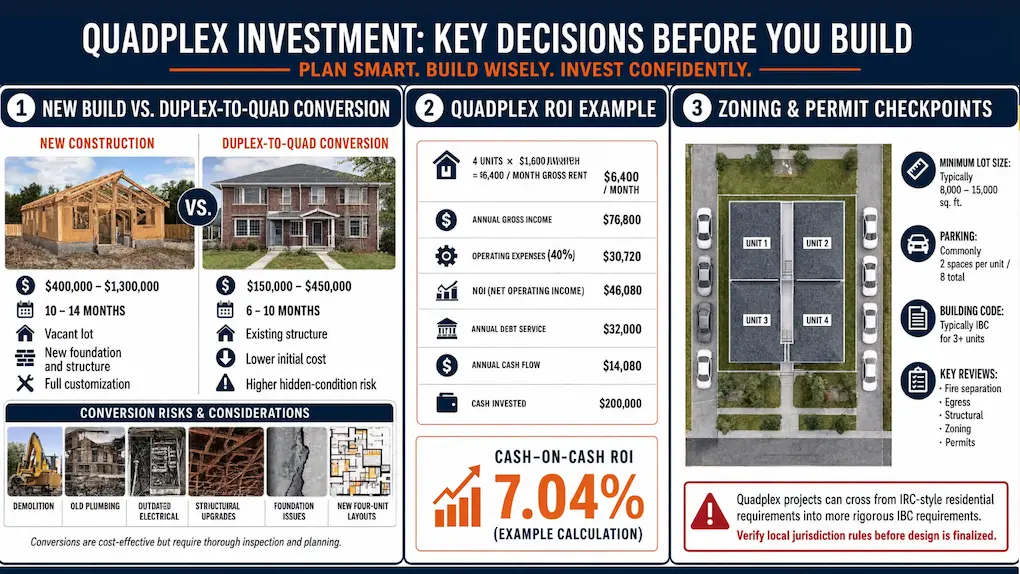
| New construction | $400,000-$1,300,000 | 10-14 months | Vacant lots, ground-up investors |
| Duplex-to-quad conversion | $150,000-$450,000 | 6-10 months | Existing structures with expandable layouts |
Localized Overview and NEDES Estimating
Conversions carry their own risk, though. Older structural systems, outdated electrical service, and undersized plumbing lines often need full replacement before four units can legally operate. Moreover, that discovery process rarely shows up until demolition begins.
Pennsylvania, in particular, has seen a surge of duplex-to-quad conversion activity in 2026, driven by older housing stock with flexible layouts and municipalities eager to add density without a full rezoning fight. The same pattern is emerging in other legacy Rust Belt and Northeast markets where prewar buildings already have oversized floor plans built for larger households.
NEDES Estimating flags these hidden-condition risks during the pre-construction estimate, before they become change orders mid-build. A thorough estimate accounts for probable-but-unconfirmed costs (knob-and-tube rewiring, cast-iron pipe replacement, foundation underpinning) as contingency line items rather than surprises discovered after demolition has already started and change-order leverage has shifted to the contractor.
How Does Financing Affect The True Cost To Build A Quadplex?
Financing costs typically add 5% to 15% on top of the construction budget, primarily through construction-loan interest, origination fees, and required reserves.
Because a quadplex still falls under the 1-to-4-unit residential classification, it qualifies for financing tools that five-plus-unit apartment buildings cannot access. One of the most notable ones is DSCR (Debt Service Coverage Ratio) loans. A DSCR loan for a quadplex qualifies the borrower based on the property’s projected rental income rather than personal income documentation.
Common Quadplex Financing Paths
- Conventional construction-to-permanent loans: Standard down payment 20-25%, best rates for qualified borrowers
- FHA 203(k) or FHA new construction: As low as 3.5% down if the owner occupies one unit
- DSCR construction loans: Income-based qualification, typically 25% down, rates in the 7.5%-8.5% range as of 2026
- VA loans: 0% down for eligible veterans who owner-occupy one unit
- Portfolio and private/hard-money loans: Faster closing, higher rates, useful for tight-timeline builds
Most residential DSCR programs require 6 months of PITIA (principal, interest, taxes, insurance, association dues) held in reserve after closing. On a typical four-unit property, that reserve requirement can exceed $20,000, and lenders will not release funds without proof it’s sitting in the bank.
What Are The Ongoing Costs After A Quadplex Is Built?
Ongoing quadplex ownership costs include property taxes, insurance, maintenance reserves, and property management, typically totaling 35% to 50% of gross rental income.
| Ongoing Cost | Typical Range (Annual) |
| Property taxes | 1%-2.5% of assessed value |
| Landlord insurance | $3,000-$8,000 |
| Maintenance reserve | 5%-10% of gross rent |
| Property management (if outsourced) | 6%-10% of gross rent |
| Vacancy reserve | 5%-8% of gross rent |
A four-unit building spreads vacancy risk across four income streams. If one unit sits empty, the property still collects roughly 75% of its potential rent. This one is a meaningful cushion compared to a single-family rental, where one vacancy means zero income.
What Is The ROI On Building A Quadplex?
Quadplex ROI is calculated by dividing annual net cash flow by total cash invested (down payment, closing costs, and construction costs paid out of pocket).
Example calculation: Assume four units each renting for $1,600/month.
- Gross monthly income: 4 × $1,600 = $6,400
- Gross annual income: $76,800
- Operating expenses (40% of gross): $30,720
- Net Operating Income (NOI): $46,080
- Annual debt service (mortgage): $32,000
- Annual cash flow: $14,080
- Cash invested (25% down + soft costs on $750,000 build): $200,000
- Cash-on-cash ROI: $14,080 ÷ $200,000 = 7.04%
Quadplex Zoning And Permit Requirements
Most jurisdictions require multi-family zoning (commonly R-3, R-4, or MF-1 designations) before a four-unit building is legally permitted.
Key zoning and permitting checkpoints:
- Minimum lot size: typically 8,000 to 15,000 square feet, though this varies widely by city
- Parking requirements: commonly 2 spaces per unit, or 8 total spaces
- Setback rules: front, side, and rear yard minimums that often exceed single-family standards
- Building code classification: buildings with 3+ units fall under the International Building Code (IBC) rather than the simpler International Residential Code (IRC) in most states, triggering more rigorous fire-separation, egress, and structural review
- Conditional use permits: some jurisdictions require public hearings or design review before approving a fourplex
A Hidden Risk In Quadplex Construction
This IBC-versus-IRC line is one of the highest hidden cost and timeline risks in quadplex construction. Crossing from a duplex (2 units, IRC-governed) into a triplex or quadplex (IBC-governed) can add commercial-grade fire-rated assemblies, sprinkler requirements in some jurisdictions, and a more expensive plan-review process.
Some states and cities are pushing to close this gap. A 2027 IRC proposal to bring triplexes and fourplexes under the simpler residential code was voted down at the committee level in early 2026, which means builders in most jurisdictions should plan around IBC requirements for the foreseeable future rather than hope for a code change mid-project.
A handful of local governments have adopted their own workarounds (expanded IRC amendments or single-stair reform ordinances) so it’s worth checking your specific municipality before assuming the stricter commercial rules apply.
Quadplex Construction Timeline
A typical quadplex build takes 10 to 14 months from permit approval to certificate of occupancy.
| Phase | Estimated Duration |
| Design & permitting | 2-4 months |
| Site prep & foundation | 3-6 weeks |
| Framing | 4-8 weeks |
| MEP rough-in | 3-5 weeks |
| Interior finishes | 8-12 weeks |
| Final inspections & CO | 2-4 weeks |
Turnkey Vs. Shell-Only Quadplex Construction
A turnkey quadplex build includes everything from foundation to final finishes, ready for tenants to move in. A shell-only build covers the structural envelope (foundation, framing, roof, exterior walls) and leaves interior buildout to the owner.
Shell-only builds cost roughly 40% to 60% less upfront but require a separate finish-out budget and timeline before the property can generate rent. Investors who plan to phase construction (building the shell now and finishing units as capital becomes available) often choose this route to manage cash flow, though it delays first rental income.
How Can You Reduce The Cost To Build A Quadplex?
Seven proven strategies lower quadplex construction costs without cutting corners on code compliance or livability.
- Choose a single-story, side-by-side layout where lot size allows. It eliminates stairwell framing and reduces fire-separation complexity between units.
- Standardize unit layouts so all four units share the same floor plan, cutting design fees and reducing framing waste.
- Get a detailed pre-construction estimate before breaking ground. This is where NEDES Estimating adds the most value, since accurate hard-cost and soft-cost projections prevent mid-project change orders.
- Choose mid-grade finishes in unit interiors; tenants rarely pay a rent premium high enough to justify luxury-tier materials.
- Bundle permit applications and work with a permit expediter in slow-moving jurisdictions to shrink the 2-4 month design-and-permitting phase.
- Negotiate fixed-price contracts with subcontractors early, locking in labor costs before material price volatility hits mid-build.
- Build during off-peak construction seasons in your region, when contractor availability is higher, and bids come in more competitively.
Why Get A Professional Quadplex Cost Estimate Before You Build?
A professional construction estimate identifies the true hard-cost and soft-cost total before you commit capital, preventing the budget overruns that sink small multifamily projects.
Generic per-square-foot ranges are a starting point, not a budget. Your actual number depends on your specific lot, your local labor market, your jurisdiction’s permit timeline, and your chosen finish tier. NEDES Estimating builds detailed, line-item quadplex estimates covering site work, framing, MEP, finishes, and soft costs, calibrated to your exact location and plans.
Whether you’re a first-time investor comparing build-versus-buy or a contractor bidding a four-unit project, an accurate estimate is the difference between a profitable build and a budget that unravels at month six.
Ready to get a real number instead of a guess? Request a detailed quadplex cost estimate from NEDES Estimating and build with a budget you can trust.
Frequently Asked Questions
How much does it cost to build a quadplex per square foot?
A quadplex costs $120 to $300 per square foot to build in 2026, with most mid-range projects landing between $150 and $220 per square foot.
How much does a quadplex cost per unit?
A quadplex costs $155,000 to $372,000 per unit, averaging around $220,000 per unit for a mid-range 2026 build.
Is it cheaper to build a quadplex than four single-family homes?
Yes. A quadplex is cheaper to build than four detached single-family homes of equal size, because shared foundations, shared roofing, and shared structural walls reduce material and labor costs per unit.
How long does it take to build a quadplex?
Building a quadplex takes 10 to 14 months from permit approval to certificate of occupancy, depending on jurisdiction and labor availability.
Can you get a conventional loan to build a quadplex?
Yes. Quadplexes qualify for residential financing, including conventional construction loans, FHA loans (with owner occupancy), VA loans, and DSCR loans, because they fall within the 1-to-4-unit residential classification.
What size lot do you need to build a quadplex?
Most jurisdictions require a minimum lot size of 8,000 to 15,000 square feet for a quadplex, though requirements vary significantly by zoning district and city.


