
Roof Replacement Cost in 2026: Prices by Size, Material & Labor
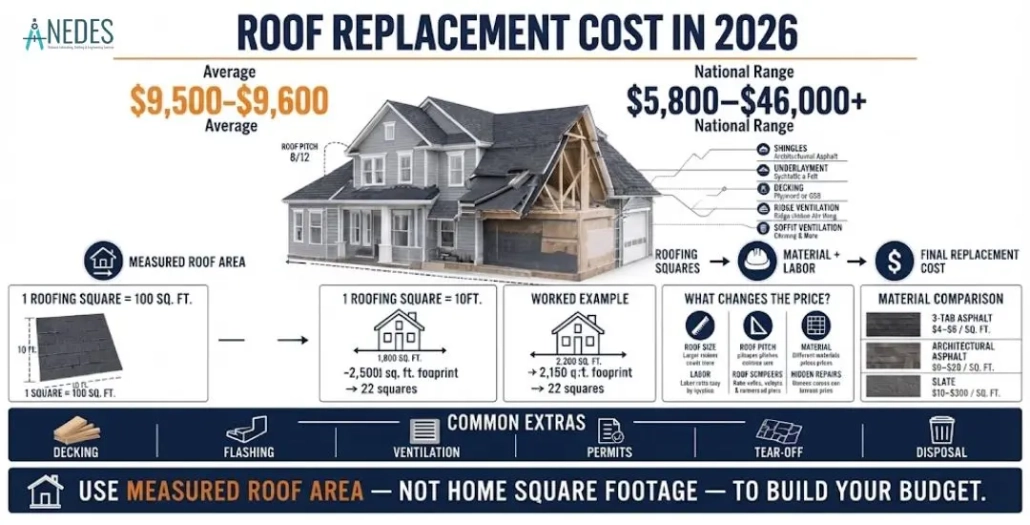
Most homeowners in the United States pay between $9,500 and $9,600 for a professionally installed roof replacement in 2026, based on national contractor pricing data from Angi. The full national range is much wider, stretching from roughly $5,800 to more than $46,000, because roof replacement cost is not one number. It is the product of roof size, material, pitch, labor conditions, and how much hidden repair work a contractor finds once the old roofing comes off.
A straightforward 2,000-square-foot asphalt shingle roof on a single-story home with a simple layout typically falls between $8,000 and $22,000. A steep, multi-plane roof covered in clay tile or standing seam metal can run two to five times higher. This guide breaks down exactly how contractors arrive at a number, so you can build your own preliminary budget, compare materials on more than sticker price, and read a contractor’s quote like someone who already knows what should be in it.
How Roof Replacement Cost Is Actually Calculated
Every roofing estimate starts with the same basic relationship: the measured area of the roof, converted into roofing squares, multiplied by an installed cost per square. Everything else in a quote (tear-off, decking, flashing, ventilation, permits) gets added on top of that base number.
What Is a Roofing Square?
A roofing square equals 100 square feet of actual roof surface. Contractors price and order material in squares because shingle bundles, underlayment rolls, and metal panels are manufactured and sold in units that cover roughly 100 square feet. A roof with 2,000 square feet of surface area needs about 20 squares of material, plus a waste allowance for cuts at hips, valleys, and ridges.
Why Roof Area Is Not the Same as Home Square Footage
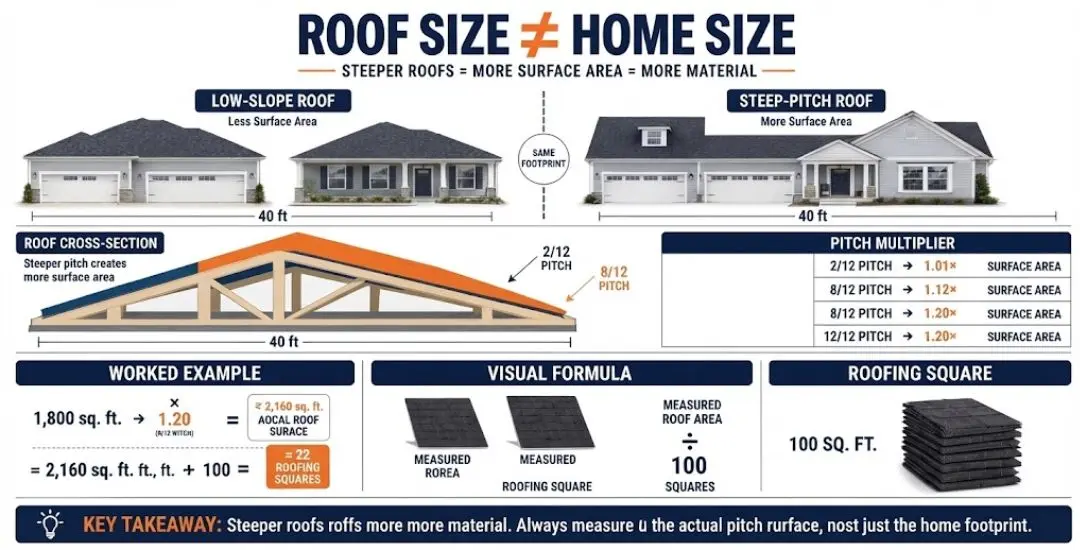
Living-space square footage describes the floor plan. Roof area describes the surface a contractor has to cover, which is almost always larger because of roof pitch, eave overhangs, attached garages, and porches.
Most contractors misjudge the quantities of material during takeoffs. That’s one of the most common mistakes during material acquisition. Two homes with identical floor plans can need noticeably different amounts of roofing material if one has a steep roof and the other has a low-slope roof.
Pitch is expressed as inches of rise per 12 inches of horizontal run. A steeper pitch stretches the same footprint over more actual surface area, which is why a contractor’s measured roof area is always the correct number to use, not the home’s listed square footage.
| Roof Pitch | Approx. Angle | Surface Area Multiplier | 1,800 sq ft Footprint Becomes |
| 2/12 (low-slope) | 9.5° | 1.01 | ≈1,818 sq ft |
| 4/12 | 18.4° | 1.05 | ≈1,890 sq ft |
| 6/12 | 26.6° | 1.12 | ≈2,016 sq ft |
| 8/12 | 33.7° | 1.20 | ≈2,160 sq ft |
| 10/12 | 39.8° | 1.30 | ≈2,340 sq ft |
| 12/12 (45°) | 45° | 1.41 | ≈2,538 sq ft |
Example: an 1,800-square-foot home footprint with an 8/12 pitch has an actual roof surface of about 2,160 square feet, or roughly 22 roofing squares once a standard waste allowance is added. That is 20 percent more material than the footprint alone would suggest.
Roof Replacement Cost by Roof Size in 2026
Using the widely published national planning range of $4 to $11 per square foot of measured roof surface, here is what different roof sizes cost to replace. These figures blend all common materials and installation conditions, so treat them as a starting budget range, not a quote for a specific material or home.
| Roof Surface Area | Roofing Squares | National Planning Range (2026) |
| 1,000 sq ft | 10 | $4,000 – $11,000 |
| 1,500 sq ft | 15 | $6,000 – $16,500 |
| 2,000 sq ft | 20 | $8,000 – $22,000 |
| 2,500 sq ft | 25 | $10,000 – $27,500 |
| 3,000 sq ft | 30 | $12,000 – $33,000 |
Remember that these ranges describe roof surface area, not the home’s living area. A 2,000-square-foot single-story ranch and a 2,000-square-foot two-story colonial can have meaningfully different roof sizes depending on footprint shape, pitch, and how much of the second floor sits under the same roof plane as the first.
Roof Replacement Cost by Material in 2026
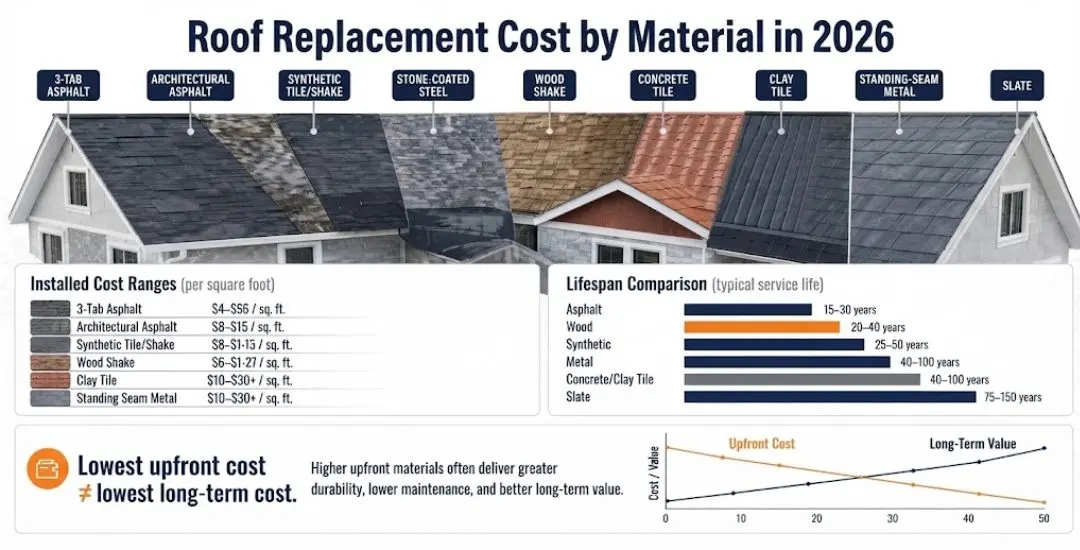
Material choice is the single biggest lever on total price. The table below compares installed cost per square foot, typical cost for a 2,000-square-foot roof, expected lifespan, and where each material tends to make the most sense.
| Material | Installed Cost / sq ft | 2,000 sq ft Roof, Typical Cost | Lifespan (Years) | Best Suited For |
| Asphalt (3-tab) | $4 – $6 | $8,000 – $12,000 | 15 – 20 | Tightest budgets, simple roof shapes |
| Asphalt (architectural) | $6 – $12 | $10,000 – $18,000 | 25 – 30 | Most US homes; cost-to-durability balance |
| Synthetic tile/shake | $8 – $15 | $16,000 – $30,000 | 25 – 50 | Slate or shake; look at lower weight and cost |
| Stone-coated steel | $10 – $18 | $20,000 – $36,000 | 40 – 70 | Hail-prone and high-wind regions |
| Wood shake | $6 – $15 | $12,000 – $25,000 | 20 – 40 | Natural aesthetic; needs regular maintenance |
| Concrete tile | $10 – $27 | $21,000 – $42,700 | 40 – 75 | Southwest and warm climates; Spanish/Mediterranean styles |
| Clay tile | $10 – $20+ | $21,000 – $42,700+ | 50 – 100 | Intense sun exposure; long ownership horizon |
| Standing seam metal | $12 – $30 | $24,000 – $37,300+ | 40 – 70 | Long-term owners; steep slopes; energy efficiency |
| Slate | $10 – $30+ | $20,000 – $60,000+ | 75 – 150+ | Historic homes; longest available lifespan |
Cost ranges above compile figures from Angi’s contractor survey data, NerdWallet’s national planning guide, and This Old House’s modeled 2026 cost research for a 2,000-square-foot roof. These sources use different assumptions about labor rates, product tiers, and roof shape, which is why ranges overlap loosely rather than matching exactly. None of them represents a specific contractor’s quote for your home.
Comparing Materials on Cost Per Year, Not Just Upfront Price
Upfront price tells only part of the story. Dividing installed cost by expected lifespan shows what a roof costs per year of service, which matters for long-term owners.
- Architectural asphalt: $10,000 over 25 to 30 years is roughly $360 per year.
- Standing seam metal: $37,300 over 40 to 70 years is roughly $530 to $675 per year.
- Clay tile: $42,700 over 50 to 100 years is roughly $570 to $850 per year.
- Wood shake: $25,400 over 20 to 40 years is the weakest per-year value here, at roughly $635 to $1,270 per year.
These figures use This Old House’s modeled 2,000-square-foot cost data and are illustrative. They exclude financing costs and regional wind or hail requirements that can favor one material regardless of price.
How to Calculate a Preliminary Roof Replacement Budget
The starting formula is simple: roofing squares × installed cost per square = approximate base cost. A contractor’s final number will almost always be higher, because a rough calculation cannot see what is happening underneath the shingles until tear-off begins.
Worked Example: Base Calculation
- Roof: 1,800 sq ft footprint, 8/12 pitch → about 2,160 sq ft of actual roof surface → 22 roofing squares.
- Material: architectural asphalt shingles at $9 per sq ft installed (midpoint of the $6-$12 range).
- Base calculation: 22 squares × $900 per square = $19,800.
Why the Final Quote Will Likely Be Higher
A rough calculation like the one above is a planning tool, not a contractor’s final quote. The items below are common on real projects and typically are not visible until the roof is measured up close or torn off.
- Steep-pitch surcharge: roofs at or above roughly 7/12 to 8/12 often add $1,000 to $3,000 for fall-protection equipment and reduced crew productivity.
- Decking replacement: rotten or delaminated plywood or OSB sheathing typically costs $75 to $150 per 4-by-8 sheet to replace, and is often not fully visible until the old roofing is removed.
- Additional tear-off layers: removing a second layer of old shingles adds roughly $1 to $2 per sq ft in extra labor and disposal.
- Flashing at chimneys, walls, and skylights: roughly $300 to $700 per penetration, depending on whether flashing is reused, rebuilt, or fully replaced.
- Ventilation upgrades: adding or correcting ridge and soffit vents typically runs $300 to $650.
- Building permits: most jurisdictions charge $150 to $500, and some require inspections at specific stages of the job.
- Disposal and dumpster fees: roughly $400 to $800 depending on roof size and local disposal costs.
Worked Example: What the Final Quote Might Look Like
| Line Item | Estimated Amount |
| Base material and labor (22 squares × $900) | $19,800 |
| Steep-pitch surcharge (8/12 roof) | $1,500 |
| Decking replacement (4 sheets at $130) | $520 |
| Chimney and two sidewall flashings | $650 |
| Ridge and soffit vent upgrade | $450 |
| Building permit | $275 |
| Disposal and dumpster fee | $550 |
| Estimated final total | $23,745 |
In this example, the extras add about 20 percent to the base calculation. That gap is normal and is exactly why a rough per-square-foot estimate should be treated as a planning number rather than a final budget.
Get a Detailed Roof Replacement Estimate
Labor Costs to Replace a Roof
Professional roofers generally charge $40 to $90 per hour per worker, according to Angi’s contractor data. A standard crew of three to six installers can typically finish a straightforward asphalt shingle roof on an average single-story home in one to three days. Metal panel systems, tile, and slate take longer because of fabrication, breakage precautions, and specialized fastening, often stretching a project to five to ten days or more.
Labor is commonly described as the majority of the cost on a simple asphalt job, but that share shrinks as material cost rises. A metal, tile, or slate roof shifts a larger portion of the total toward material cost even though the labor hours involved may be similar or greater. Because of this, comparing one contractor’s stated “labor percentage” against another’s is not a reliable way to judge value. Compare what each written proposal actually includes instead.
What Else Affects Roof Replacement Prices
- Roof complexity: hips, valleys, dormers, and multiple roof planes increase cutting, flashing, and waste.
- Number of stories and accessibility: second- and third-story roofs need additional fall protection and slow material staging.
- Local cost of living: labor rates and permit fees vary significantly by metro area and state.
- Climate-driven code requirements: hail-prone states often call for impact-resistant Class 4 shingles, hurricane-exposed coastal areas require wind-rated fastening patterns and sometimes FORTIFIED roof standards, and wildfire-prone Western states may require Class A fire-rated assemblies.
- Seasonal timing: spring and fall are peak demand seasons in most regions; scheduling during winter or the local off-season can offer more flexibility and, in some markets, softer pricing.
- Existing roofing layers: removing more than one layer of old shingles adds tear-off time and disposal weight.
- Contractor overhead: licensing, insurance, workers’ compensation coverage, and warranty administration are built into every legitimate quote.
Regional Price Differences Across the US
Roof replacement cost is not uniform nationally, and the differences are usually tied to climate and building code rather than pure geography.
● Hurricane And Coastal Zones
Enhanced fastening schedules, sealed decks, and wind-rated underlayment raise both material and labor costs.
● Hail-Prone Midwest And Plains States
Impact-resistant shingles cost more upfront but can qualify homeowners for insurance discounts in some states.
● Wildfire-Prone Western States
Class A fire-rated assemblies are often required by local code, ruling out some lower-cost options.
● High Cost-Of-Living Metros
Labor rates and permit fees run higher than national planning averages.
● Rural Areas
Fewer contractors specialize in premium materials, which can add travel time and reduce competitive bidding.
| State | Avg. Cost (2026) | Typical Range | Rank vs. Other States |
| Florida | $15,729 (Fixr) | $11,000 – $30,000 | Highest of this group |
| Georgia | ~$12,000 (Fixr, midpoint) | $8,000 – $20,000 | High |
| Colorado | $9,534 | $7,332 – $23,862 | High |
| Texas | $8,634 | $6,777 – $20,531 | Above average |
| Virginia | $8,315 | $6,774 – $19,409 | Above average |
| Washington | $8,118 | $6,156 – $20,811 | Above average |
| North Carolina | $7,653 | $6,022 – $19,233 | Near average |
| Pennsylvania | $7,489 | $5,740 – $19,078 | Near average |
| Arizona | $7,484 | $5,706 – $19,407 | Near average |
| Massachusetts | $7,361 | $5,748 – $17,575 | Near average |
| Ohio | $6,831 | $5,222 – $17,531 | Below average |
| Michigan | $6,553 | $4,994 – $16,840 | Below average |
| Illinois | $6,525 | $5,081 – $16,643 | Below average |
| California | $6,046 | $4,277 – $17,413 | Lower than expected given cost of living |
| New York | $5,519 | $4,254 – $13,879 | Lowest of this group (per this source) |
Roofing contractors follow installation standards published by the National Roofing Contractors Association, and local building departments enforce code requirements on top of those standards.
Repair vs. Replacement: How to Decide
Repair is not always the cheaper long-term choice, and replacement is not always necessary just because a roof is leaking. The table below outlines how the two scenarios typically differ.
| Factor | Repair Often Fits | Replacement Often Needed |
| Damage extent | Isolated leak or single flashing failure | Multiple leaks across different roof areas |
| Roof age | Well under the material’s expected lifespan | At or near the manufacturer’s expected lifespan |
| Shingle condition | Small localized damage | Widespread curling, cracking, or granule loss |
| Decking | Sound, no rot found on inspection | Soft spots, sagging, or rot in multiple areas |
| Typical cost | $300 – $1,500 | $8,000 and up, depending on size and material |
| Underlying cause | One-time storm or impact event | Ongoing, age-related deterioration |
Warning signs that point toward replacement rather than another round of repairs include shingles curling or missing across several slopes, granules collecting in gutters, visible daylight through the roof deck from inside the attic, repeated leaks in different locations after past repairs, and a roof that already carries two layers of shingles, since most codes limit a home to two layers before a full tear-off is required.
Does Homeowners Insurance Cover Roof Replacement?
Coverage depends on the cause of damage and the specific policy. Most homeowners insurance covers sudden, accidental damage from a named peril such as wind, hail, fire, or a falling tree, but not gradual wear or deferred maintenance.
Two settlement types matter here. Replacement cost value (RCV) pays what a comparable new roof actually costs. Actual cash value (ACV) pays the depreciated value of the old roof, which can leave a gap even after a covered claim. Some insurers shift older roofs to ACV automatically or exclude coverage past a certain age, and wind or hail deductibles are sometimes a percentage of the home’s insured value rather than a flat dollar amount.
Policy language and state rules vary widely, so review your specific policy or speak with a licensed insurance professional before assuming a claim will cover a full replacement. This article is not insurance advice.
Financing a Roof Replacement
A roof replacement is a major expense, and most homeowners use one of a few common financing paths rather than paying the full amount in cash.
- Contractor in-house financing: offered directly by the roofing company, sometimes through a third-party lender partner.
- Manufacturer promotional financing: tied to installing a specific product line, occasionally with limited-time promotional terms.
- Unsecured personal loans: faster to obtain and not secured by the home, typically at a higher interest rate than home-secured options.
- Home equity loans or HELOCs: often carry lower interest rates because the loan is secured by the home, but they put the home itself at risk if payments are missed.
Interest rates, fees, and promotional terms change often, so compare current offers directly with lenders rather than relying on a rate you saw previously. This article is not financial advice; consult a lender or financial professional about which option fits your situation.
What Should a Roof Replacement Estimate Include?
A useful, comparable roof estimate spells out the following rather than presenting a single lump-sum number:
- Measured roof area and roofing squares, not the home’s living-area square footage
- Tear-off scope, including the number of existing layers being removed
- Decking inspection terms and a unit price for any sheathing replaced after tear-off
- Underlayment type, including where ice-and-water shield will be installed
- Roofing material, brand, and product line, named specifically
- Flashing scope at chimneys, sidewalls, valleys, and skylights
- Ventilation plan, including intake and exhaust balance
- Permit responsibility and fees, plus cleanup and a magnetic nail sweep
- Manufacturer warranty terms and a separate workmanship warranty from the contractor
- Payment schedule and estimated start and completion dates
Questions to Ask a Roofing Contractor
Not asking the right questions is one of the most common construction estimating mistakes. Asking the wrong questions can lead to unnecessary answers and cost you a huge amount of time and revenue. Here’s a list of queries to put forward while roof replacement
- How many roofing squares did you measure, and how?
- What happens to the price if you find damaged decking once tear-off begins?
- Is the installation crew employed directly by your company or subcontracted?
- What does your workmanship warranty cover, separate from the manufacturer’s warranty?
- Can you provide proof of licensing and insurance for this jurisdiction?
- How will you protect landscaping, siding, and gutters during tear-off?
Ways to Reduce Roof Replacement Costs
- Get at least three written, itemized quotes rather than comparing verbal totals
- Schedule during a shoulder season or winter if the roof is not actively leaking
- Ask the contractor to replace only decking that inspection shows is damaged, not a blanket percentage
- Ask about installer-specific warranty upgrades, which can add coverage without changing shingle cost
- Consider architectural asphalt over premium tile or metal if you plan to sell within about ten years
- Bundle attic ventilation corrections into the same project instead of a separate service call
- Ask your insurer whether impact-resistant shingles qualify for a premium discount in hail-prone regions
How Long Should a New Roof Last?
A properly designed, installed roofing system should provide solid protection for roughly 20 years as a baseline, according to the National Roofing Contractors Association, with premium materials such as metal, tile, and slate lasting substantially longer, as shown in the material comparison table above. Extreme weather, poor ventilation, and substandard installation can shorten that baseline regardless of the material chosen.
New roofs typically come with two separate types of protection. The manufacturer warranty covers defects in the roofing product itself and can range from 25 years to a limited lifetime term. The workmanship warranty comes from the installing contractor and covers labor-related issues, typically for a much shorter period, often two to ten years. Confirm both in writing, since neither warranty guarantees the roof will reach its full expected lifespan under all conditions.
Frequently Asked Questions
How much does a new roof cost for a 2,000-square-foot house?
Using the $4 to $11 per square foot national planning range, a 2,000-square-foot roof typically falls between $8,000 and $22,000, though the exact figure depends heavily on material choice.
How much does a roof cost per square foot?
Installed roofing cost generally ranges from $4 to $30 per square foot depending on material, with asphalt shingles at the low end and slate, standing seam metal, and clay tile at the high end.
What is the cheapest roofing material?
Three-tab asphalt shingles are typically the least expensive option, at roughly $4 to $6 per square foot installed, though they also carry the shortest lifespan of common roofing materials.
Does roof replacement price include removing the old roof?
Standard installed pricing usually includes removing one layer of existing roofing. Removing a second layer, or dealing with unusually heavy or adhered material, typically adds an extra charge.
Is it cheaper to repair or replace a roof?
Repairing isolated damage, such as $300 to $1,500 for a localized leak, is cheaper upfront than a full replacement. Repeated repairs on an aging roof, however, can eventually cost more than a single planned replacement.
How can I reduce roof replacement costs?
Compare multiple written quotes, schedule during the off-season when possible, avoid unnecessary blanket decking replacement, and ask about insurance discounts for impact-resistant materials in applicable regions.
How many roofing squares does my house need?
Divide the measured roof surface area by 100. A roof with 2,000 square feet of surface area needs approximately 20 roofing squares, plus a waste allowance for cuts and roof geometry.
The Bottom Line
Roof replacement cost in 2026 comes down to a straightforward calculation multiplied by a long list of real-world variables: roof size in squares, material cost per square foot, pitch, complexity, region, and whatever a contractor finds once the tear-off begins.
Start with the size and material tables above to build a realistic planning range, then request a written, itemized estimate based on an actual roof measurement rather than a phone-quoted lump sum. A homeowner who understands how the number is built is in a far stronger position to evaluate whether a specific quote is fair. Call us to get more insights on construction estimating services and roof repair costs.


