
Construction Take-Off Costs in the US: A Practical Guide for Contractors
In today’s US construction market, intuition doesn’t pay the bills. Precision does! By 2025, construction-related costs made up more than 64% of the average new home price, leaving almost no room for sloppy math or optimistic assumptions. One missed quantity can erase a profit margin before the first crew shows up.
This is why the real groundwork of a profitable project isn’t poured on-site. It happens earlier inside the construction take-off costs.
This guide walks through what take-offs actually cost in the United States, how methods have changed, and why they now function as a financial control tool rather than a clerical task. Whether you work alone or run a growing GC operation, these numbers shape how safely you can bid.
What Is a Construction Take-Off? (2025 Perspective)
At its core, a construction take-off is a count. Every stud. Every fixture. Every square foot of drywall. It translates drawings into quantities, nothing more and nothing less. Think of it as the project’s ingredient list before pricing ever enters the picture.
In 2025, the process looks very different from what it once did. Paper plans and manual scaling have largely disappeared. Digital quantification now dominates, allowing estimators to work faster, revisit assumptions, and adjust scope without starting over.
How Take-Off Methods Have Changed
Estimators once relied on rulers, markers, and long afternoons hunched over printed sheets. That era is fading. Today, two primary approaches define the industry:
- 2D Digital Take-Off
PDF-based workflows using on-screen take-off software to measure lengths, areas, and item counts with far less friction.
- 3D / BIM Take-Off
Quantity extraction directly from Building Information Models. This approach shines on complex geometry and reduces clashes between trades when models are properly coordinated.
Each method has a place. Many firms now use both, depending on project size and documentation quality.
Average Take-Off Service Costs in the US
Keeping an estimator on payroll all year isn’t realistic for everyone. That’s why many contractors push take-offs outside the company. You pay when you need them. You don’t know when you don’t.
In 2025, most firms providing construction estimating services charge in one of three ways. Sometimes it’s a flat fee. Sometimes it’s hourly. High-volume builders may land on subscriptions, but that’s the exception, not the rule.

Hourly Rates for Professional Estimators (By Region)
Hourly pricing has no single baseline. Location matters. So does trade complexity. A residential drywall take-off is not priced like a healthcare project with layered specs and revisions.
| Region | Avg. Hourly Rate (Junior) | Avg. Hourly Rate (Senior / Expert) |
| Northeast (NY, MA, NJ) | $45 – $65 | $95 – $150+ |
| West Coast (CA, WA, OR) | $50 – $70 | $100 – $160+ |
| Midwest (IL, OH, MI) | $35 – $50 | $75 – $120 |
| South (TX, FL, GA) | $30 – $48 | $70 – $115 |
Junior estimators usually handle clean counts. Straight lines. Simple scopes. Senior estimators get pulled in when assemblies stack up, drawings conflict, or the bid actually carries risk.
Project-Based Take-Off Pricing
Flat pricing shows up most often on well-defined projects. The estimator knows what they’re walking into. Fewer surprises. Fewer revisions.
Rates are commonly tied to drawing count or total building size.
| Project Type | Typical Cost Range |
| Small Residential (Remodels / Additions) | $250 – $600 |
| Single-Family New Build (Standard) | $500 – $1,200 |
| Commercial (Small Office / Retail) | $1,000 – $3,500+ |
| Large Industrial / Multifamily | $5,000 – $15,000+ |
Once drawings start piling up, pricing climbs fast. A thicker set doesn’t just mean more pages. It means more coordination. More assumptions. More chances to miss something.
In-House Take-Off Costs: Software vs. Staff
Some contractors eventually pull take-offs inside. It can work. But only if volume stays steady. Otherwise, the math turns ugly.
There are two real construction take-off costs here. One is people, and the other is the tools they sit in front of.
Construction Estimator Salaries (2025 Data)
In 2025, a full-time construction estimator in the US earns about $89,471 per year on average.
| Experience Level | Salary Range |
| Entry-Level | $66,000 – $75,000 |
| Senior / Chief Estimator | $105,000 – $145,000+ |
That number isn’t the real cost. You need to add benefits, estimate property taxes, find out software licenses, and manage training time.
When it’s all counted, one in-house estimator usually costs $120,000 to $180,000 per year. Whether that’s smart or risky depends entirely on how often you’re bidding.
For firms with consistent bid volume, that investment can pay off. For others, outsourcing remains the safer financial move.
Take-off and Estimating Software Pricing
Investing in software reduces the time spent on take-offs by up to 50-70%. Here is a look at the current market rates for popular tools in 2025:
| Software | Best For | Estimated Cost (2025) |
| STACK | Cloud-based collaboration | ~$1,899+ / year per user |
| PlanSwift | Advanced 2D Take-off | ~$1,749+ / year |
| Buildxact | Small Residential/Remodelers | ~$150 – $400 / month |
| Contractor Foreman | Budget-conscious teams | ~$49 – $150 / month |
| Active Takeoff | One-time license seekers | ~$898 (One-time fee) |
Factors That Influence Construction Take-off Costs
Not all take-offs are created equal. Several variables can drive the cost of an estimate up or down:
- Project Complexity: A square warehouse is significantly easier (and cheaper) to quantify than a custom hospital with complex MEP (Mechanical, Electrical, Plumbing) systems.
- Trade Specificity: “General” take-offs are cheaper than “Specialty” take-offs. For example, a detailed electrical take-off requiring wire-length calculations and conduit counts is more labor-intensive than a simple framing take-off.
- Turnaround Time: Standard delivery is usually 3–5 business days. Expedited “Rush” take-offs (24-48 hours) often command a 25% – 50% premium.
- Quality of Plans: If the architectural drawings are incomplete or messy, the estimator must spend more time on “assumptions,” which increases the labor cost.
Get Accurate Construction Take-Off Costs—Consult Our Experts Today!
Regional Construction Cost Variations (Per Square Foot)
To understand construction take-off costs, one must understand the scale of the projects being estimated. In 2025, the national average to build a standard home ranges from $150 to $300 per square foot.
Commercial Construction Benchmarks
| Building Type | Low End (Per Sq. Ft.) | High End (Per Sq. Ft.) |
| Warehouse/Industrial | $140 | $240 |
| Standard Office | $240 | $500 |
| Medical/Healthcare | $450 | $1,000+ |
| Retail/Shopping | $120 | $450 |
Why Accuracy in Take-offs is the Ultimate Cost-Saver
While a professional take-off might cost you $1,000 upfront, a “bad” take-off can cost you $50,000 in the field.
The Hidden Costs of Poor Take-offs:
- Material Waste: Ordering 15% too much lumber due to a rounding error directly eats your profit.
- Shortages: Realizing you are short on specialized tiles mid-project can lead to “Rush Shipping” fees and idle labor costs while the crew waits for delivery.
- Underbidding: If your take-off misses a major component (like 200 linear feet of retaining wall), you may win the bid but lose money on every hour you work.
Pro Tip: In the current 2025 market, steel and lumber prices remain volatile. An accurate take-off allows you to lock in material quotes with suppliers early, protecting you against mid-project price spikes.
Strategic Value: The Bid-Hit Ratio
For contractors, the take-off is a numbers game. You likely won’t win every job you bid on.
- Industry Average: Most contractors have a “Bid-Hit” ratio of 1:5 or 1:10.
- The Problem: If you spend $1,000 on a professional take-off for every bid, and you only win 1 out of 10, you have “wasted” $9,000 in estimating construction takeoff costs for that one win.
- The Solution: Many successful contractors use Lightweight Preliminary Take-offs for the initial bid and only invest in a Detailed Professional Take-off once they make the short-list.
Trade-Specific Take-off Complexity: Why One Size Doesn’t Fit All
While a general contractor might look at a “total square footage” take-off, specialty trades require a much higher level of granularity. In 2025, the cost of a take-off is heavily influenced by the Density of Data required for that specific trade.
Electrical and MEP Take-offs: The High-Data Trades
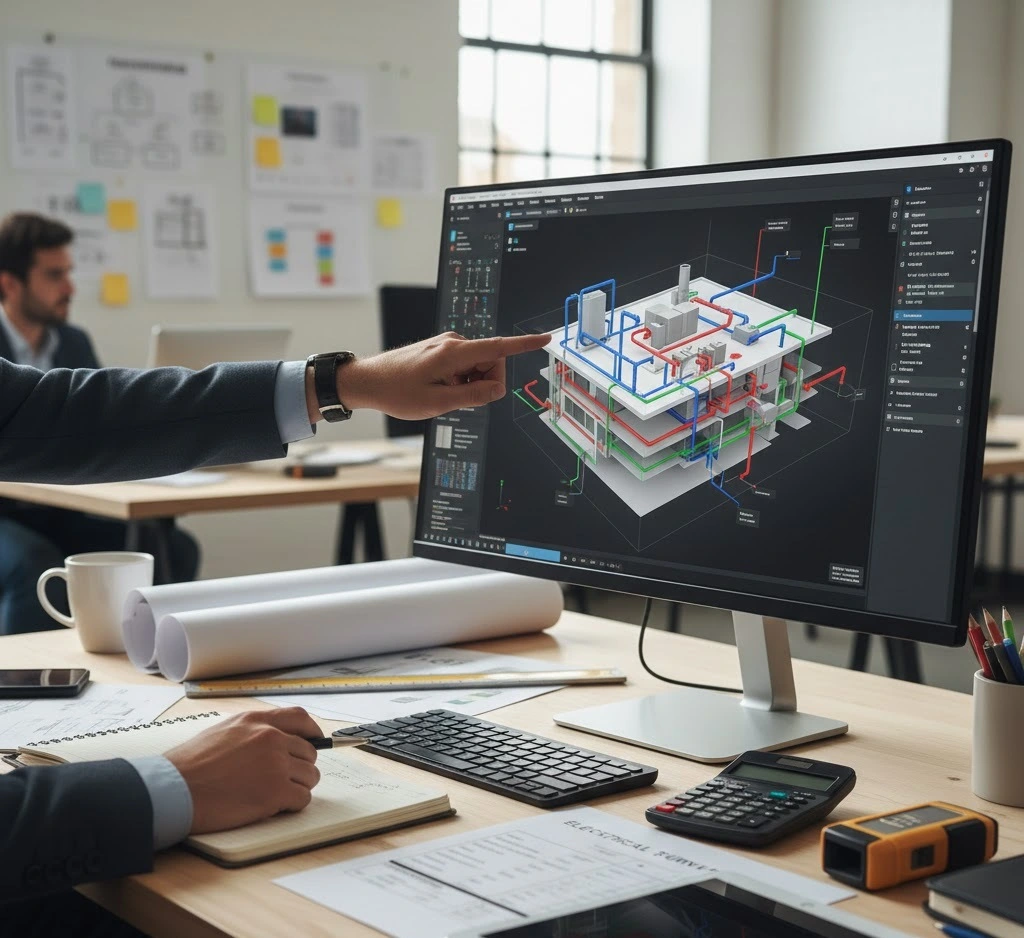
Electrical take-offs are widely considered the most difficult. They don’t just count fixtures; they must quantify linear feet of conduit, wire gauges, switchgear components, and specialized low-voltage systems.
- Complexity Factor:
- Outsourced Cost: Often 20-30% higher than standard framing take-offs.
- 2025 Trend: Integration of “Auto-Routing” software that predicts wire lengths based on device placement, reducing manual error by 40%.
Concrete and Structural Steel
Concrete take-off costs focus on volume and reinforcement. Accuracy here is vital because concrete has a “perishing” timeline once it leaves the plant.
- Key Metric: Cubic yards of concrete + Tons of rebar + Square feet of formwork.
- Risk: A 5% error in a large slab pour can lead to “short-load” fees or, worse, a cold joint in the structure.
| Trade | Primary Unit of Measure | 2025 Take-off Difficulty |
| Framing/Lumber | Board Feet / Linear Feet | Medium |
| Roofing | Squares (100 sq. ft.) | Low (Satellite imagery used) |
| HVAC | Linear Feet of Duct / BTU Load | High |
| Flooring | Square Yards / Square Feet | Low |
| Drywall | Total Square Footage of Wall | Medium |
Manual vs. Digital vs. AI: The 2025 Efficiency Gap
The role of AI in construction estimating is growing every passing day. In fact, the construction industry is currently undergoing an “AI Revolution.” As of late 2025, AI-driven take-off tools have moved from experimental to mainstream, creating a massive efficiency gap between those using legacy methods and those adopting automation.
The Efficiency Breakdown
| Metric | Manual (Paper/PDF) | Digital (On-Screen) | AI-Automated (2025) |
| Time Spent (Standard Home) | 6 – 10 Hours | 2 – 4 Hours | 15 – 30 Minutes |
| Error Rate | 5% – 10% | 2% – 5% | < 1% (with human review) |
| Update Speed | Very Slow (Re-draw) | Medium (Click/Drag) | Instant (Re-scan) |
| Avg. Cost per Bid | High (Labor-intensive) | Medium (Subscription) | Low (Per-project credits) |
AI and the New Language of Symbols
By 2025, take-off software no longer just measures lines. It reads drawings. Tools such as Beam AI and Drawer AI can move through a 100-page planset in minutes, spotting electrical outlets, sprinkler heads, window types, and repeated symbols across trades without missing a beat.
For contractors, the impact is practical, not theoretical. Work that once tied up an estimator for days now happens almost instantly. The result isn’t just speed but capacity! Many firms find they can pursue four times as many bids without expanding their estimating team.
The Legal Framework: Who Is Liable for Take-off Errors?
While calculating the cost to build a house, every contractor wonders if the take-off is wrong, who pays for the extra material? In the US, the answer depends heavily on your contract language and whether the estimator is an employee or a third-party consultant.
Independent Estimating Firms vs. Employees
- Third Party Estimators: Most established estimating firms protect themselves with Errors and Omissions (E&O) insurance. That sounds reassuring, and to a point, it is. But the fine print matters more than the policy name.
Nearly every estimating contract includes a limit of liability clause. In plain terms, responsibility is capped at the fee you paid. If a $500 take-off contains an error that later costs $10,000 in overruns, the firm’s exposure may still stop at that original $500. The risk doesn’t disappear. It just shifts.
- In-House Estimators: The contractor is 100% liable for errors made by employees. This is why many firms implement a “Double-Check” protocol where a senior superintendent reviews the take-off before the bid is submitted.
The “Spearin Doctrine” and Plan Accuracy
Under the Spearin Doctrine, a legal precedent in the US, the owner (or the architect they hire) provides an “implied warranty” that the plans are accurate. If the take-off is wrong because the blueprints were missing a page or had conflicting dimensions, the contractor may be entitled to a Change Order to cover the cost.
How to Negotiate Rates with Estimating Firms
If you choose to outsource your take-offs, you shouldn’t always accept the first quote. Use these 2025 strategies to get better value:
- Volume Discounts: If you commit to 5+ take-offs per month, most firms will offer a 15–20% discount on their project fees.
- Trade-Only Bundles: Don’t pay for a “General” take-off if you only need the HVAC quantities. Ask for a “Trade-Specific” rate.
- Provide Clean Files: Estimators charge for their time. If you provide organized, high-resolution vector PDFs instead of messy scans, they can work faster and charge you less.
- Value Engineering (VE): Ask the firm to provide a VE report alongside the take-off. If they can suggest a different material that meets the spec but costs 10% less, the take-off pays for itself immediately.
Incorporating Green Building and LEED Quantities
In 2025, a construction take-off is no longer just about volume; it is about “Carbon and Compliance.” With the U.S. government increasing incentives for green building, estimators are now tasked with a “Secondary Take-off” for sustainability metrics.
- Embodied Carbon Tracking: Modern take-offs often include a calculation of the carbon footprint of the materials listed. This is increasingly required for state-funded projects in California, New York, and Washington.
- Waste Diversion Estimates: A high-level take-off now predicts the volume of “scrap” or waste generated (e.g., 10% for lumber, 5% for drywall). By quantifying waste before the first delivery, contractors can order “Custom-Length” materials for a slight premium that actually saves money by reducing on-site dumpster fees and labor.

The “Volatility Buffer”: Protecting Profits in a Shifting Market
One of the most significant challenges for U.S. contractors in the current economy is the gap between the Take-off Date and the Procurement Date. In 2025, price locks from suppliers have shortened from 30 days to sometimes as little as 7 days for commodities like copper and PVC.
The Shift Toward “Model-Based” Procurement
The most advanced contractors in the US are moving away from traditional “Linear Take-offs” and toward Model-Based Estimating. In this workflow, the take-off data is plugged directly into the supplier’s ordering system.
- Just-In-Time (JIT) Delivery: By having a hyper-accurate take-off, you can schedule “Phased Deliveries.” Instead of having $100,000 of lumber sitting on a muddy job site (prone to theft and weather damage), you use the take-off to deliver exactly what is needed for “Floor 1” on Monday and “Floor 2” the following week. This improves cash flow and reduces insurance premiums on-site.
Conclusion: Where Accuracy Pays Back
By 2025, a construction take-off will have quietly moved out of the “busywork before bidding” category. It now sits closer to strategy. Every count pulled during this phase ends up touching something else, material orders, crew sequencing, even how much room you have to absorb surprises without bleeding cash.
Firms that treat construction take-off costs as a serious discipline tend to feel it in the numbers. Contractors using refined processes, better software, experienced estimators, or trusted external partners often see profit margins climb by as much as 12 percent. In a field where five percent is considered healthy, that gap is not academic. It’s survival.
FAQs
What does a professional residential take-off usually cost in 2025?
For a typical single-family home, pricing commonly lands between $500 and $1,200. The final number depends on size and scope. A basic structural count costs less than a full breakdown covering MEP systems.
Can AI take-off tools fully replace human estimators now?
No. AI is fast. Very fast. It measures and counts with impressive speed. What it still lacks is judgment. Human review is needed to catch overlaps, unusual assemblies, and design intent that software misreads.
How is a take-off different from an estimate?
A take-off deals only in quantities. Nothing more. An estimate builds on that foundation by adding labor, material pricing, overhead, markup, and taxes. Without clean quantities, cost projections quickly fall apart.
Why do commercial take-offs cost so much more than residential ones?
Commercial drawings are heavier, longer, and regulated to a different standard. Code requirements, accessibility rules, and fire systems add complexity. It’s not unusual to review 200 sheets instead of 15. That time adds up.
Can I use free take-off software?
There are free tools like “Adobe Acrobat” or basic PDF viewers with measuring tools, but they cannot “categorize” and “sum” data. For any professional contractor, the time wasted using a free tool is usually more expensive than paying for a $100/month subscription.
Should I charge my clients for the cost of the take-off?
Most contractors include the cost of estimating in their “Overhead” or “Pre-construction Fee.” If you are doing a complex design-build, it is common to charge a non-refundable “Estimating Fee” that is credited back to the client if they sign the construction contract.