Construction Bidding Software: Guide for Contractors in 2026
Contractors are bidding against more companies, on tighter timelines and with thinner margins. One missed detail in your bid package can cost you a contract worth hundreds of thousands of dollars. That’s where construction bidding software changes the game entirely.
The global construction bid management software market is expected to grow to USD 3.35 billion by 2035 a CAGR of 12.03%. Nearly 70% of US construction firms already rely on some form of bid management software to sharpen their competitive edge.
This guide covers everything you need to know. We will highlight what the construction bidding software does, which features matter, how to choose the right tool, and how Nedes Estimating fits into that picture.
What Is Construction Bidding Software?
Construction bidding software is a digital platform that helps contractors organize, prepare, and submit bids for construction projects. It replaces the old way of doing things (spreadsheets, email chains, paper files) with a single centralized system.
But it goes far beyond just submitting proposals. The right platform connects every stage of the pre-construction workflow: finding project leads, estimating costs, coordinating with subcontractors, managing bid documents, and tracking outcomes, all in one place. Think of it as your pre-construction command center!
The Three Core Functions
1. Project Discovery
Helps you find relevant bid opportunities early enough to respond competitively
2. Bid Management
Centralizes invitations, documents, subcontractor outreach, and all communication
3. Estimating Integration
Connects takeoff data to cost calculations so your numbers stay accurate

Why Construction Bidding Is Broken Without the Right Tools
Manual bidding is slow, error-prone, and exhausting. Most contractors are managing five to fifteen active bids at any given time. Without software, that means tracking dozens of deadlines across scattered spreadsheets, chasing subcontractor quotes over text and email, and rebuilding estimates from scratch every time.
The cost of getting it wrong is severe. An underbid project erodes your margin. An overbid means losing the contract entirely. A missed submission deadline means zero revenue from weeks of work.
According to industry data, contractors who adopt bid management tools report significant improvements in bid accuracy, win rates, and overall project profitability. The software doesn’t just save time but also fundamentally improves how decisions get made.
Common Problems Contractors Face Without Software
- Losing track of bid deadlines across multiple projects
- Inaccurate estimates caused by manual data entry errors
- Poor visibility into subcontractor responses and availability
- Wasted hours rebuilding similar bids from scratch each time
- Inconsistent bid packages that hurt your professional image
- No historical data to analyze which bids you win and why
Key Features to Look for in Construction Bidding Software
Not all platforms are created equal. Some are built for general contractors. Others target specialty trades or subcontractors with specific features (integrating real-time tariff tracking). The features that matter most depend on your role and project scope.
That said, there’s a core set of capabilities that every serious platform should offer.
| Feature | Why It Matters | Who Benefits Most |
| Cost Estimation Tools | Accurate pricing without manual calculation | GCs, Specialty Contractors |
| Document Management | Centralized storage of plans, specs, and RFIs | All Contractors |
| Subcontractor Management | Track quotes, compliance, and availability | General Contractors |
| Bid Tracking Dashboard | Monitor submission status and deadlines in real time | Estimators, PMs |
| Template Library | Reuse winning bid formats to save setup time | All Contractors |
| Cloud-Based Access | Work from any device, anywhere | Field Teams, Remote Staff |
| Integration with Project Management | Winning bids flow directly into project workflows | GCs, Owners |
| Analytics & Reporting | Understand win rates and refine your strategy | Business Owners |
Types of Construction Bidding Software Explained
The market breaks down into a few distinct categories. Knowing which type fits your workflow prevents you from paying for features you’ll never use or missing the ones you need most.
1. Construction Estimating Software
This type focuses on calculating project costs. It provides access to cost databases, material pricing, labor rate libraries, and takeoff tools. Estimators can build detailed line-item breakdowns with construction estimating software without starting from zero each time.
Best for: Estimators and specialty contractors who need speed and precision in pricing.
2. Bid Management Platforms
These platforms manage the full lifecycle of a bid, from invitation to submission. They centralize document distribution, track who has downloaded plans, send automated reminders, and let you compare incoming subcontractor quotes side by side.
Best for: General contractors managing complex bid packages across multiple trades.
3. Project Lead & Discovery Tools
These tools help you find projects in the first place. They scan public and private project databases, filter by location and trade, and alert you when relevant opportunities go out to bid.
Best for: Business development teams and contractors looking to grow their pipeline.
4. All-in-One Construction Management Suites
Platforms like Procore combine bidding, estimating, project management, and financials under one roof. Once a bid is won, all the data flows directly into scheduling, budgeting, and field management, with no duplicate entry required.
Best for: Mid-to-large contractors who want a single platform across the full project lifecycle.
Top Construction Bidding Software Platforms in 2026
The market has matured significantly. Cloud-based platforms now account for more than 60% of the market, and for good reason. Real-time data access, automatic updates, and lower upfront costs make SaaS the preferred choice for most contractors today.
Here’s a quick comparison of the leading platforms:
| Platform | Best For | Standout Feature | Pricing Model |
| Procore | Large GCs | End-to-end project integration | Custom quote |
| Buildertrend | Residential Builders | Client-facing portal + scheduling | Monthly subscription |
| BuildingConnected | Subcontractor outreach | Bid invitation network | Freemium + paid tiers |
| PlanHub | GCs & Specialty Trades | Project lead discovery + document sharing | Subscription |
| STACK | Estimators | Digital takeoff + cloud estimating | Per-user pricing |
| Sage Estimating | Enterprise Contractors | Deep cost database integration | Custom quote |
| CoConstruct | Custom Home Builders | Client selection sheets + budgeting | Monthly subscription |
No single platform is perfect for every contractor. The right choice depends on your trade, team size, and the complexity of your typical projects.
How Construction Bidding Software Improves Win Rates
Speed and accuracy are the two biggest factors that separate winning bids from losing ones. Construction bidding software directly attacks both.
Speed: Submit Before Your Competitors
When a project goes out to bid, the contractors who respond first (with complete, professional packages) make a better first impression. Software cuts the time it takes to assemble a bid by pulling in templates, pre-loaded cost data, and saved subcontractor lists. What used to take three days can be done in one afternoon.
Ready to find the best construction bidding software for your business? Contact our experts today and discover the tools that can help you win more projects in 2026.
Accuracy: Price It Right Every Time
Manual estimating is where mistakes hide. A transposed number, an outdated material price, a missed line item, any of these can turn a profitable bid into a money-losing contract.
Software integrates live cost databases, automatically recalculates totals when quantities change, and flags inconsistencies before submission. That kind of built-in checking is something spreadsheets simply cannot replicate. Also, it helps in easy approvals from the GSA (General Services Administration) for federal construction projects.
Professionalism: Win on Presentation Too
A polished, well-organized bid package signals competence. Software generates clean, branded proposals automatically. Owners and developers notice this, especially on competitive bids where the price difference between finalists is narrow.
Construction Bidding Software vs. Manual Estimating
| Factor | Manual Estimating | Construction Bidding Software |
| Time per bid | 3-5 days average | 4-16 hours depending on complexity |
| Error rate | High (human data entry) | Low (automated calculations) |
| Historical data access | Spreadsheet archives (slow) | Instant database search |
| Subcontractor coordination | Phone calls + email threads | Centralized invite + response tracking |
| Scalability | Limited by team size | Handles multiple simultaneous bids |
| Document version control | Manual, prone to confusion | Automatic version tracking |
| Reporting & analytics | Manual compilation | Real-time dashboards |
| Cost | Low upfront, high labor cost | Subscription fee, lower labor overhead |
What Makes a Good Construction Bid? Software Can Only Help If Your Estimates Are Solid
Here’s something the software vendors won’t tell you: no platform can fix a bad estimate. If your material quantities are wrong, if your labor rates are outdated, or if you’ve missed a scope item entirely, the software will just calculate the wrong number faster.
That’s why the most successful contractors pair great software with expert estimating. The software manages the process. The expertise drives the numbers.
At Nedes Estimating, we provide professional construction estimating services that slot directly into your bidding workflow. Whether you’re using Procore, Buildertrend, or a simpler platform, our detailed takeoffs and cost estimates give you the foundation your bid needs to be competitive and profitable.
How to Choose the Right Construction Bidding Software for Your Business
With dozens of platforms on the market, making the wrong choice wastes both money and time. Here’s a practical framework for evaluating your options.
Step 1: Define Your Role in the Bidding Process
Are you a general contractor managing subcontractors? A specialty trade contractor responding to invitations? A residential builder working directly with homeowners? Each role has different software requirements.
Step 2: Identify Your Biggest Pain Points
Is time the problem? Then prioritize platforms with strong template libraries and automation. Is accuracy the issue? Focus on estimating tools with robust cost databases. Are you losing track of deadlines? Look for a platform with a clear bid tracking dashboard.
Step 3: Assess Your Team’s Tech Comfort Level
The most powerful platform is worthless if your team won’t use it. Consider how much training is required, how intuitive the interface is, and whether the vendor offers responsive customer support.
Step 4: Check Integration Compatibility
Your bidding software should connect to the tools you already use. Check whether it integrates with your accounting software, project management platform, and scheduling tools. Isolated software creates data silos, which defeats the purpose.
Step 5: Start with a Trial Before Committing
Most serious platforms offer a free trial or demo period. Take full advantage. Run a real bid through the system. If it creates friction rather than removing it, that’s a clear signal to look elsewhere.
The Role of Cloud Technology in Modern Construction Bidding
Cloud-based platforms now dominate the market, accounting for more than 60% of all construction bidding software deployments. The shift makes sense. Cloud platforms update automatically, require no IT infrastructure, and allow your team to access bid data from any device, like a site trailer, home office, or client meeting.
Real-time collaboration is the biggest advantage. When your estimator updates a material quantity in the office, your project manager sees the revised total immediately on their tablet in the field. No version confusion, no outdated spreadsheets circulating in email threads.
For small and medium contractors in particular, cloud software levels the playing field. You get enterprise-grade capabilities, bid consultancy services, and synergic collaboration without enterprise-level IT costs.
Construction Bidding Software Pricing: What to Expect in 2026
Pricing varies widely based on platform size, features, and company scale. Most vendors use tiered models rather than flat per-user rates, and many require a custom quote for larger teams.
| Pricing Tier | Typical Monthly Cost | What’s Included | Best For |
| Basic / Starter | $49 – $149/month | Core estimating, templates and limited users | Solo contractors, small teams |
| Professional | $150 – $499/month | Full bid management, subcontractor tools, integrations | Growing SMBs |
| Business / Advanced | $500 – $1,500/month | Analytics, unlimited users, priority support | Mid-size contractors |
| Enterprise | Custom quote | Full suite, dedicated onboarding, API access | Large GCs, national firms |
Beyond the subscription fee, factor in implementation time, training, and the cost of migrating existing data. Most serious platforms offset these costs quickly through labor savings alone.
Hidden Costs and Pitfalls to Watch Out For
Software vendors are good at selling benefits. They’re less forthcoming about the challenges. Here’s what the fine print often doesn’t say.
- Implementation takes longer than expected. Budget 2-4 weeks minimum for setup and team onboarding
- Data migration is tedious. Moving years of historical estimates into a new system is time-consuming
- Integration gaps exist. Not every platform connects cleanly with every accounting or PM tool
- Per-seat pricing adds up fast. What looks affordable for two users becomes expensive at ten
- Feature bloat is another hidden cost. Some platforms charge for modules you’ll never need
What’s The Fix?
Define your requirements clearly before you shop. Build a checklist of must-have features, nice-to-haves, and dealbreakers, then evaluate platforms against that list, not the vendor’s marketing.
How We Support Your Bidding Process
Software handles the workflow. Expertise handles the numbers. The most competitive contractors understand that these two things work best together.
Nedes Estimating provides outsourced construction estimating services for contractors across all trades, residential, commercial, and industrial. Our estimators work directly from your project drawings and specifications to produce detailed, accurate takeoffs and cost estimates.
What does that mean for your bidding process? It means you can respond to more RFBs without burning out your in-house team. You get professionally formatted estimates that plug directly into your bidding software. And you get a team that’s done this thousands of times across every major trade.
Our Services Include
- Material and quantity takeoff services
- Electrical, mechanical, plumbing, and HVAC estimating
- Concrete, framing, and structural estimating
- Commercial and residential cost estimating
- Bid consultancy and review services
- Xactimate estimating for insurance and restoration work
Whether you’re bidding on your next commercial project or managing a pipeline of residential developments, Nedes Estimating helps you walk into every bid with numbers you can stand behind. Visit the NEDES webpage to get started or request a free estimate.
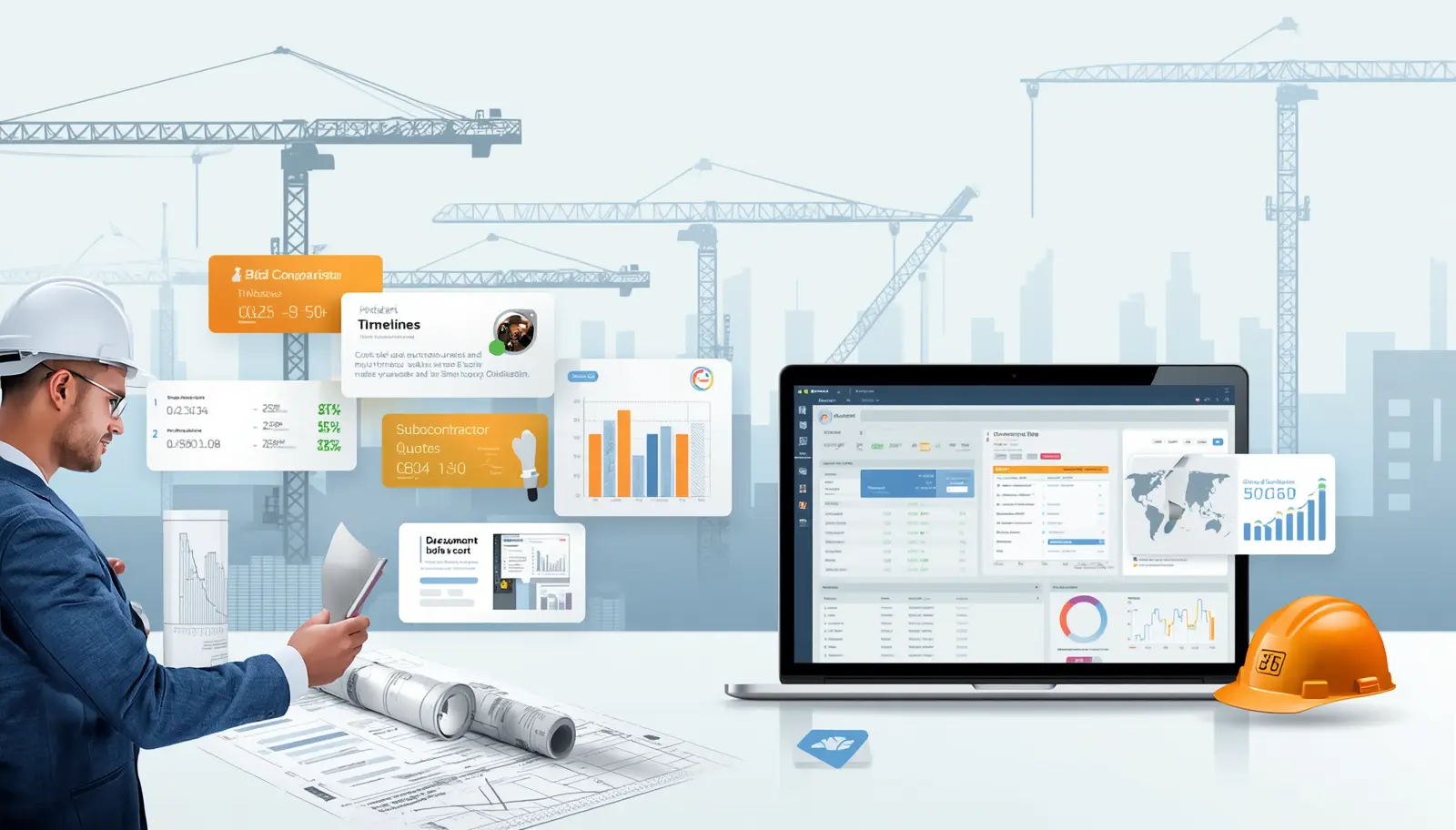
The Future of Construction Bidding Software
Technology is evolving fast. AI-powered cost prediction, automated scope gap detection, and machine learning-driven win rate analysis are no longer science fiction; they’re features appearing in leading platforms right now.
Expect the next generation of software to get smarter about risk. Platforms will flag when a bid’s margin is too thin for the project’s complexity. They’ll predict subcontractor response rates based on historical data. They’ll suggest scope adjustments based on your past win patterns.
The construction management software market is forecast to grow from USD 10.62 billion in 2025 to USD 17.81 billion by 2031, a clear signal that digital transformation in construction is accelerating, not slowing down.
Contractors who build their workflows around good software today will be significantly better positioned to compete as the tools get sharper.
Frequently Asked Questions
What is construction bidding software used for?
It’s used to manage the full pre-construction bidding workflow, finding project leads, building cost estimates, organizing bid documents, coordinating with subcontractors, and tracking submission deadlines. The goal is faster, more accurate bids that win more contracts.
Is construction bidding software worth it for small contractors?
Yes. In fact, small contractors often benefit the most. With limited staff, every hour saved on manual bid prep has a direct impact on capacity. Cloud-based platforms with starter-tier pricing make professional bid management accessible even for solo operators.
How does bidding software help with subcontractor management?
Most platforms let you send bid invitations to a database of subcontractors, track who has opened the documents, and compare incoming quotes side by side. This dramatically reduces the back-and-forth of traditional subcontractor coordination.
Can construction bidding software integrate with accounting tools?
Most major platforms integrate with accounting tools like QuickBooks, Sage, and others. Check integration compatibility before committing; this is one of the most common post-purchase frustrations contractors report.
What’s the difference between estimating software and bid management software?
Estimating software focuses on calculating project costs (takeoffs, material pricing, labor rates. Bid management software handles the broader process) invitations, document distribution, subcontractor communication, and submission tracking. Many contractors use both or choose an all-in-one platform that combines them.
How can Nedes Estimating help with my construction bids?
Nedes Estimating provides outsourced takeoff and cost estimating services for contractors across all trades. We deliver detailed, accurate estimates that you can import directly into your bidding software, so you spend less time on number-crunching and more time on winning work. Visit nedesestimating.com to learn more.
Final Thoughts
Construction bidding software isn’t a luxury anymore. It’s infrastructure. The contractors who win consistently in 2026 are the ones who’ve built disciplined, tech-enabled bidding processes, where every estimate is accurate, every deadline is tracked, and every submission looks professional.
The software handles the workflow. But the quality of your estimates is still what separates a winning bid from a losing one. That’s where Nedes Estimating comes in with accurate construction estimating services, fast turnaround in every trade and project type.