Cement Blocks vs Cinder Blocks vs Concrete Blocks: What’s the Difference?
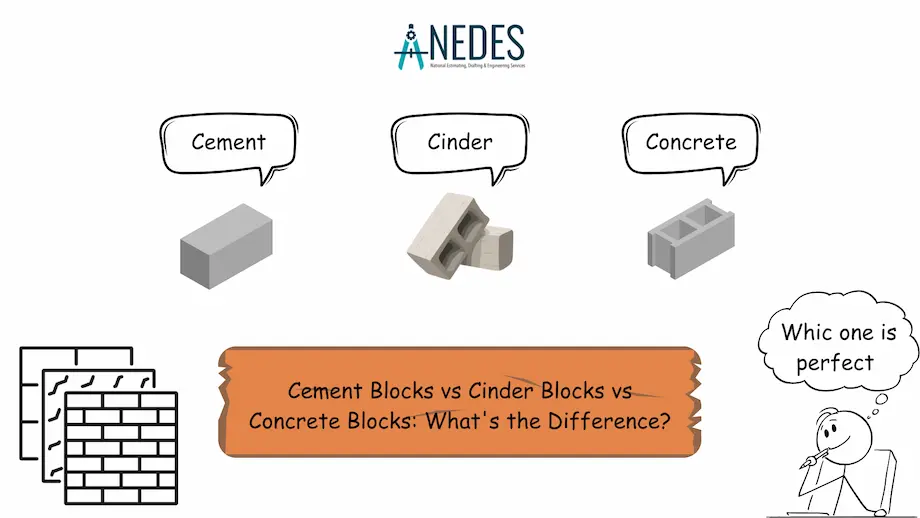
Cement blocks, cinder blocks, and concrete blocks get treated like interchangeable products on most job sites, but they are not built the same way.
- Cement blocks are made primarily from cement, fine sand, and water, with little or no coarse aggregate, which caps how much weight they can carry.
- Cinder blocks historically relied on coal cinders as a lightweight filler aggregate, trading strength for reduced weight.
- Concrete blocks, formally called concrete masonry units (CMU), use dense aggregate such as gravel and crushed stone, and they now dominate structural construction because of it.
Composition decides everything downstream: strength, weight, durability, fire resistance, and cost. For the complete breakdown of every masonry unit used in U.S. construction, contact our team.
Choosing a block by price, or by whatever sits on the yard’s first pallet, tends to surface problems years later: cracked partitions, water-damaged garden walls, and foundations that fail inspection. Cement blocks, cinder blocks, and concrete blocks differ across five practical categories: strength, cost, weight, durability, and application.
Each category determines whether a block belongs in a load-bearing wall or a flower bed, not personal preference or habit. This guide compares all three using current ASTM standards and real contractor data rather than trade-name habit. For a broader look at how block selection affects project budgets, contact our team.
Understanding the Three Types of Blocks
Cement, cinder, and concrete get used interchangeably in casual conversation, but only one of the three terms maps to an actual regulated category. “Concrete block” refers to a defined product, the concrete masonry unit, governed by ASTM C90. “Cinder block” refers to a now-uncommon aggregate type that survives mainly as a nickname for any lightweight CMU.
“Cement block” is not a standardized industry category at all; suppliers use the term regionally to describe a cement-heavy, low-aggregate block. Four entities matter most once you start comparing performance: the concrete masonry unit (CMU), Portland cement, aggregate, and fly ash.
Each one shapes how a finished block behaves once it is mortared into a wall, which is why understanding the building block terminology correctly matters before comparing specifications.
What Are Cement Blocks?
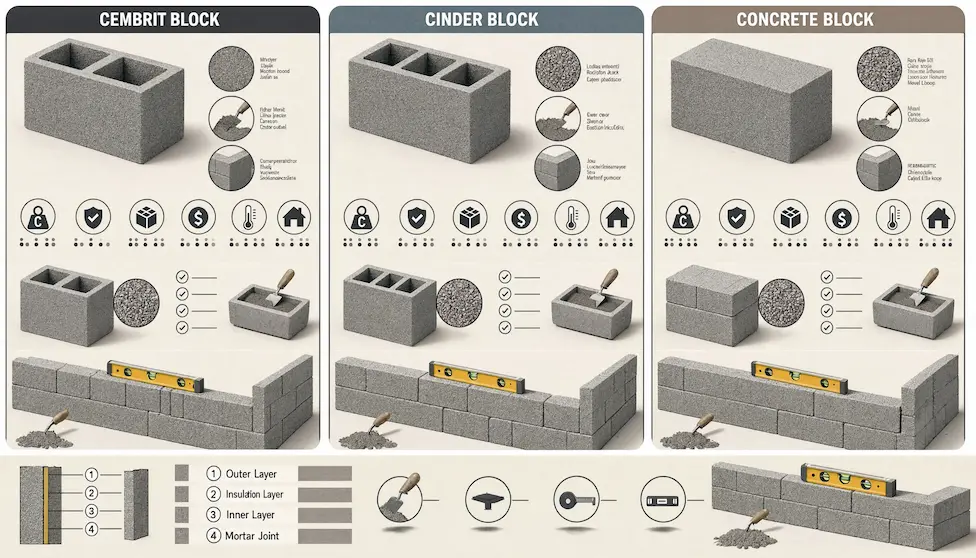
A cement block is a precast masonry unit made primarily from Portland cement, fine sand, and water, with little to no coarse aggregate added to the mix. Manufacturers combine the materials into a semi-dry mixture, press it into molds under high pressure, and cure the units for 24 to 48 hours before they are stacked for sale.
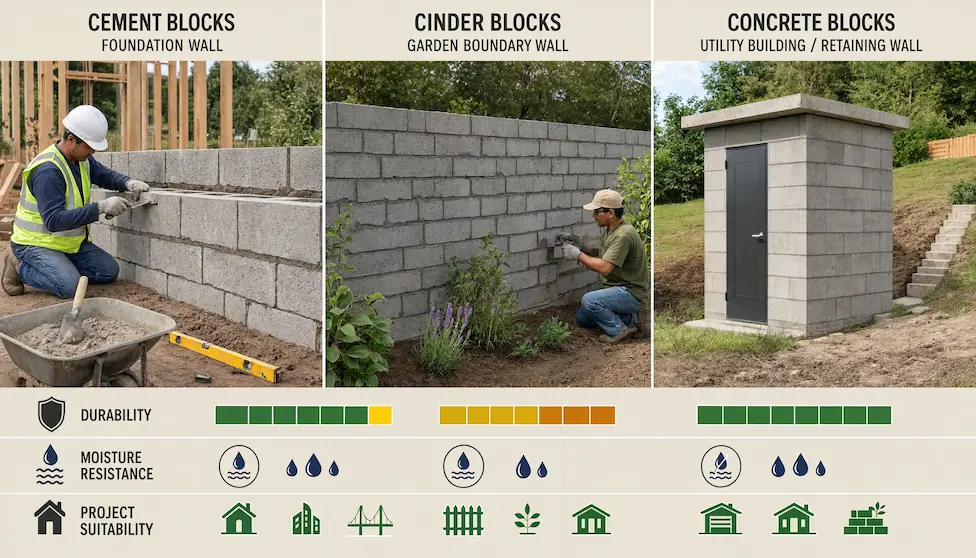
The low aggregate content keeps cement blocks dense in cement paste, but it also limits compressive strength compared to a CMU built with gravel or crushed stone. Builders typically specify cement blocks for garden walls, planters, low partition walls, and other applications where load-bearing capacity is not required.
What Are Cinder Blocks?
A cinder block is a masonry unit traditionally made by mixing Portland cement with coal cinders, the ash byproduct left over from burning coal.
Manufacturers used cinder blocks heavily from the 1920s through the 1950s, when coal-fired furnaces and power plants generated cinders as cheap, abundant waste material. Coal cinder supply collapsed once power plants modernized their combustion processes, and true cinder blocks became rare by the 1970s.
Modern lightweight masonry blocks, still sold and referred to as “cinder blocks” out of habit, now use fly ash instead, a finer combustion byproduct that improves mix consistency and reduces waste. The American Coal Ash Association reported that the construction industry reused 28.4 million tons of fly ash in 2022, with concrete and masonry products representing the largest single application category.
Whether built with true cinders or modern fly ash, these units suit non-load-bearing structures: partition walls, fences, and decorative screens. See common cinder block uses before specifying one for an outdoor build.
What Are Concrete Blocks?
A concrete block, formally a Concrete Masonry Unit (CMU), is a precast block made from Portland cement, water, sand, and coarse aggregate such as crushed stone or gravel, manufactured to meet ASTM C90. ASTM C90 requires a minimum average net-area compressive strength of 2,000 psi, with no single unit testing below 1,800 psi, a threshold the standard raised from 1,900 psi in its 2014 revision.
That dense aggregate core is what separates a CMU from a cement block or cinder block, and it is why concrete blocks dominate modern load-bearing construction: foundations, structural walls, parking structures, and retaining walls.
CMUs are also classified into three density classes by unit weight: lightweight (under 105 pounds per cubic foot), medium weight (105 to 125 pcf), and normal weight (125 pcf or higher). Each density class still has to clear the same concrete masonry units strength minimum set by ASTM C90.
Cement Blocks vs Cinder Blocks vs Concrete Blocks: Quick Comparison
Lined up side by side, cement blocks vs cinder blocks vs concrete blocks separate clearly once weight, strength, and cost sit in the same table. The figures below reflect standard 8×8×16-inch units, the size most common in U.S. residential and light commercial work, and represent typical ranges rather than a single manufacturer’s spec sheet.
| Attribute | Cement Block | Cinder Block | Concrete Block (CMU) |
|---|---|---|---|
| Composition | Cement, fine sand, water; minimal or no coarse aggregate | Cement, coal cinders or fly ash, sand | Cement, sand, gravel or crushed stone, water |
| Density | Moderate, roughly 100–115 pcf | Low, roughly 85–100 pcf | 105–140+ pcf, by density class |
| Weight (8×8×16″) | 28–32 lb | 25–28 lb | 26 lb (lightweight) – 38 lb (standard) |
| Compressive Strength | ~1,000–1,700 psi | ~700–1,500 psi (historical); fly-ash units to 3,000 psi | 2,000 psi minimum (ASTM C90); up to 5,000+ psi |
| Durability | Moderate; sensitive to moisture cycling | Lower; prone to cracking and freeze-thaw damage | High; engineered for sustained structural load |
| Fire Resistance | Non-combustible, moderate rating | Non-combustible, moderate rating | Non-combustible, 1–4-hour rating by thickness |
| Moisture Resistance | Fair; absorbs water if unsealed | Poor; porous core | Good, especially in solid or grouted units |
| Cost (per block) | $1.00–$2.00 | $1.00–$3.00 | $1.25–$3.00 (decorative up to $8) |
| Lifespan | 20–40 years | 30–50 years | 75–100+ years |
| Best Use Cases | Garden walls, planters, partitions | Sheds, decorative walls, raised beds | Foundations, structural and retaining walls |
Composition Differences
Aggregate is the parent material that defines every block’s performance profile; it is the bulk filler mixed with Portland cement paste to form the block body. Concrete blocks use dense aggregate, crushed stone, gravel, and coarse sand, which is what gives CMUs their compressive strength and density.
Cinder blocks substitute lighter aggregate, historically coal cinders and now usually fly ash, trading strength and density for reduced weight. Cement blocks sit between the two, relying on fine sand with little or no coarse aggregate, which caps their structural ceiling but keeps the block lighter to mold and ship.
The aggregate is not filler in a cosmetic sense; it controls density, freeze-thaw resistance, moisture absorption, and compressive strength simultaneously. A block manufactured with the wrong aggregate for a region’s climate or load demands typically cracks, leaks, or shifts within years rather than decades.
Strength and Structural Performance
Concrete blocks outperform cinder blocks and cement blocks structurally because ASTM C90 sets a 2,000 psi compressive strength floor that cinder and cement blocks were never engineered to meet.
Compressive strength measures how much force a unit withstands before crushing, and it is the number structural engineers use to size foundations, bearing walls, and multi-story assemblies. Historical cinder blocks tested as low as 700 to 1,500 psi, since porous coal-cinder aggregate leaves more air void inside the block body.
Cement blocks typically land in the 1,000 to 1,700 psi range, limited by their fine-sand, low-aggregate mix design. Foundation walls, structural columns, and any application carrying vertical load from floors above require CMU-grade strength; most U.S. building codes exclude cinder blocks and cement blocks from these applications outright.
Durability and Lifespan
Concrete blocks last 75 to 100-plus years in proper applications, while cinder blocks typically reach 30 to 50 years before significant degradation, and cement blocks fall in a comparable 20 to 40-year range, depending on sealing and climate exposure. Freeze-thaw cycling drives most of that gap: water enters a block’s pore structure, freezes, expands, and fractures the surrounding material over repeated cycles.
Cinder blocks, with their porous cinder or fly-ash aggregate, absorb more moisture and crack faster under this cycling than dense CMU does. Cement blocks resist moisture better than cinder blocks, but still need sealant or parging in exterior, wet-climate applications to hit their full service life.
Concrete blocks, especially solid or grouted units, resist water infiltration well enough that most codes permit them in below-grade and foundation applications without added waterproofing in dry climates. Specifying durable building materials upfront avoids re-pointing and patch repairs ten years into a structure’s life.
Avoid costly block selection mistakes — contact us for a professional masonry estimate.
Weight and Handling Differences
Lighter blocks install faster: a mason can typically lay 15 to 20 percent more cinder block per hour than standard CMU, simply because each unit weighs less and requires less physical effort to lift and set. Standard 8×8×16-inch CMU weighs 33 to 38 pounds; lightweight CMU drops to roughly 26 pounds; cinder block, depending on aggregate, runs 25 to 28 pounds; cement block lands close behind at 28 to 32 pounds.
That weight gap compounds across a project. A 200-block garden wall built with cinder block instead of standard concrete block can save a two-person crew several hours of lifting over a single workday. Contractors weigh that labor savings against the structural ceiling, since lighter blocks install faster but cannot be specified where code requires CMU-grade strength. Factor these construction labor considerations into any bid that compares block types on price alone.
Fire Resistance and Safety
All three block types are non-combustible, but wall thickness and aggregate type determine how many hours a wall resists fire before failing, not the block category by itself. Per the International Building Code, a 4-inch CMU wall provides roughly one hour of fire resistance, an 8-inch hollow wall provides about two hours, and a fully grouted 8 to 12-inch wall reaches three to four hours.
Standard drywall fails in roughly 37 seconds under the same test conditions, and fiber-reinforced gypsum panels fail in about 10 seconds, which is why code officials specify masonry for firewalls and stairwell enclosures in commercial buildings.
Cement blocks and cinder blocks carry similar non-combustible ratings at equivalent thickness, but builders rarely use them in fire-rated commercial assemblies, since those applications also demand CMU-level structural strength. Schools, hospitals, and multifamily buildings typically specify concrete block walls for both fire code compliance and load-bearing capacity in the same assembly. Verify fire-resistant construction materials requirements with the local code official before finalizing wall assemblies.
Cost Comparison
Cinder blocks carry the lowest material cost of the three, cement blocks sit close behind, and standard concrete blocks cost slightly more per unit but typically less over the life of the structure.
Material price alone misrepresents the comparison, since labor, reinforcement, and long-term maintenance shift the total cost picture once a wall actually goes up. A non-load-bearing cinder block wall needs no rebar or grout fill, which keeps labor costs down for fences, partitions, and garden walls.
A load-bearing concrete block wall typically requires rebar, grout, and a reinforced footing, adding material and labor cost upfront but avoiding the repair and replacement costs that shorter-lived cement and cinder block walls accumulate over 20 to 30 years.
Estimating total project cost, not just per-block price, is the single biggest factor separating an accurate masonry bid from a budget overrun.
Best Uses for Cement Blocks
Cement blocks fit projects where load-bearing capacity is not required and where moderate weight savings matter more than maximum strength.
- Garden walls and raised planters
- Interior, non-load-bearing partition walls
- Landscaping borders and edging
- Low decorative walls under 4 feet in height
- Utility sheds without structural framing requirements
Best Uses for Cinder Blocks
Cinder blocks suit lightweight, outdoor, non-structural builds where ease of handling outweighs maximum compressive strength.
- Retaining walls under 3 feet (non-engineered)
- Raised garden beds
- Decorative screen walls and breeze walls
- Storage sheds and outbuildings
- Fire pit surrounds and outdoor seating walls
Best Uses for Concrete Blocks
Concrete blocks handle any application where the wall carries structural load, resists lateral soil pressure, or has to meet a fire-rated assembly requirement.
- Residential and commercial foundation walls
- Load-bearing structural walls in multi-story buildings
- Engineered retaining walls over 3 feet
- Fire-rated walls in schools, hospitals, and commercial buildings
- Parking structures and industrial facilities
Which Block Is Best for Your Project?
The right block depends on one question: does this wall carry structural load? Cost, weight, and finish are secondary to that single decision.
| Project Type | Load-Bearing? | Recommended Block | Why |
|---|---|---|---|
| Foundation wall | Yes | Concrete block (CMU) | Meets ASTM C90 strength minimums required by code |
| Retaining wall over 3 ft | Yes | Concrete block (CMU) | Engineered lateral load capacity |
| Garden wall / planter | No | Cement or cinder block | No structural demand; lower material cost |
| Interior partition | No | Cement block | Lighter, faster install, adequate for non-bearing walls |
| Decorative / privacy screen | No | Cinder block | Lightest option, lowest material cost |
| Fire-rated commercial wall | Yes (typ.) | Concrete block (CMU) | Meets fire-resistance hour ratings and structural code |
Pros and Cons of Each Block Type
| Block Type | Pros | Cons |
|---|---|---|
| Cement block | Lightweight, low material cost, easy to cut and shape | Limited load-bearing capacity, moderate moisture resistance |
| Cinder block | Lowest weight, fastest install, lowest material cost | Lowest compressive strength, prone to cracking, shorter lifespan |
| Concrete block (CMU) | Highest strength, longest lifespan, best fire resistance, code-compliant for structural use | Heavier to handle, higher material and labor cost upfront |
Expert Recommendations
Match the block to three factors before ordering material: the project’s load requirements, the local building code, and the regional climate. Structural engineers size foundations and bearing walls using the unit-strength design method in TMS 402, which requires ASTM C90-compliant CMU paired with the correct mortar type, so substituting cement or cinder block on a load-bearing job is not a cost-saving option; it is a code violation.
Climate matters nearly as much as load: in freeze-thaw regions, even non-structural cinder block walls benefit from a denser CMU or added sealant, since repeated freezing inside a porous block accelerates cracking.
Local jurisdictions also vary on mortar type requirements, Type S for structural and below-grade work versus Type N for above-grade non-structural walls, so confirming code requirements before ordering material avoids inspection failures and rework later. For professional masonry advice and a verified material takeoff before you order, NEDES estimating services builds quantity and cost breakdowns directly from your plans.
Frequently Asked Questions
Are cement blocks and concrete blocks the same?
No. Cement blocks use fine sand with little or no coarse aggregate, while concrete blocks (CMUs) use gravel or crushed stone aggregate and meet ASTM C90 strength minimums. That aggregate difference is what separates a decorative or partition block from a structural one. See What Are Cinder Blocks? for the full technical definition.
Which block is strongest?
Concrete blocks (CMUs) are strongest, with a minimum 2,000 psi compressive strength required by ASTM C90 and standard ranges reaching 5,000 psi or higher for high-strength units. Cinder blocks and cement blocks typically test below 1,700 psi.
Which block lasts longest?
Concrete blocks last longest, typically 75 to 100-plus years in proper applications, compared to 30 to 50 years for cinder blocks and 20 to 40 years for cement blocks.
Are cinder blocks outdated?
Largely, yes. True coal-cinder blocks are rare today because coal cinder supply collapsed after power plants modernized their combustion processes in the mid-20th century. What gets sold and called a “cinder block” now is almost always a lightweight fly-ash CMU.
Which block is cheapest?
Cinder blocks typically carry the lowest material cost per unit, though concrete blocks often cost less over a structure’s full lifespan due to lower maintenance and replacement frequency. See the full Cost Comparison breakdown above.
Can cinder blocks be load-bearing?
Standard cinder blocks generally cannot meet load-bearing code requirements, since their compressive strength falls below the ASTM C90 minimum required for structural masonry. Projects that need load-bearing capacity should specify ASTM C90-compliant concrete block instead; see Strength and Structural Performance for the code basis.
Conclusion
Cement blocks, cinder blocks, and concrete blocks differ in composition, strength, weight, durability, fire resistance, and cost, and that difference determines exactly where each one belongs on a job site. Concrete blocks carry structural loads and meet the fire and building code minimums that cement and cinder blocks cannot match. Cinder blocks save weight and material cost on non-structural, outdoor, and decorative projects.
Cement blocks fill the gap for light partitions and garden applications where ASTM C90 strength is not required. Matching the block to the load, climate, and code requirements before ordering material prevents redo work and inspection failures that come from guessing. Ready to put accurate material counts behind your next masonry project? Explore masonry solutions with our estimation company and get a detailed takeoff before the first block ships.