Concrete Slab Cost in 2026: Per-Square-Foot Prices, Size Charts & How to Calculate Yours
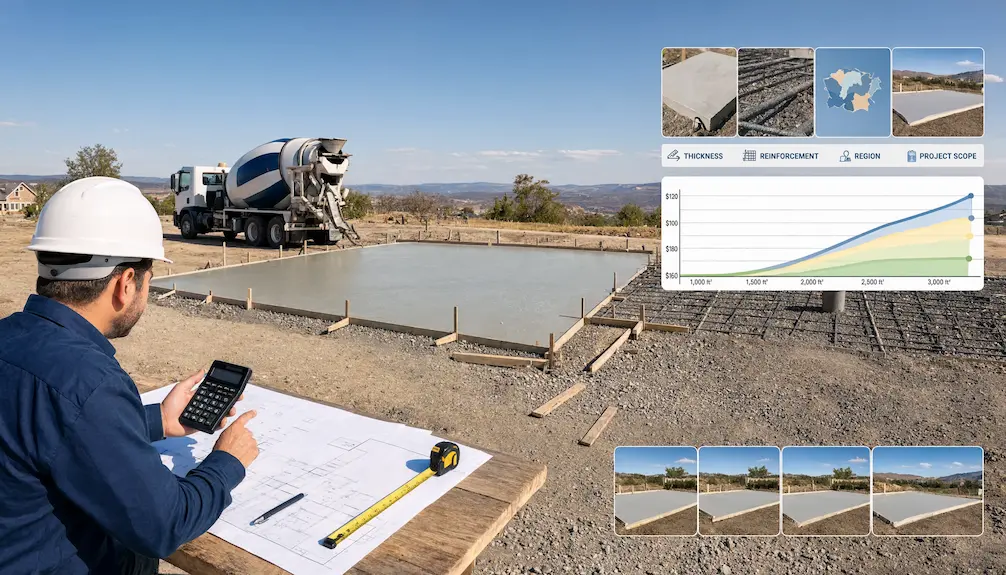
A concrete slab costs $6 to $12 per square foot installed in 2026, with the national average sitting near $8. That range holds for a standard 4-inch residential pour with basic reinforcement and a broom finish. Push the thickness to 6 inches, add rebar instead of wire mesh, or build in a coastal metro, and the number climbs fast. Sometimes it goes past $16 per square foot before decorative work even enters the conversation.
Every homeowner asking this question eventually asks a second one: how do you actually get to that number? This guide answers both. You’ll find current pricing by slab size and project type, a full breakdown of what moves the price, and the cubic-yard and total-cost formulas contractors use to price a job before they ever pick up a shovel.
Concrete Slab Cost Per Square Foot
Skip the scrolling. Here’s where most 2026 projects land, installed, before permits:
| Slab Type | Cost Per Sq Ft (Installed) |
| Basic shed pad, 4″ | $6 – $9 |
| Standard patio, 4″ | $6 – $10 |
| Garage floor, 6″ reinforced | $7 – $12 |
| Driveway, 5-6″ reinforced | $8 – $16 |
| Stamped or decorative finish | $10 – $20 |
| House foundation slab | $5 – $14 |
Materials account for 35-45% of that total. Labor takes another 40-50%. Site prep, permitting, and equipment mobilization absorb whatever’s left. Three variables move the number more than anything else: slab thickness, reinforcement type, and distance from the nearest ready-mix plant.
Concrete Slab Cost by Size
Bigger pours cost less per square foot. Delivery, setup, and crew mobilization are largely fixed costs, so they spread thinner across a bigger footprint. A 10-foot pad and a 900-square-foot slab don’t scale the same way, and the table below shows why.
| Slab Size | Square Feet | Estimated Installed Cost |
| 10′ x 10′ shed pad | 100 | $600 – $1,200 |
| 12′ x 12′ patio | 144 | $900 – $1,700 |
| 20′ x 20′ patio or garage | 400 | $2,400 – $4,800 |
| 20′ x 24′ two-car garage | 480 | $2,900 – $5,800 |
| 24′ x 24′ garage | 576 | $3,500 – $6,900 |
| 30′ x 30′ slab | 900 | $5,400 – $10,800 |
| 2,000 sq ft house foundation | 2,000 | $12,000 – $28,000 |
Slab foundations aren’t a niche choice, either. According to U.S. Census Bureau New Residential Construction data from 2024, 75% of new U.S. homes are built on slab foundations rather than basements or crawl spaces. That’s largely because a slab costs $5-$14 per square foot versus $35-$50 per square foot for an unfinished basement shell.
Concrete Slab Cost Per Cubic Yard
Concrete is sold by the cubic yard, not the square foot, so every square-foot price you see is really a conversion. Standard 3,000 PSI ready-mix runs $125-$175 per cubic yard delivered in most 2026 U.S. markets. The West Coast typically runs higher, $150-$200 per yard, while the Southeast and Midwest often land under $150.
One cubic yard covers a predictable amount of area depending on thickness:
- 81 square feet at 4 inches thick
- 65 square feet at 5 inches thick
- 54 square feet at 6 inches thick
Order fewer than 3-4 yards, and most suppliers add a short-load fee, typically $50-$150 per yard below their minimum. That’s the real reason a tiny shed pad sometimes costs more per square foot than a mid-size patio: the fixed penalty for a small order outweighs the savings from less concrete.
What Actually Moves Concrete Slab Cost Up or Down
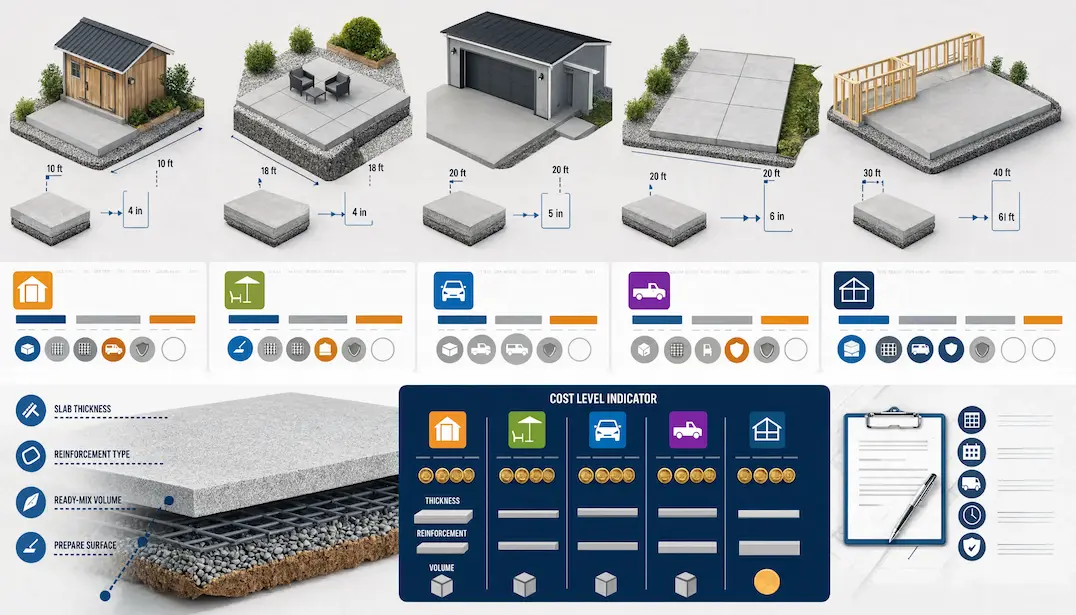
Thickness
Each additional inch adds roughly $0.50-$1.25 per square foot. A 6-inch slab uses about 50% more concrete volume than a 4-inch slab covering the identical footprint, and that extra volume shows up directly in your material bill. Patios, walkways, and shed floors get by fine at 4 inches. Garages, driveways, and anything supporting vehicle weight need 5-6 inches.
PSI Strength
PSI measures compressive strength. Simply put, it measures how much load the cured concrete can bear before it fails. Higher PSI means a denser mix with more Portland cement per yard, and it costs more accordingly. The American Concrete Institute recommends a minimum 4,000 PSI air-entrained mix for freeze-thaw regions, which cover most of the Midwest, Northeast, and Mountain West. Moving from the standard 3,000 PSI baseline up to 4,000-4,500 PSI adds $10-$40 per cubic yard.
Reinforcement
Concrete resists compression well but handles almost no tension, which is exactly what steel reinforcement is for.
| Reinforcement Type | Cost | Best Use |
| Wire mesh (6×6 W1.4) | $0.15 – $0.60 / sq ft | Patios, sidewalks, light-duty slabs |
| Rebar grid (#3-#4, 12-18″ OC) | $0.50 – $1.20 / sq ft | Driveways, garages, vehicle loads |
| Post-tensioned cable system | $1.50 – $3.00 / sq ft | Expansive clay soils (TX, OK, CO) |
| Fiber reinforcement (mix additive) | $8 – $15 / cubic yard | Supplemental crack control |
Finish
| Finish Type | Cost Per Sq Ft |
| Standard broom finish | $5 – $10 |
| Exposed aggregate | $7 – $12 |
| Colored concrete | $6 – $12 |
| Stamped concrete | $10 – $20 |
| Polished concrete | $3 – $15 |
Site Preparation
Excavation and grading run $1-$5 per square foot, depending mostly on soil difficulty and how much topsoil has to be moved. A compacted gravel sub-base adds $0.80-$1.50 per square foot on top of that, and a 6-mil vapor barrier (required under current IRC guidance for interior slabs) adds another $0.10-$0.15 per square foot. None of these show up in a bare quote for “concrete and labor,” which is exactly why itemized bids matter more than a single lump-sum number.
Labor and Region
Labor for pouring a slab runs $3-$5 per square foot nationally, covering formwork, placement, screeding, finishing, and control joints. That figure climbs past $8 per square foot in high-cost metro labor markets. The U.S. Bureau of Labor Statistics’ 2025 OEWS data puts the national mean wage for cement masons and concrete finishers at $28.87 per hour. Regionally, coastal states like California and New York average around $8.50 per square foot for a standard slab, while central states average closer to $5.35, a gap of more than 35% for comparable work.
Concrete Slab Cost by Project Type
| Project | Typical Size | Installed Cost |
| HVAC or generator pad | 16 – 32 sq ft | $600 – $1,100 |
| Shed foundation | 100 sq ft | $600 – $1,500 |
| Backyard patio | 400 sq ft | $2,400 – $4,800 |
| Two-car garage floor | 480 – 576 sq ft | $2,900 – $6,900 |
| Driveway | 640 sq ft | $5,100 – $10,200 |
| House foundation slab | 1,500 – 2,000 sq ft | $9,000 – $28,000 |
Driveways sit at the higher end of that range for a reason: they need thicker pours (5 inches minimum), stronger mix design (3,500-4,000 PSI), full rebar reinforcement, and a properly compacted sub-base to survive repeated vehicle loading without cracking.
How to Calculate Concrete Slab Cost (With the Actual Formula)
This is the part most cost guides either skip or bury three sections deep, and it’s the exact thing people searching “concrete slab cost” actually want to do themselves before calling a contractor.
Step 1: Calculate Cubic Yards
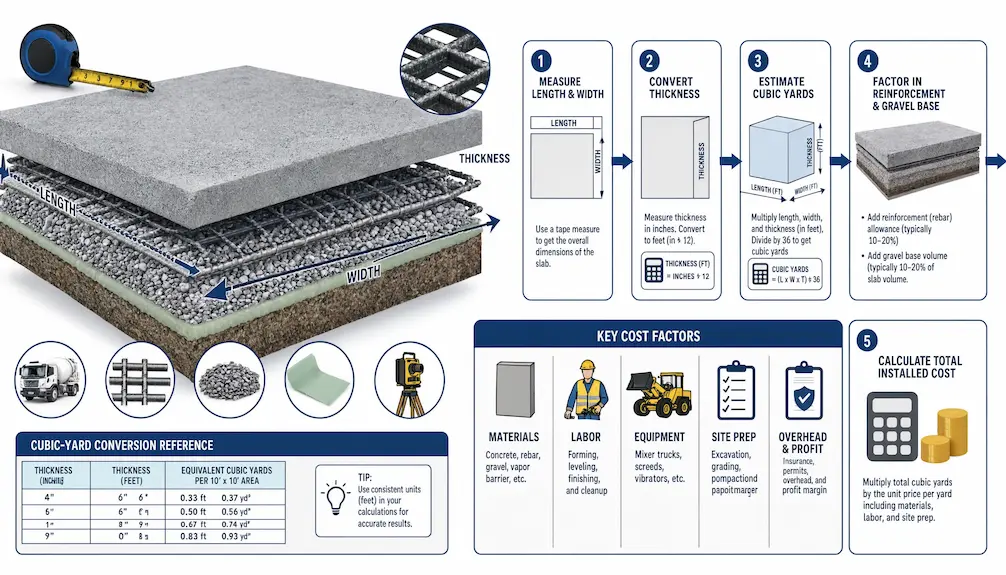
Cubic Yards = (Length × Width × Thickness in feet) ÷ 27
Thickness needs converting to feet first; divide inches by 12. A 4-inch slab equals 0.333 feet of thickness; a 6-inch slab equals 0.5 feet.
Worked example:
- 20×24 garage slab at 6 inches thick:
- 20 × 24 × 0.5 = 240 cubic feet
- 240 ÷ 27 = 8.89 cubic yards
- Add a 10% waste factor: 8.89 × 1.10 = 9.78 cubic yards, rounded up to 10
Round up, always. Ready-mix trucks don’t do partial return trips, and coming up short mid-pour risks a cold joint ( a weak seam where old and new concrete fail to bond) that can compromise the entire slab.
Step 2: Price the Concrete
Multiply your cubic yards by the local delivered rate:
10 yards × $140 per yard (mid-range 2026 rate) = $1,400 in material cost
Step 3: Add Labor, Reinforcement, and Site Prep
Total Installed Cost = [Area (sq ft) × (Material Rate + Labor Rate)] + Reinforcement Cost + Site Prep Cost
Applied to the same 480-square-foot garage slab:
- Material + labor at $9 per sq ft (mid-range): 480 × 9 = $4,320
- Rebar reinforcement at $0.80 per sq ft: 480 × 0.80 = $384
- Gravel sub-base at $1 per sq ft: 480 × 1 = $480
- Total installed estimate: approximately $5,184
That lands squarely inside the $2,900-$5,800 range quoted for two-car garage floors earlier, which is the whole point of running the formula yourself. It lets you sanity-check a contractor’s bid instead of taking a single number on faith.
If all of the above mathematical calculations seem too much for you, try getting concrete estimating services from a credible firm. That’s an easy way to get extremely precise values before construction begins.
Need a concrete slab estimate? Get accurate pricing for your project today.
Quick-Reference Formula Table
| What You Need | Formula |
| Cubic yards of concrete | (L × W × T ÷ 12) ÷ 27 |
| 80 lb bags of concrete | Cubic yards × 45 |
| Total installed cost | Area × ($/sq ft rate) + reinforcement + site prep |
| Rebar linear footage (18″ OC grid) | (L ÷ 1.5 × W) + (W ÷ 1.5 × L), approximate |
Concrete Slab Cost Trends: 2026 vs. Recent Years
Slab installation costs have climbed noticeably over the past two years. Industry data shows U.S. slab installation costs rose roughly 6.7% year-over-year heading into 2025, driven mainly by volatile cement pricing rather than labor. Cement production is energy-intensive, so any spike in natural gas or electricity costs flows almost directly into the price of a cubic yard.
A second, smaller pressure has entered the market too: green building standards. Several states now require low-carbon cement mixes for certain projects, and those mixes currently carry what the industry calls a green premium of roughly 5-8% over standard Portland cement blends. It’s a real cost today, though most producers expect it to shrink as low-carbon production capacity scales up.
| Important Insights From Experts |
| Import dependency adds a third variable in specific markets. The U.S. imports a meaningful share of cement and clinker from Canada, Mexico, and Turkey, and tariff uncertainty around North American imports has added pricing volatility in border and coastal regions. |
Cost Of Removing an Old Slab
Replacing cracked or sinking concrete isn’t just the cost of the new pour; the old slab has to come out first. Demolition and hauling typically run $2-$6 per square foot, depending on slab thickness and whether it’s reinforced. A rebar-reinforced slab costs noticeably more to break up and haul away than an unreinforced one, since crews need to cut and separate the steel before disposal.
For minor damage, resurfacing is almost always the cheaper path: filling small cracks and resealing runs as little as $0.20 per linear foot, and full resurfacing costs $3-$5 per square foot, both well under the $6-plus per square foot for a full replacement pour, before demolition is even factored in. Full replacement only makes sense once damage is structural: sinking, heaving, or cracks that run through the full depth of the slab.
Common Mistakes That Quietly Inflate the Bill
Most cost overruns on slab projects trace back to a handful of avoidable mistakes, not bad luck.
- Underordering concrete is the most common mistake. Trucks don’t do partial returns, and running short mid-pour forces a rushed, weaker cold joint
- Skipping reinforcement to save $0.50 per square foot today, then paying for full replacement in three to five years
- Not confirming truck access is another one. Restricted sites need pump trucks at $150-$400 per hour, a cost that’s easy to miss until pour day
- Ordering the wrong PSI, a residential 3,000 PSI mix under a commercial loading dock, will crumble under sustained heavy weight
- Accepting a bid with no line items, which makes it impossible to compare against a second, more detailed quote
Slab Foundations vs. Other Foundation Types
A slab-on-grade foundation costs $5-$14 per square foot installed, making it the least expensive residential foundation type by a wide margin. A full basement shell runs $35-$50 per square foot before any interior finishing. Slabs perform best in warm-to-temperate climates with flat, stable, well-drained soil; they perform poorly in northern climates with deep frost penetration or on expansive clay without post-tensioning.
Types of Concrete Slabs (And Why the Type Changes the Price)
Not every slab is built the same way, and the construction method affects both cost and long-term performance.
● Monolithic Slab
It is poured in a single continuous operation, with thicker edges to bear structural load and a thinner center for the floor. The most common and generally the least expensive slab foundation method.
● Post-Tensioned Slab
This type is reinforced with steel cables tensioned after the pour cures, adding $1.50-$3.00 per square foot but resisting cracking far better in expansive clay soils common across Texas, Oklahoma, and Colorado.
● Slab With Foundation Walls
This slab is used when a structure needs additional support from piers or post holes beneath the slab, common on sloped or uneven lots.
DIY vs. Hiring a Contractor
| Factor | DIY | Contractor |
| Material cost | $3 – $5 / sq ft | Same, often bundled |
| Labor cost | Your time | $3 – $7 / sq ft |
| Typical savings | $2 – $3 / sq ft | — |
| Working window | 60-90 min per truck | Managed by crew |
| Best fit | Slabs under 5 cubic yards | Anything over 5 yards or structural |
DIY pouring is genuinely viable for small, simple slabs, a patio or shed pad under roughly 5 cubic yards, with an experienced helper crew. The math gets less forgiving past that point. Once the truck starts pouring, there’s a 60-90 minute working window to screed, float, and finish before the concrete sets. Learn more about the time it takes for concrete to set in our detailed guide.
Regional Concrete Slab Cost Differences
| Region | Typical Cost Per Sq Ft |
| Midwest / Southeast | $5.35 – $9.00 |
| Northeast | Add 15-25% over baseline |
| West Coast | Add 20-35% over baseline |
| Coastal metros (CA, NY) | Up to $8.50 |
Material costs stay relatively flat nationwide since ready-mix pricing doesn’t swing wildly between regions. Labor is the variable that actually moves the needle, along with local permitting costs and, in a handful of import-dependent coastal markets, cement supply tied to imports from Canada, Mexico, and Turkey.
What a Legitimate Concrete Bid Should Include
A bid showing only a single total with no line items isn’t a complete bid. On the contrary, it’s a guess with a dollar sign in front of it. Every itemized quote should specify:
- Slab dimensions and thickness
- PSI rating of the concrete mix
- Reinforcement type and spacing (wire mesh or rebar)
- Sub-base depth and compaction method
- Finish type
- Control joint plan
- Curing method
- All exclusions
Getting at least three quotes on identical specifications is the single best protection against overpaying. That’s because labor rates and overhead alone can shift the total by 20-30% for the exact same job.
How to Save Money on a Concrete Slab
- Combine multiple projects with one contractor to reduce mobilization costs
- Choose broom finish over stamped or exposed aggregate for functional slabs
- Schedule the pour during the contractor’s off-season, typically late fall or winter in most regions
- Order the exact cubic yardage. Over-ordering wastes money, and under-ordering triggers standby fees
- Use wire mesh instead of rebar where code and load requirements allow it
Concrete Slab Cost: Frequently Asked Questions
How much does a 12×12 concrete slab cost?
A 12×12 slab (144 square feet) typically costs $900-$1,700 installed at standard 4-inch thickness, depending on region and finish.
Is it cheaper to pour concrete yourself?
Yes. DIY pouring saves roughly $2-$3 per square foot in labor. On a 400-square-foot slab, that’s $800-$1,200 in savings, though it requires renting equipment and coordinating a helper crew within the concrete’s working window.
How thick should a concrete slab be?
4 inches is standard for patios, walkways, and shed floors. 5-6 inches is required for garages, driveways, and anything bearing vehicle weight or heavy equipment.
Does rebar really matter for a small patio?
For light-duty patios on stable, compacted soil, wire mesh is generally sufficient. Rebar becomes necessary once a slab carries vehicles, heavy equipment, or sits on problematic soil, since it provides far greater tensile reinforcement against cracking.
How long does a concrete slab take to cure?
Concrete reaches about 50% of its design strength in 3-7 days and full strength at 28 days. Walking on it is safe after 24-48 hours; driving on it should wait a full 7 days at minimum.
Why do concrete prices vary so much between contractors?
Because most bids aren’t scoped the same way. One quote might include gravel base, vapor barrier, and rebar; another might quote bare concrete and labor only. Comparing totals without comparing scope is how homeowners end up surprised.
Do I need a permit to pour a concrete slab?
Most jurisdictions require a permit for structural slabs, driveways, and anything exceeding a minimum square footage, though small pads under local thresholds are often exempt. Permit and inspection fees generally run $100-$300 and should appear as a line item on any complete bid.
What’s the difference between a slab and a footing?
A slab is a horizontal concrete surface, typically 4-6 inches thick, serving as a floor or patio. A footing is a deeper concrete support, usually 8-12 inches, placed below the frost line to carry the weight of foundations and walls. Most structures use both together, with the slab resting on compacted gravel and the footing extending into undisturbed soil.
The Bottom Line
A concrete slab costs $6 to $12 per square foot installed in 2026 for most residential projects, with thickness, reinforcement, region, and finish doing the real work of moving that number up or down. Run the cubic-yard formula yourself before calling anyone, get three itemized bids on identical specs, and treat any single-line quote with healthy suspicion. The math isn’t complicated. However, it can get complex if you do not have enough knowledge about the construction elemental price analysis. If you do not want the hassle of calculating slab cost in 2026 all by yourself, our construction estimating company is your best bet. We can provide an extremely precise and code-compliant estimation of slab cost in 2026 at an affordable price. Contact us to get a free quote!